
Yellow-casqued Hornbill
Ceratogymna elata
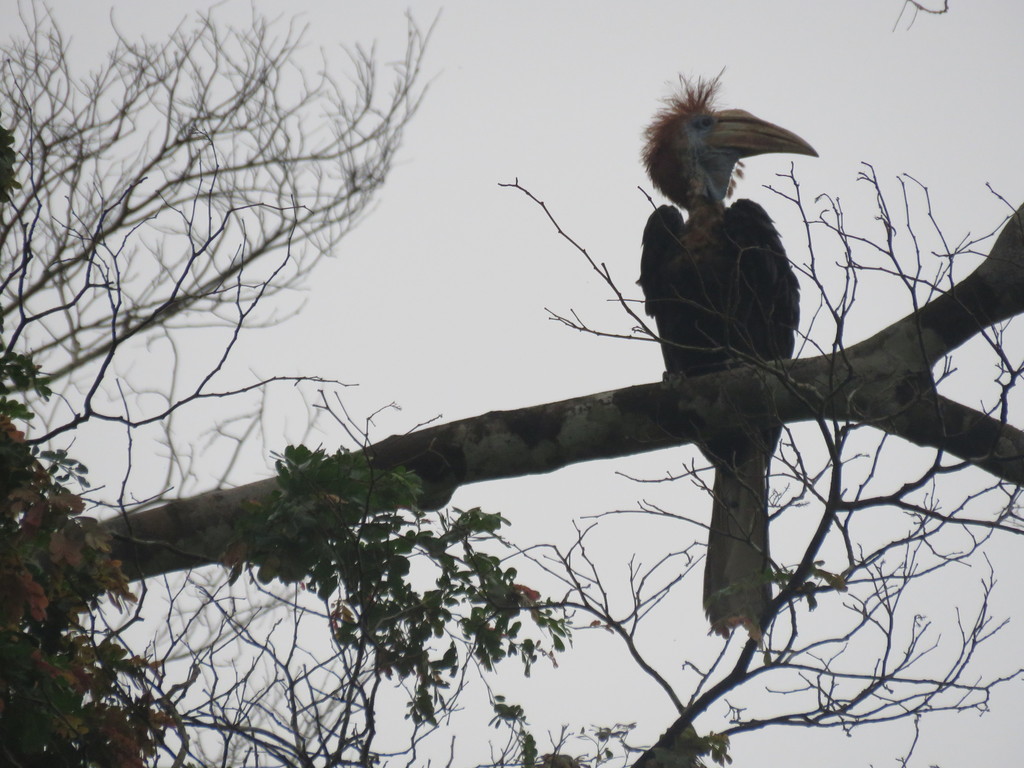
The yellow-casqued hornbill (Ceratogymna elata), also known as the yellow-casqued wattled hornbill, is found in the rainforest of coastal regions of West Africa, for example in Côte d'Ivoire.
- Kingdom
- Animalia
- Phylum
- Chordata
- Class
- Aves
- Order
- Bucerotiformes
- Family
- Bucerotidae
- Genus
- Ceratogymna
- Species
- Ceratogymna elata
Description
The yellow-casqued hornbill (Ceratogymna elata), also known as the yellow-casqued wattled hornbill, is found in the rainforest of coastal regions of West Africa, for example in Côte d'Ivoire. It is threatened by habitat loss. The yellow-casqued hornbill is one of the largest birds of the West African forest, with adults weighing up to two kilograms (4+1⁄2 pounds). They live mainly in the forest canopy, rarely feeding on the ground. They live in small family groups containing at least one adult male and female, with one or two immature birds, though they sometimes gather in larger flocks to exploit a major food supply such as an ant or termite nest. The birds are occasionally preyed upon by crowned hawk-eagles, and they respond to the presence of an eagle (sometimes indicated by its characteristic shriek) by mobbing – approaching it and emitting calls. Since the eagles depend on surprise to make a catch, this frequently causes them to leave the area. Recent research (Rainey et al., 2004) has shown that the birds respond in the same way to the alarm calls that Diana monkeys, which live in the same areas, emit if they notice an eagle, and that they can distinguish the calls made by the monkeys in the presence of eagles from those they make in the presence of leopards, which prey on the monkeys but not on the hornbills.
Gallery
Ajouter des photos
Partagez vos photos de cette espèce (jusqu'à 20 à la fois) : elles sont vérifiées automatiquement, puis publiées.
Répartition
Occurrences observées (données GBIF). Les zones hors aire d'origine peuvent indiquer une présence introduite ou invasive.
Sources et crédits
Informations provenant de plusieurs sources vérifiées. Dernière mise à jour : .
Crédits photos (8)
- Photo : @benbarca · CC BY-NC 4.0 · via iNaturalist
- Photo : Mark Hulme (@markhulme) · CC BY-NC 4.0 · via iNaturalist
- Photo : @mlanguy · CC BY-NC 4.0 · via iNaturalist
- Photo : Royle Safaris (@roylesafaris) · CC BY-NC 4.0 · via iNaturalist
- Photo : Saint Guillaume K. ODOUKPE (@sgodoukpe) · CC BY-NC 4.0 · via iNaturalist
- Photo : @paulinetib · CC BY-NC 4.0 · via iNaturalist
- Photo : @congonaturalist · CC BY-NC 4.0 · via iNaturalist
- Photo : Dr Anh Galat-Luong (@galat-luong_anh) · CC BY-NC 4.0 · via iNaturalist
Mentions de licence
Texte disponible sous licence CC BY-SA 4.0. Il adapte notamment Wikipedia (CC BY-SA) : Yellow-casqued hornbill, Calao à casque jaune (Wikipédia, auteurs dans l’historique de l’article).
- Taxonomie : GBIF Backbone Taxonomy (CC BY 4.0)
- Carte : occurrences GBIF, fond © contributeurs OpenStreetMap (ODbL)
- Statut de conservation : Liste rouge de l'UICN, via Wikidata (CC0)
Détail : Sources et licences.
Discussion (0)
Aucun message pour l’instant. Lancez la discussion sur cette fiche (sources, précisions, débats éditoriaux).
Connectez-vous pour participer à la discussion.