
Australasian Bittern
Botaurus poiciloptilus
The Australasian bittern (Botaurus poiciloptilus), or Matuku-hūrepo in Māori, is a stocky, sizeable and elusive heron-like bird native to the wetlands of Australia, New Zealand, and New Caledonia.
- Kingdom
- Animalia
- Phylum
- Chordata
- Class
- Aves
- Order
- Pelecaniformes
- Family
- Ardeidae
- Genus
- Botaurus
- Species
- Botaurus poiciloptilus
Description
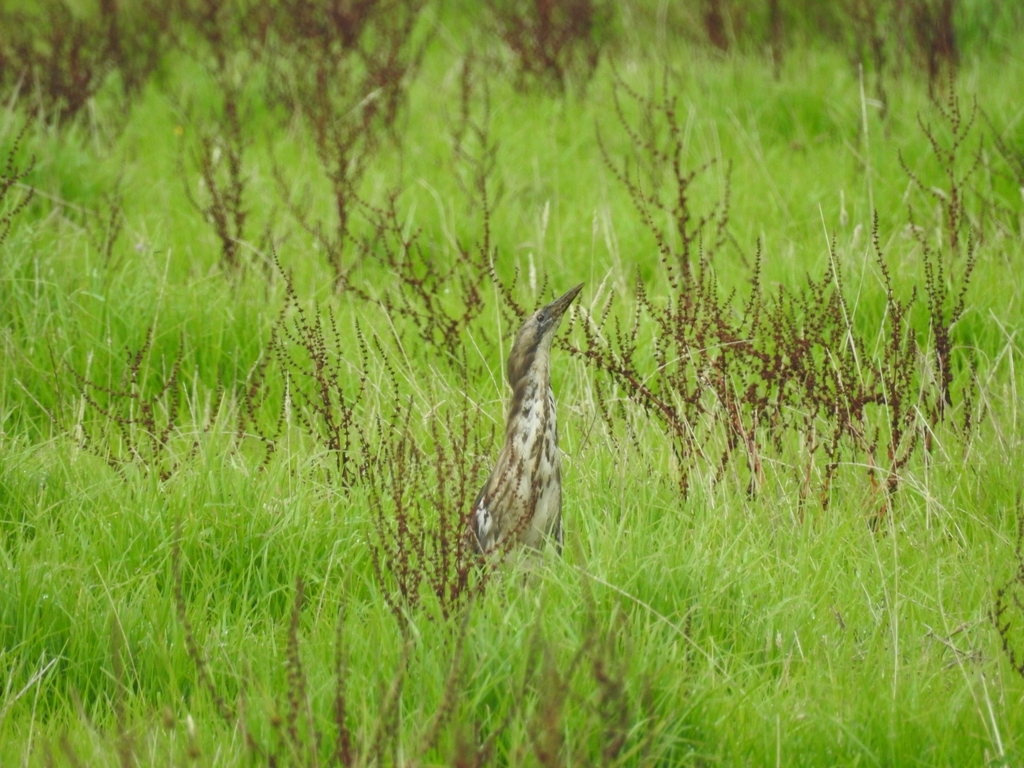
The Australasian bittern (Botaurus poiciloptilus), or Matuku-hūrepo in Māori, is a stocky, sizeable and elusive heron-like bird native to the wetlands of Australia, New Zealand, and New Caledonia. It belongs to the bittern subfamily of the heron family Ardeidae. The Australasian bittern is best known for its cryptic plumage and behaviours, which allows it to blend into the rushes and reeds of its wetland habitats, making it particularly difficult to spot. Despite being rarely seen, Australasian bittern males have a distinct "booming" call that can carry long distances. This call is said to resemble that of a Bunyip, which is why the Australasian bittern is often known as "the Bunyip Bird" in parts of Australia. Physically, the Australasian bittern stands around 66-76 cm tall with a wingspan of around a metre long. Its streaky, beige, mottled plumage allows it to camouflage itself among the reeds and rushes of its habitat to avoid predators and hunt for prey, undetected. The species primarily feeds on fish, amphibians, and invertebrates, which it hunts by quietly stalking through shallow waters or remaining "frozen" before ambushing its prey. Historically, the Australasian bittern was described in the early 19th century and has since been of significant interest due to its cryptic nature. The species is classified as Vulnerable on the IUCN Red List, and continues to experience population declines resulting from habitat reduction and disturbance from wetland drainage, climate change and agricultural expansion. Conservation efforts are therefore becoming increasingly necessary for its survival. Researchers continue to attempt to understand this birds' daily patterns, ecology, and breeding behaviour to improve current conservation strategies, although their cryptic nature makes this particularly difficult.
Gallery
Ajouter des photos
Partagez vos photos de cette espèce (jusqu'à 20 à la fois) : elles sont vérifiées automatiquement, puis publiées.
Répartition
Occurrences observées (données GBIF). Les zones hors aire d'origine peuvent indiquer une présence introduite ou invasive.
Sources et crédits
Informations provenant de plusieurs sources vérifiées. Dernière mise à jour : .
Crédits photos (8)
- Photo : Joe Dillon (@joedillon) · CC BY 4.0 · via iNaturalist
- Photo : EcoNeighbour_ (@econeighbour_) · CC BY-NC 4.0 · via iNaturalist
- Photo : @carrrat · CC BY-NC 4.0 · via iNaturalist
- Photo : @smathichong · CC BY-NC 4.0 · via iNaturalist
- Photo : @nick_goldwater · CC BY 4.0 · via iNaturalist
- Photo : Dennis Hocking (@dennis_hocking) · CC BY-NC 4.0 · via iNaturalist
- Photo : @hdennis · CC BY-NC 4.0 · via iNaturalist
- Photo : ou.wildlife (@ou_wildlife) · CC BY-NC 4.0 · via iNaturalist
Mentions de licence
Texte disponible sous licence CC BY-SA 4.0. Il adapte notamment Wikipedia (CC BY-SA) : Australasian bittern (Wikipédia, auteurs dans l’historique de l’article).
- Taxonomie : GBIF Backbone Taxonomy (CC BY 4.0)
- Carte : occurrences GBIF, fond © contributeurs OpenStreetMap (ODbL)
- Statut de conservation : Liste rouge de l'UICN, via Wikidata (CC0)
Détail : Sources et licences.
Discussion (0)
Aucun message pour l’instant. Lancez la discussion sur cette fiche (sources, précisions, débats éditoriaux).
Connectez-vous pour participer à la discussion.