
American Bittern
Botaurus lentiginosus
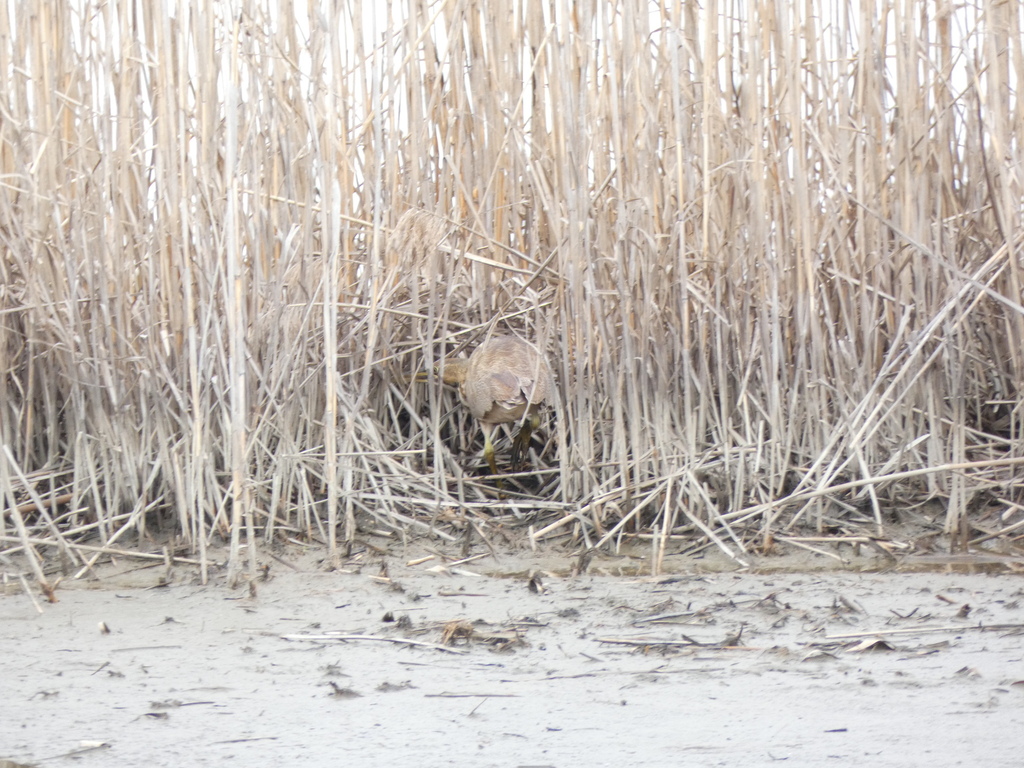
The American bittern (Botaurus lentiginosus) is a species of wading bird in the heron family.
- Kingdom
- Animalia
- Phylum
- Chordata
- Class
- Aves
- Order
- Pelecaniformes
- Family
- Ardeidae
- Genus
- Botaurus
- Species
- Botaurus lentiginosus
Description
The American bittern (Botaurus lentiginosus) is a species of wading bird in the heron family. It has a Nearctic distribution, breeding in Canada and the northern and central parts of the United States, and wintering in the U.S. Gulf Coast states, all of Florida into the Everglades, the Caribbean islands and parts of Central America. It is a well-camouflaged, solitary brown bird that unobtrusively inhabits marshes and the coarse vegetation at the edge of lakes and ponds. In the breeding season it is chiefly noticeable by the loud, booming call of the male. The nest is built just above the water, usually among bulrushes and cattails, where the female incubates the clutch of olive-colored eggs for about four weeks. The young leave the nest after two weeks and are fully fledged at six or seven weeks. The American bittern feeds mostly on fish but also eats other small vertebrates as well as crustaceans and insects. It is fairly common over its wide range, but its numbers are thought to be decreasing, especially in the south, because of habitat degradation. However the total population is large, and the International Union for Conservation of Nature has assessed its conservation status as being of "Least Concern".
Gallery
Ajouter des photos
Partagez vos photos de cette espèce (jusqu'à 20 à la fois) : elles sont vérifiées automatiquement, puis publiées.
Répartition
Occurrences observées (données GBIF). Les zones hors aire d'origine peuvent indiquer une présence introduite ou invasive.
Sources et crédits
Informations provenant de plusieurs sources vérifiées. Dernière mise à jour : .
Crédits photos (8)
- Photo : Etienne Falquet (@efalquet) · CC0 (domaine public) · via iNaturalist
- Photo : Howard Friedman (@howardfriedman1) · CC BY-NC 4.0 · via iNaturalist
- Photo : @crpvictor · CC BY-NC 4.0 · via iNaturalist
- Photo : Karen (with occasional help from Mike) (@mpkw) · CC BY 4.0 · via iNaturalist
- Photo : NoooV (@nooov) · CC BY-NC 4.0 · via iNaturalist
- Photo : Donna L Dugan (@donnadugan) · CC BY-NC 4.0 · via iNaturalist
- Photo : Jamie Simmons (@sphyrapicus) · CC BY-NC 4.0 · via iNaturalist
- Photo : Tate Putman (@r2d2yoda1) · CC BY-NC 4.0 · via iNaturalist
Mentions de licence
Texte disponible sous licence CC BY-SA 4.0. Il adapte notamment Wikipedia (CC BY-SA) : American bittern (Wikipédia, auteurs dans l’historique de l’article).
- Taxonomie : GBIF Backbone Taxonomy (CC BY 4.0)
- Carte : occurrences GBIF, fond © contributeurs OpenStreetMap (ODbL)
- Statut de conservation : Liste rouge de l'UICN, via Wikidata (CC0)
Détail : Sources et licences.
Discussion (0)
Aucun message pour l’instant. Lancez la discussion sur cette fiche (sources, précisions, débats éditoriaux).
Connectez-vous pour participer à la discussion.