
Southern Ground Hornbill
Bucorvus leadbeateri
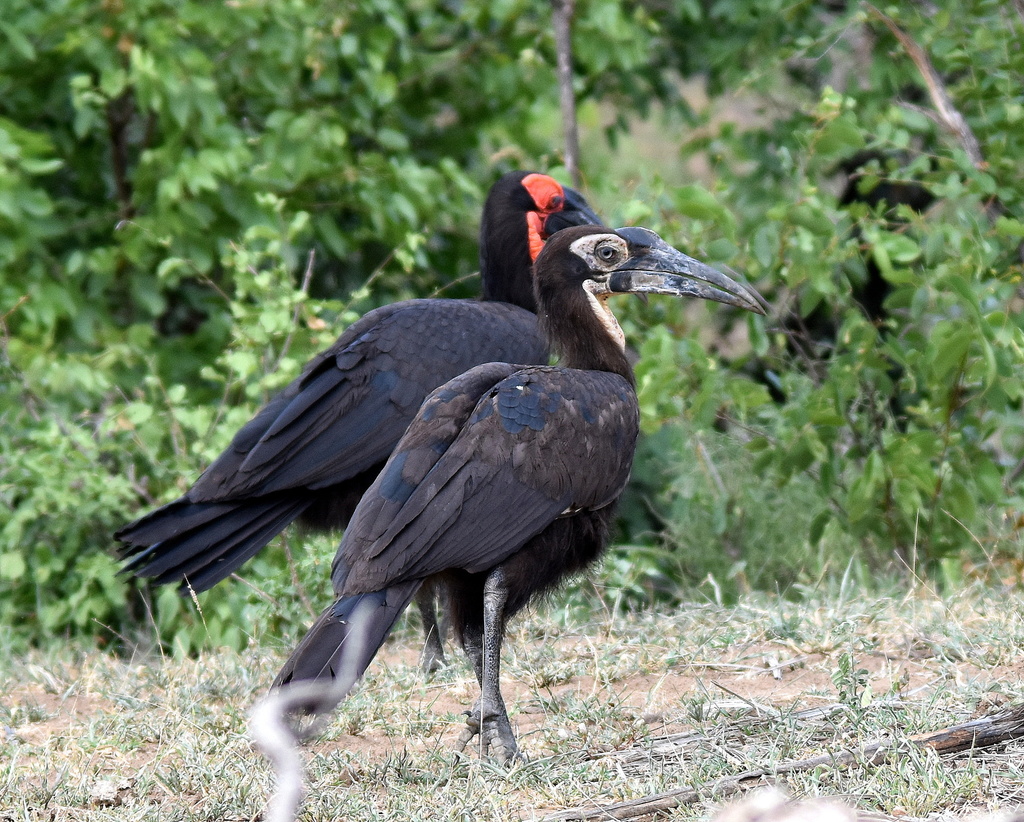
The southern ground hornbill (Bucorvus leadbeateri) is one of two species of ground hornbill, both of which are found solely within Africa, and is the largest species in the hornbill order worldwide.
- Kingdom
- Animalia
- Phylum
- Chordata
- Class
- Aves
- Order
- Bucerotiformes
- Family
- Bucorvidae
- Genus
- Bucorvus
- Species
- Bucorvus leadbeateri
Description
The southern ground hornbill (Bucorvus leadbeateri) is one of two species of ground hornbill, both of which are found solely within Africa, and is the largest species in the hornbill order worldwide. It can be found in the southern regions of Africa, ranging from Kenya to South Africa. Within these regions, they inhabit both woodlands and savannas. The other species of the genus Bucorvus is the Abyssinian ground hornbill, B. abyssinicus. Southern ground hornbills are carnivorous and hunt mostly on the ground. Their food ranges from insects to small vertebrates. Their nests are often found in high tree cavities or other shallow cavities, such as rock holes in cliff faces. These birds are a long-lived species, having lifespans in the range of 50–60 years, and up to 70 in captivity. In relation to their long lives, they do not reach sexual maturity until 4–6 years old, and begin breeding around 10 years old. Their sex can be identified by the colour of their throats: the male's is pure red and the female's is a deep violet-blue. Southern ground hornbills are a culturally pervasive and important species in southern Africa. Kruger National Park, located within South Africa, lists southern ground hornbills as one of their 'Big Six' bird species. However, their numbers have been declining, due in part to persecution, habitat destruction, cultural beliefs, and other factors. They are listed globally as 'Vulnerable' by the IUCN as of 2018, and as 'Endangered' in South Africa, Lesotho, Namibia and Eswatini.
Gallery
Ajouter des photos
Partagez vos photos de cette espèce (jusqu'à 20 à la fois) : elles sont vérifiées automatiquement, puis publiées.
Répartition
Occurrences observées (données GBIF). Les zones hors aire d'origine peuvent indiquer une présence introduite ou invasive.
Sources et crédits
Informations provenant de plusieurs sources vérifiées. Dernière mise à jour : .
Crédits photos (7)
- Photo : copper (@happyasacupcake) · CC BY-NC 4.0 · via iNaturalist
- Photo : @chupacabra64 · CC BY-NC 4.0 · via iNaturalist
- Photo : @des_animaux · CC BY-NC 4.0 · via iNaturalist
- Photo : @markdewolf · CC BY-NC 4.0 · via iNaturalist
- Photo : @maltamama · CC BY-NC 4.0 · via iNaturalist
- Photo : Michiel Daniel Hugo (@mhugo) · CC BY-NC 4.0 · via iNaturalist
- Photo : @candacemain · CC BY-NC 4.0 · via iNaturalist
Mentions de licence
Texte disponible sous licence CC BY-SA 4.0. Il adapte notamment Wikipedia (CC BY-SA) : Southern ground hornbill (Wikipédia, auteurs dans l’historique de l’article).
- Taxonomie : GBIF Backbone Taxonomy (CC BY 4.0)
- Carte : occurrences GBIF, fond © contributeurs OpenStreetMap (ODbL)
- Statut de conservation : Liste rouge de l'UICN, via Wikidata (CC0)
Détail : Sources et licences.
Discussion (0)
Aucun message pour l’instant. Lancez la discussion sur cette fiche (sources, précisions, débats éditoriaux).
Connectez-vous pour participer à la discussion.