
Grasshopper Sparrow
Ammodramus savannarum
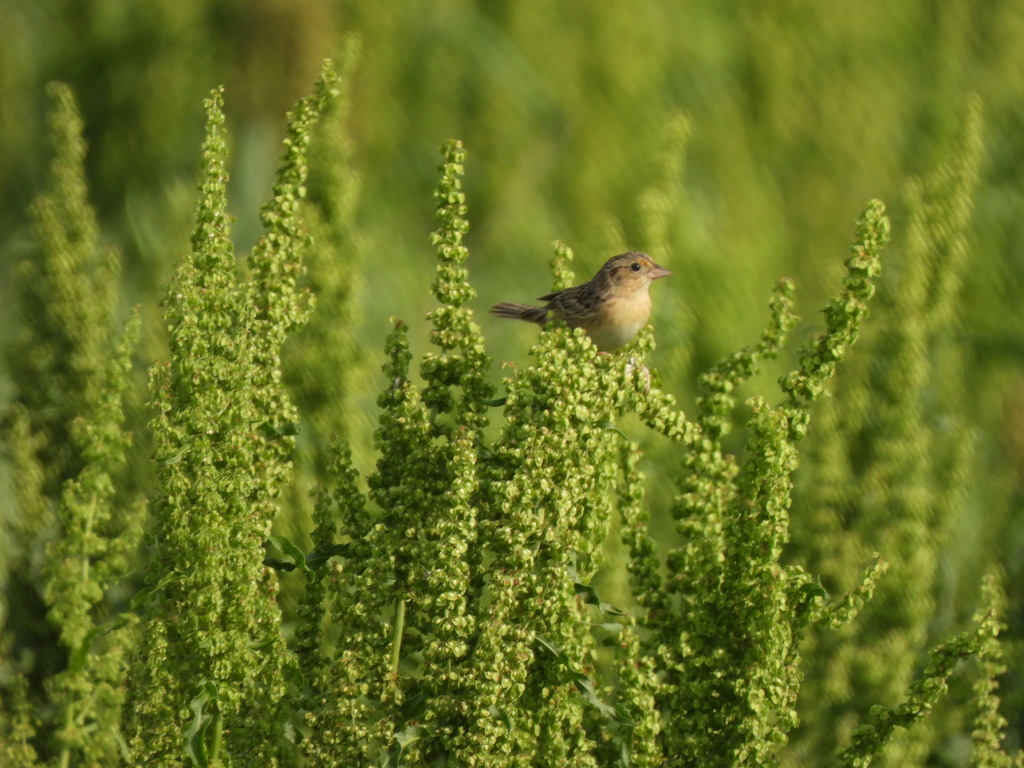
The grasshopper sparrow (Ammodramus savannarum) is a small New World sparrow.
- Kingdom
- Animalia
- Phylum
- Chordata
- Class
- Aves
- Order
- Passeriformes
- Family
- Passerellidae
- Genus
- Ammodramus
- Species
- Ammodramus savannarum
Description
The grasshopper sparrow (Ammodramus savannarum) is a small New World sparrow. It belongs to the genus Ammodramus, which contains three species that inhabit grasslands and prairies. Grasshopper sparrows are sometimes found in crop fields and they will readily colonize reclaimed grassland. In the core of their range, grasshopper sparrows are dependent upon large areas of grassland where they avoid trees and shrubs. They seek out heterogenous patches of prairie that contain clumps of dead grass or other vegetation where they conceal their nest, and also contain barer ground where they forage for insects (especially grasshoppers), spiders, and seeds. Grasshopper sparrows are unusual among New World sparrows in that they sing two distinct song types, the prevalence of which varies with the nesting cycle. The primary male song, a high trill preceded by a stereotyped series of short chips, is reminiscent of the sounds of grasshoppers and is the origin of this species' name. Like some other birds of the central North American grasslands, this species also moves around a lot, not only via annual migrations, but individuals frequently disperse between breeding attempts or breeding seasons. Grasshopper sparrows are in steep decline across their range, even in the core of the breeding distribution in the tallgrass prairies of the central Great Plains. The Florida grasshopper sparrow (Ammodramus savannarum floridanus) is highly endangered.
Gallery
Ajouter des photos
Partagez vos photos de cette espèce (jusqu'à 20 à la fois) : elles sont vérifiées automatiquement, puis publiées.
Répartition
Occurrences observées (données GBIF). Les zones hors aire d'origine peuvent indiquer une présence introduite ou invasive.
Sources et crédits
Informations provenant de plusieurs sources vérifiées. Dernière mise à jour : .
Crédits photos (8)
- Photo : @charley · CC BY-NC 4.0 · via iNaturalist
- Photo : @toad-wife · CC BY 4.0 · via iNaturalist
- Photo : Peter Olsoy (@peterolsoy) · CC BY-NC 4.0 · via iNaturalist
- Photo : Alfredo Acosta (@alfacosta) · CC BY-NC 4.0 · via iNaturalist
- Photo : Garth Harwood (@garth_harwood) · CC BY 4.0 · via iNaturalist
- Photo : Pepe Santillan (@pepesantillan) · CC BY-NC 4.0 · via iNaturalist
- Photo : Jason Alexander (@jasonalexander) · CC BY 4.0 · via iNaturalist
- Photo : Dan Riley (@driley) · CC BY 4.0 · via iNaturalist
Mentions de licence
Texte disponible sous licence CC BY-SA 4.0. Il adapte notamment Wikipedia (CC BY-SA) : Grasshopper sparrow (Wikipédia, auteurs dans l’historique de l’article).
- Taxonomie : GBIF Backbone Taxonomy (CC BY 4.0)
- Carte : occurrences GBIF, fond © contributeurs OpenStreetMap (ODbL)
- Statut de conservation : Liste rouge de l'UICN, via Wikidata (CC0)
Détail : Sources et licences.
Discussion (0)
Aucun message pour l’instant. Lancez la discussion sur cette fiche (sources, précisions, débats éditoriaux).
Connectez-vous pour participer à la discussion.