
House Bunting
Emberiza sahari
The house bunting (Emberiza sahari) is a passerine bird in the bunting family Emberizidae.
- Kingdom
- Animalia
- Phylum
- Chordata
- Class
- Aves
- Order
- Passeriformes
- Family
- Emberizidae
- Genus
- Emberiza
- Species
- Emberiza sahari
Description
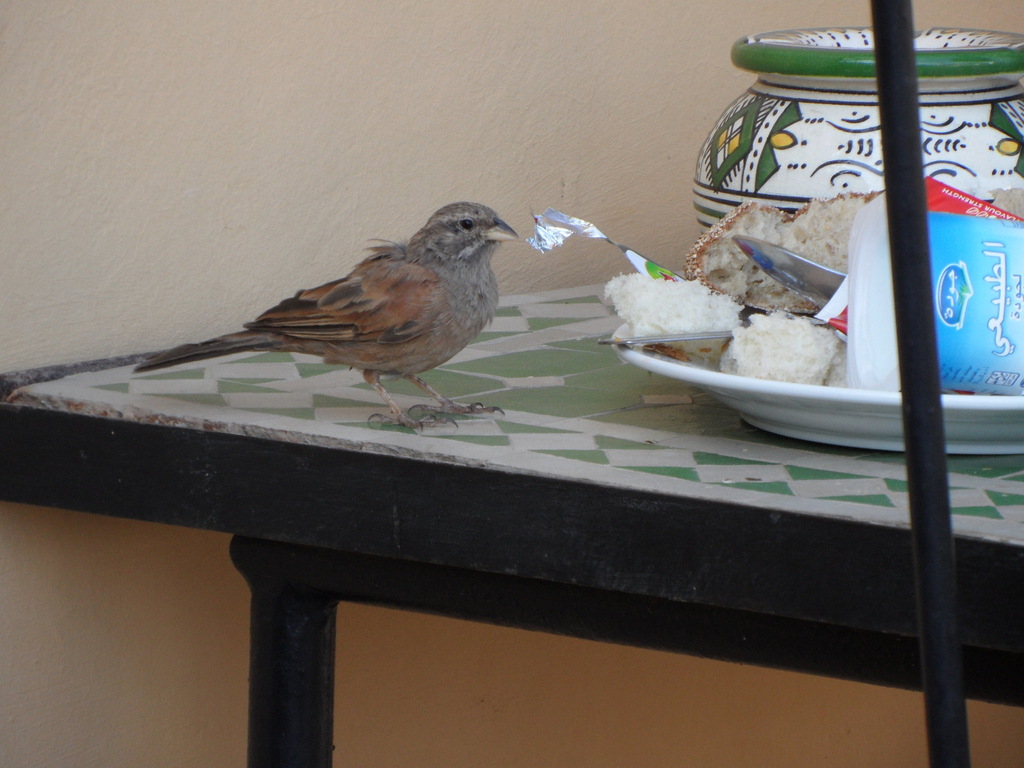
The house bunting (Emberiza sahari) is a passerine bird in the bunting family Emberizidae. It is a resident breeder of dry country from northwestern Africa from Morocco south to Mali and east to Chad. In Morocco, the species has expanded from the Atlas Mountains northwards since the 1960s, and has recently reached Tangier and Tétouan on the southern shore of the Strait of Gibraltar. The house bunting bred in Europe for the first time in 2023, in Algeciras in southern Spain. The house bunting breeds around human habitation, laying two to four eggs in a nest in a hole in a wall or building. Its natural food consists seeds, or when feeding young, insects. It is 14 cm long, similar in size to the striolated bunting and smaller than the rock bunting. The breeding male has a sandy orange-brown body and a grey head slightly dark-streaked but without the white supercilium that the striolated bunting has. The female's head has a brown tint to the grey, and more diffused streaking. The house bunting has recently been split from the closely related striolated bunting, of which it used to be treated as a subspecies, Emberiza striolata sahari. The striolated bunting has stronger facial striping and a paler belly than the house bunting. The incubation period of the clutch of three eggs is 12–14 days. The song, given from a perch, is similar to but weaker than that of the common chaffinch. In Morocco, the species is traditionally regarded as sacred, and has become very tame, freely entering and feeding inside houses, shops and mosques.
Gallery
Ajouter des photos
Partagez vos photos de cette espèce (jusqu'à 20 à la fois) : elles sont vérifiées automatiquement, puis publiées.
Répartition
Occurrences observées (données GBIF). Les zones hors aire d'origine peuvent indiquer une présence introduite ou invasive.
Sources et crédits
Informations provenant de plusieurs sources vérifiées. Dernière mise à jour : .
Crédits photos (8)
- Photo : Mark (@schmitzensmark) · CC BY-NC 4.0 · via iNaturalist
- Photo : Vincent Laurie (@vincentlaurie) · CC BY-NC 4.0 · via iNaturalist
- Photo : Dragonfyre (@dragonfyre) · CC BY-NC 4.0 · via iNaturalist
- Photo : Anaís Fidalgo (@ajfidalgo) · CC BY-NC 4.0 · via iNaturalist
- Photo : @dgoggs · CC BY-NC 4.0 · via iNaturalist
- Photo : Oliver Brockmann (@maturine) · CC BY-NC 4.0 · via iNaturalist
- Photo : Tom Field (@tomfeild) · CC BY 4.0 · via iNaturalist
- Photo : RUFRAY Maël (@loeildelynx) · CC BY-NC 4.0 · via iNaturalist
Mentions de licence
Texte disponible sous licence CC BY-SA 4.0. Il adapte notamment Wikipedia (CC BY-SA) : House bunting, Bruant du Sahara (Wikipédia, auteurs dans l’historique de l’article).
- Taxonomie : GBIF Backbone Taxonomy (CC BY 4.0)
- Carte : occurrences GBIF, fond © contributeurs OpenStreetMap (ODbL)
- Statut de conservation : Liste rouge de l'UICN, via Wikidata (CC0)
Détail : Sources et licences.
Discussion (0)
Aucun message pour l’instant. Lancez la discussion sur cette fiche (sources, précisions, débats éditoriaux).
Connectez-vous pour participer à la discussion.