
Red-headed Bunting
Emberiza bruniceps
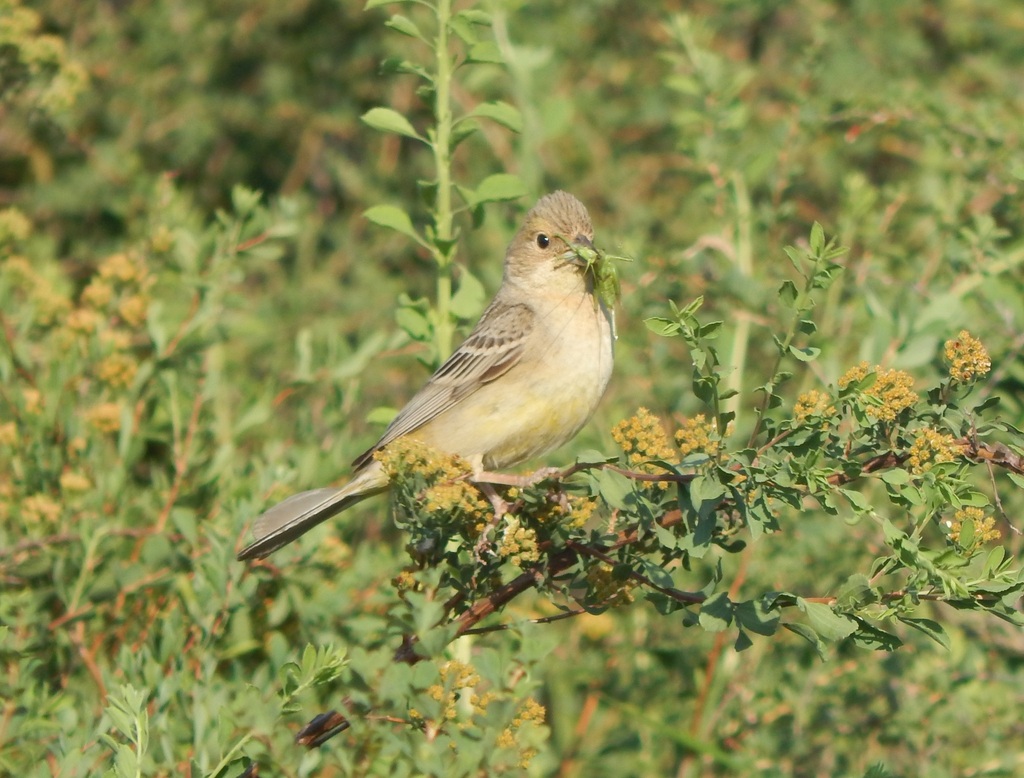
The red-headed bunting (Emberiza bruniceps) is a passerine bird in the bunting family Emberizidae.
- Kingdom
- Animalia
- Phylum
- Chordata
- Class
- Aves
- Order
- Passeriformes
- Family
- Emberizidae
- Genus
- Emberiza
- Species
- Emberiza bruniceps
Description
The red-headed bunting (Emberiza bruniceps) is a passerine bird in the bunting family Emberizidae. It breeds in central Asia, including Afghanistan, Iran, Kazakhstan, Kyrgyzstan, Mongolia; Russia (European Russia, Central Asian Russia), Tajikistan, Turkmenistan, Uzbekistan and China. It is migratory, wintering in India and Bangladesh. Its status in western Europe, where it is a vagrant, has been confused by escapes, especially as this species has been more commonly recorded than the closely related black-headed bunting, despite the latter having a more westerly breeding range. Reports in Britain have declined dramatically over recent years, coinciding with the decline in some Emberizidae species from the impact of illegal trade. An individual found on Shetland in 2010 was deemed to be wild in origin. The red-headed bunting breeds in open scrubby areas including agricultural land. It lays three to five eggs in a nest in a tree or bush. Its natural food consists of seeds, or when feeding young, insects. This bird is 17 cm long, larger than reed bunting, with a long tail. The breeding male has bright yellow underparts, green upperparts and a brownish-red face and breast. The female is a washed-out version of the male, with paler underparts, a grey-brown back and a greyish head. The juvenile is similar, and both can be difficult to separate from the corresponding plumages of black-headed bunting bird. The song, given from a high perch, is a jerky sweet-sweet-churri-churri-churri.
Gallery
Ajouter des photos
Partagez vos photos de cette espèce (jusqu'à 20 à la fois) : elles sont vérifiées automatiquement, puis publiées.
Répartition
Occurrences observées (données GBIF). Les zones hors aire d'origine peuvent indiquer une présence introduite ou invasive.
Sources et crédits
Informations provenant de plusieurs sources vérifiées. Dernière mise à jour : .
Crédits photos (8)
- Photo : Какошкина Татьяна Васильевна (@kakoshkina56) · CC BY-NC 4.0 · via iNaturalist
- Photo : Olga Sivokon (@olga_si) · CC BY-NC 4.0 · via iNaturalist
- Photo : Afsar Nayakkan (@afsarnayakkan) · CC BY 4.0 · via iNaturalist
- Photo : Михаил Новичков (@mikhail_novichkov) · CC BY-NC 4.0 · via iNaturalist
- Photo : @lina_golovneva · CC BY-NC 4.0 · via iNaturalist
- Photo : Евгений Попов (@evgeny_popov) · CC BY-NC 4.0 · via iNaturalist
- Photo : Pavel Shukov (@shukov) · CC BY-NC 4.0 · via iNaturalist
- Photo : Artem Naydenov (@artem_24) · CC BY-NC 4.0 · via iNaturalist
Mentions de licence
Texte disponible sous licence CC BY-SA 4.0. Il adapte notamment Bruant à tête rousse, Wikipedia (CC BY-SA) : Red-headed bunting (Wikipédia, auteurs dans l’historique de l’article).
- Taxonomie : GBIF Backbone Taxonomy (CC BY 4.0)
- Carte : occurrences GBIF, fond © contributeurs OpenStreetMap (ODbL)
- Statut de conservation : Liste rouge de l'UICN, via Wikidata (CC0)
Détail : Sources et licences.
Discussion (0)
Aucun message pour l’instant. Lancez la discussion sur cette fiche (sources, précisions, débats éditoriaux).
Connectez-vous pour participer à la discussion.