
Black-chinned Sparrow
Spizella atrogularis
The black-chinned sparrow (Spizella atrogularis) is a small bird in the genus Spizella, in the New World sparrow family Passerellidae.
- Kingdom
- Animalia
- Phylum
- Chordata
- Class
- Aves
- Order
- Passeriformes
- Family
- Passerellidae
- Genus
- Spizella
- Species
- Spizella atrogularis
Description
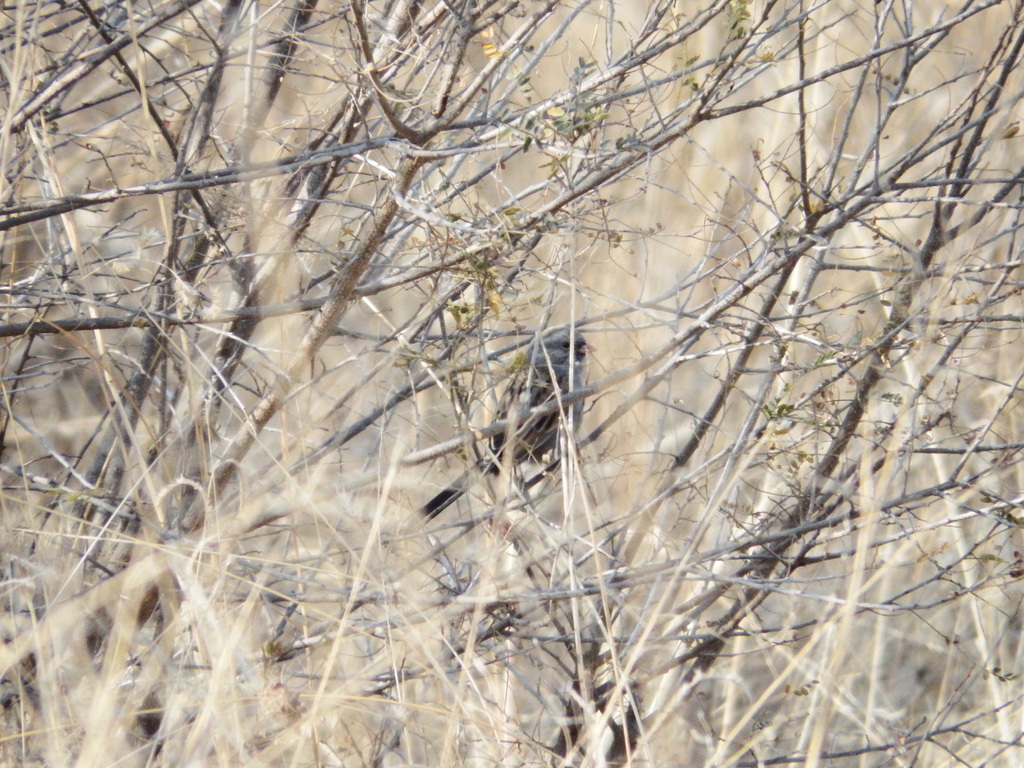
The black-chinned sparrow (Spizella atrogularis) is a small bird in the genus Spizella, in the New World sparrow family Passerellidae. It is found in the southwestern United States and throughout much of Mexico north of the Isthmus of Tehuantepec; most populations in the US migrate south after breeding while those in Mexico are resident. It is a slim, long-tailed bird, primarily gray with a reddish-brown back streaked with black, brown wings and tail, a pink beak, and brownish legs and feet. In the breeding season, the male shows black on his throat, chin, and the front of his face. Females, youngsters and nonbreeding males show little or no black in these areas. An unobtrusive bird, it spends much of its time foraging slowly along the ground, either alone or in small groups, sometimes mixing with other Spizella species. It is an omnivore, feeding primarily on seeds during the winter and insects during the summer. It builds a cup-shaped nest of grasses, rootlets, or plant fibers, into which the female lays 2–5 pale blue eggs. The female does most or all of the egg incubation, but both parents feed the hatched nestlings. The species was first described by Jean Louis Cabanis in 1851. Four subspecies have been identified: one breeds only in the US, one only in Mexico, and the other two breed in both countries. Most northern populations move south-primarily into Mexico-for the winter. Because of its apparently large population size and very large range, it is considered to be a species of least concern. However, increasing global temperatures could have a significantly negative impact on its numbers.
Gallery
Ajouter des photos
Partagez vos photos de cette espèce (jusqu'à 20 à la fois) : elles sont vérifiées automatiquement, puis publiées.
Répartition
Occurrences observées (données GBIF). Les zones hors aire d'origine peuvent indiquer une présence introduite ou invasive.
Sources et crédits
Informations provenant de plusieurs sources vérifiées. Dernière mise à jour : .
Crédits photos (8)
- Photo : Luis Rodriguez (@verde_ollin) · CC BY-NC 4.0 · via iNaturalist
- Photo : Mark Dorriesfield (@markdorriesfield) · CC BY-NC 4.0 · via iNaturalist
- Photo : @kwat · CC BY-NC 4.0 · via iNaturalist
- Photo : Salvador Sánchez (@yolcaquixtiani) · CC BY-NC 4.0 · via iNaturalist
- Photo : zahir santillan (@mainter_gonox) · CC BY-NC 4.0 · via iNaturalist
- Photo : RAFAEL JUAREZ LARA (@rafacoix16) · CC BY-NC 4.0 · via iNaturalist
- Photo : Alexis Salazar (@almithos) · CC BY-NC 4.0 · via iNaturalist
- Photo : Leoadan (@leoadan) · CC BY-NC 4.0 · via iNaturalist
Mentions de licence
Texte disponible sous licence CC BY-SA 4.0. Il adapte notamment Wikipedia (CC BY-SA) : Black-chinned sparrow (Wikipédia, auteurs dans l’historique de l’article).
- Taxonomie : GBIF Backbone Taxonomy (CC BY 4.0)
- Carte : occurrences GBIF, fond © contributeurs OpenStreetMap (ODbL)
- Statut de conservation : Liste rouge de l'UICN, via Wikidata (CC0)
Détail : Sources et licences.
Discussion (0)
Aucun message pour l’instant. Lancez la discussion sur cette fiche (sources, précisions, débats éditoriaux).
Connectez-vous pour participer à la discussion.