
Canada Goose
Branta canadensis
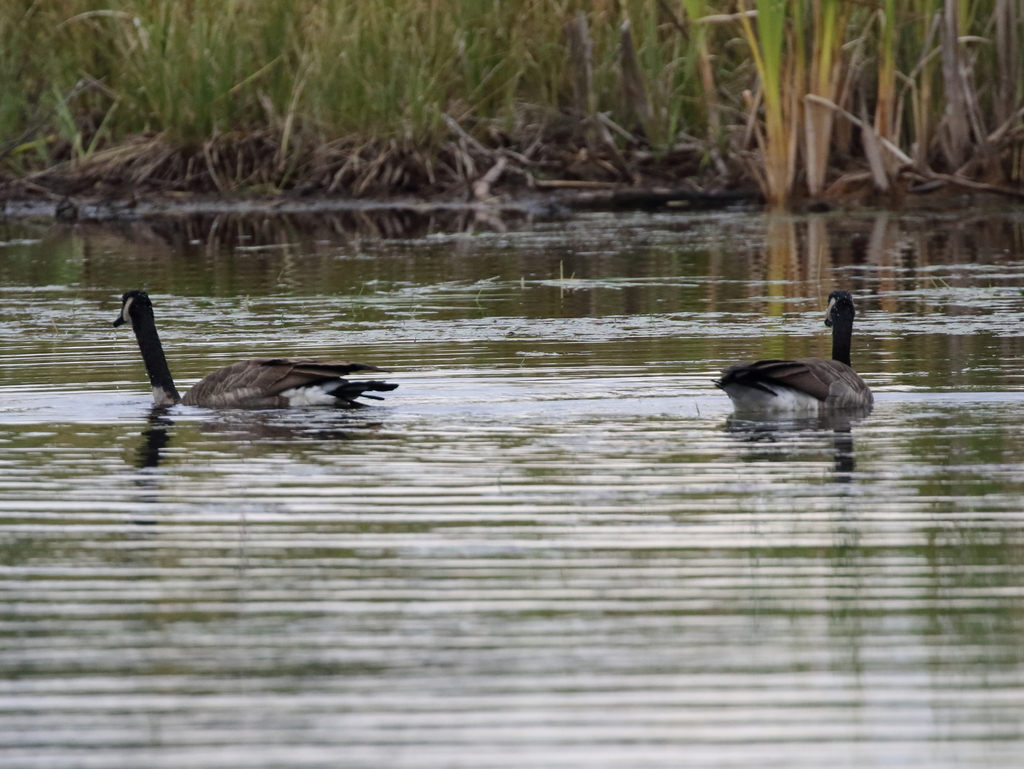
The Canada goose (Branta canadensis) is a large species of goose with a black head and neck, white cheeks, white under its chin, and a brown body.
- Kingdom
- Animalia
- Phylum
- Chordata
- Class
- Aves
- Order
- Anseriformes
- Family
- Anatidae
- Genus
- Branta
- Species
- Branta canadensis
Description
The Canada goose (Branta canadensis) is a large species of goose with a black head and neck, white cheeks, white under its chin, and a brown body. It is native to the Arctic and temperate regions of North America, and it is occasionally found during migration across the Atlantic in northern Europe. It has been introduced to France, the United Kingdom, Ireland, Scandinavia, New Zealand, Japan, Chile, Argentina, and the Falkland Islands. Like most geese, the Canada goose is primarily herbivorous and normally migratory; often found on or close to fresh water, the Canada goose is also common in brackish marshes, estuaries, and lagoons. Adept at living in human-altered areas, Canada geese have established breeding colonies in urban and cultivated habitats, which provide food and have few natural predators. The success of this common park species has led to it often being considered a pest species. This is because of its excrement, its depredation of crops, its noise, its aggressive territorial behavior toward both humans and other animals, and its habit of stalking and begging for food. The last is a result of humans not following artificial feeding policies toward wild animals.
Gallery
Ajouter des photos
Partagez vos photos de cette espèce (jusqu'à 20 à la fois) : elles sont vérifiées automatiquement, puis publiées.
Répartition
Occurrences observées (données GBIF). Les zones hors aire d'origine peuvent indiquer une présence introduite ou invasive.
Sources et crédits
Informations provenant de plusieurs sources vérifiées. Dernière mise à jour : .
Crédits photos (7)
- Photo : ColinDJones (@colindjones) · CC BY-NC 4.0 · via iNaturalist
- Photo : S. Queen (@sylbird) · CC BY-NC 4.0 · via iNaturalist
- Photo : @ruth_nervig · CC BY-NC 4.0 · via iNaturalist
- Photo : @yellowstoneman2007 · CC BY-NC 4.0 · via iNaturalist
- Photo : Tonja Hamel (@tonja) · CC BY-NC 4.0 · via iNaturalist
- Photo : Susan Marley (@susan_marley) · CC BY 4.0 · via iNaturalist
- Photo : Sam Kieschnick (@sambiology) · CC BY 4.0 · via iNaturalist
Mentions de licence
Texte disponible sous licence CC BY-SA 4.0. Il adapte notamment Wikipedia (CC BY-SA) : Canada goose (Wikipédia, auteurs dans l’historique de l’article).
- Taxonomie : GBIF Backbone Taxonomy (CC BY 4.0)
- Carte : occurrences GBIF, fond © contributeurs OpenStreetMap (ODbL)
- Statut de conservation : Liste rouge de l'UICN, via Wikidata (CC0)
Détail : Sources et licences.
Discussion (0)
Aucun message pour l’instant. Lancez la discussion sur cette fiche (sources, précisions, débats éditoriaux).
Connectez-vous pour participer à la discussion.