
Short-billed Dowitcher
Limnodromus griseus
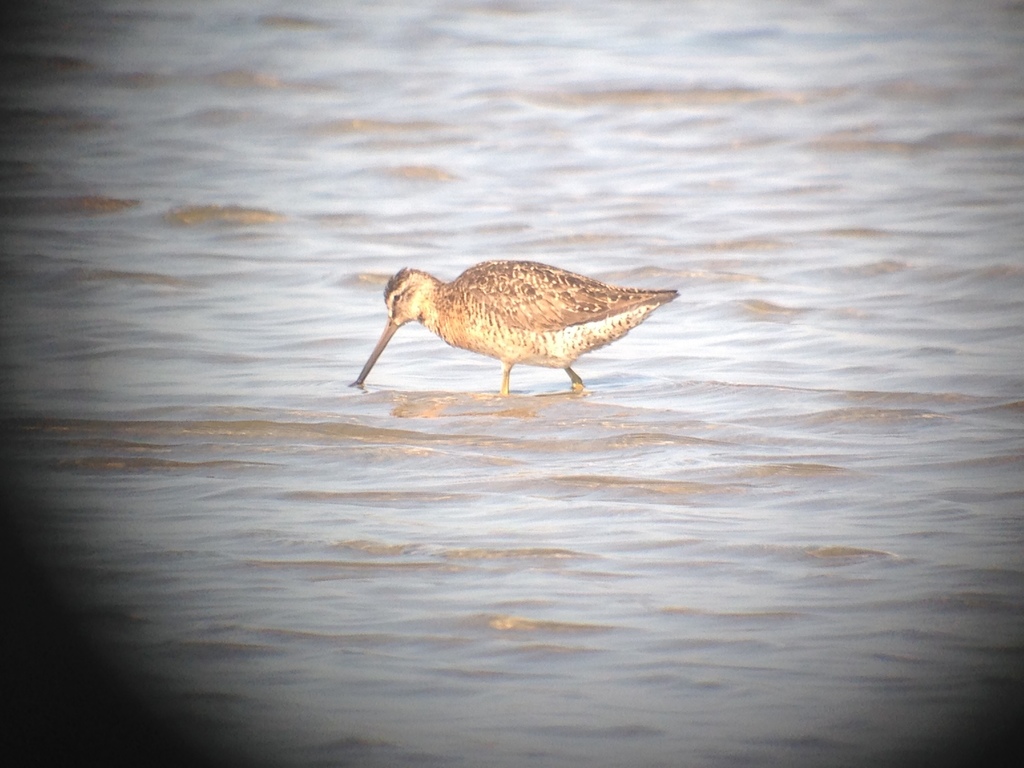
The short-billed dowitcher (Limnodromus griseus), like its congener, the long-billed dowitcher, is a medium-sized, stocky, long-billed shorebird in the family Scolopacidae.
- Kingdom
- Animalia
- Phylum
- Chordata
- Class
- Aves
- Order
- Charadriiformes
- Family
- Scolopacidae
- Genus
- Limnodromus
- Species
- Limnodromus griseus
Description
The short-billed dowitcher (Limnodromus griseus), like its congener, the long-billed dowitcher, is a medium-sized, stocky, long-billed shorebird in the family Scolopacidae. It is an inhabitant of North America, Central America, the Caribbean, and northern South America. It is strongly migratory; it completely vacates its breeding areas during the snow-bound months. This species favors a variety of habitats, including tundra in the north to ponds and mudflats in the south. It feeds on invertebrates often by rapidly probing its bill into mud in a sewing machine fashion. It and the very similar long-billed dowitcher were considered one species until 1950. Field identification of the two American Limnodromus remains difficult today. Distinguishing wintering or juvenile short-billed dowitchers from the long-billed species is very difficult and, even given examination of their subtlety different body shapes, cannot always be isolated to a particular species. They differ most substantially in vocalizations. The names of American dowitchers are misleading, as there is much overlap in their bill lengths. Only a small percentage can be identified by this character alone.
Gallery
Ajouter des photos
Partagez vos photos de cette espèce (jusqu'à 20 à la fois) : elles sont vérifiées automatiquement, puis publiées.
Répartition
Occurrences observées (données GBIF). Les zones hors aire d'origine peuvent indiquer une présence introduite ou invasive.
Sources et crédits
Informations provenant de plusieurs sources vérifiées. Dernière mise à jour : .
Crédits photos (8)
- Photo : Cin-Ty Lee (@cintylee) · CC BY-NC 4.0 · via iNaturalist
- Photo : John D Reynolds (@johndreynolds) · CC BY-NC 4.0 · via iNaturalist
- Photo : Otto Seydel (@ottoseydel) · CC BY-NC 4.0 · via iNaturalist
- Photo : Luis Michael (@luis_michael) · CC BY-NC 4.0 · via iNaturalist
- Photo : Brian Vigorito (@bmvig) · CC BY-NC 4.0 · via iNaturalist
- Photo : Jonathan Sowers (@underscore1234) · CC0 (domaine public) · via iNaturalist
- Photo : Cameron Eckert (@camerondeckert) · CC BY-NC 4.0 · via iNaturalist
- Photo : @phyllisnewbie · CC BY-NC 4.0 · via iNaturalist
Mentions de licence
Texte disponible sous licence CC BY-SA 4.0. Il adapte notamment Wikipedia (CC BY-SA) : Short-billed dowitcher (Wikipédia, auteurs dans l’historique de l’article).
- Taxonomie : GBIF Backbone Taxonomy (CC BY 4.0)
- Carte : occurrences GBIF, fond © contributeurs OpenStreetMap (ODbL)
- Statut de conservation : Liste rouge de l'UICN, via Wikidata (CC0)
Détail : Sources et licences.
Discussion (0)
Aucun message pour l’instant. Lancez la discussion sur cette fiche (sources, précisions, débats éditoriaux).
Connectez-vous pour participer à la discussion.