
Sri Lanka Whistling Thrush
Myophonus blighi
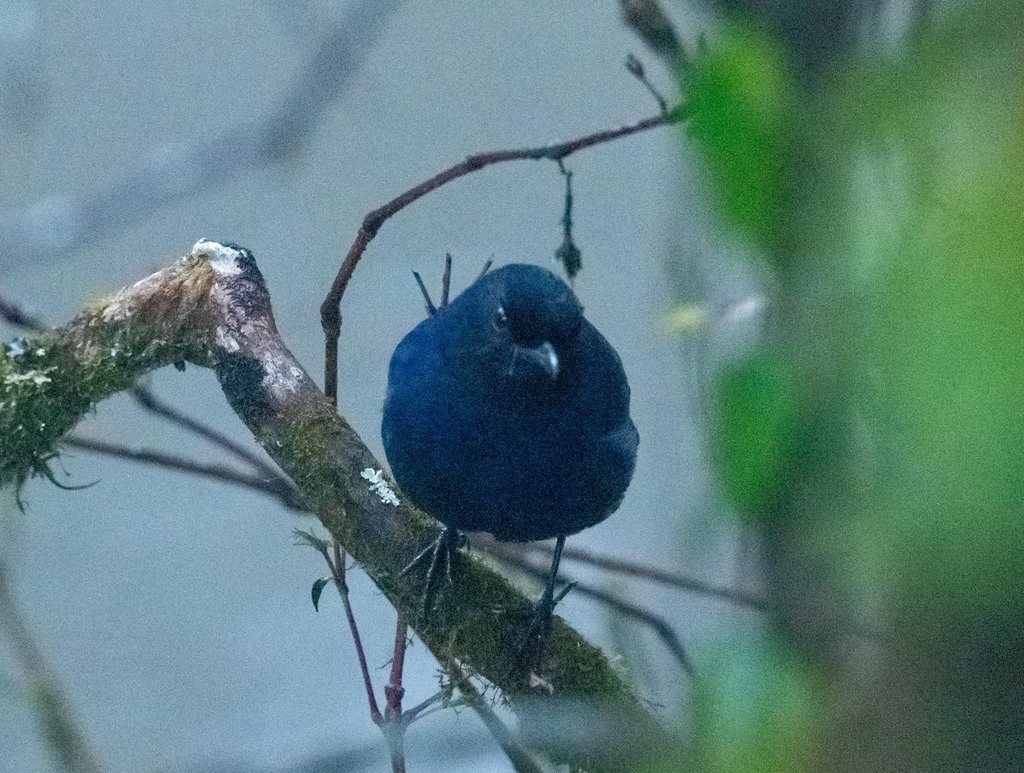
The Sri Lanka whistling thrush (Myophonus blighi) is a whistling thrush in the family Muscicapidae.
- Kingdom
- Animalia
- Phylum
- Chordata
- Class
- Aves
- Order
- Passeriformes
- Family
- Muscicapidae
- Genus
- Myophonus
- Species
- Myophonus blighi
Description
The Sri Lanka whistling thrush (Myophonus blighi) is a whistling thrush in the family Muscicapidae. It is a resident endemic bird in Sri Lanka. It is found in the highlands of Sri Lanka in jungle or other dense forest near water. It is omnivorous, eating a wide range of insects, frogs, earthworms and berries. It lays one or two eggs in a neat cup-shaped nest in a bush or on a ledge near water. It does not form flocks, although several birds may be loosely associated in suitable habitat. This is a small whistling thrush, at only 20 cm. Adult males are dark blue with a darker head and back. There are bright blue patches on the shoulders, supercilia and forehead. The female is brown above and chestnut below, but has a bright blue shoulder patch like the male. The male sings its simple whistling song from trees, usually in deep cover. This is a notoriously difficult species to see, even when the males are singing in the breeding season, which starts in February. It is very shy, scarce, localised and declining due to habitat loss. Perhaps the best chance is at dawn at Horton Plains National Park 2000m up in the highlands of Sri Lanka and a site near the Haggala Botanical Gardens close to Nuwara Eliya town.
Gallery
Ajouter des photos
Partagez vos photos de cette espèce (jusqu'à 20 à la fois) : elles sont vérifiées automatiquement, puis publiées.
Répartition
Occurrences observées (données GBIF). Les zones hors aire d'origine peuvent indiquer une présence introduite ou invasive.
Sources et crédits
Informations provenant de plusieurs sources vérifiées. Dernière mise à jour : .
Crédits photos (8)
- Photo : Marc Cronje (@marccronje) · CC BY-NC 4.0 · via iNaturalist
- Photo : Andrew Kruger (@andrewkruger) · CC BY-NC 4.0 · via iNaturalist
- Photo : Sanjaya Kanishka (@sanjaya_kanishka) · CC BY-NC 4.0 · via iNaturalist
- Photo : Tero Linjama (@terolinjama) · CC0 (domaine public) · via iNaturalist
- Photo : Simon Bradfield (@scompeti) · CC BY-NC 4.0 · via iNaturalist
- Photo : Ruchira Nethmina (@ruchiranethmina) · CC BY-NC 4.0 · via iNaturalist
- Photo : @hokoonwong · CC BY-NC 4.0 · via iNaturalist
- Photo : Tim Cowley (@tc271) · CC BY-NC 4.0 · via iNaturalist
Mentions de licence
Texte disponible sous licence CC BY-SA 4.0. Il adapte notamment Wikipedia (CC BY-SA) : Sri Lanka whistling thrush, Arrenga de Ceylan (Wikipédia, auteurs dans l’historique de l’article).
- Taxonomie : GBIF Backbone Taxonomy (CC BY 4.0)
- Carte : occurrences GBIF, fond © contributeurs OpenStreetMap (ODbL)
Détail : Sources et licences.
Discussion (0)
Aucun message pour l’instant. Lancez la discussion sur cette fiche (sources, précisions, débats éditoriaux).
Connectez-vous pour participer à la discussion.