
Steppe Eagle
Aquila nipalensis
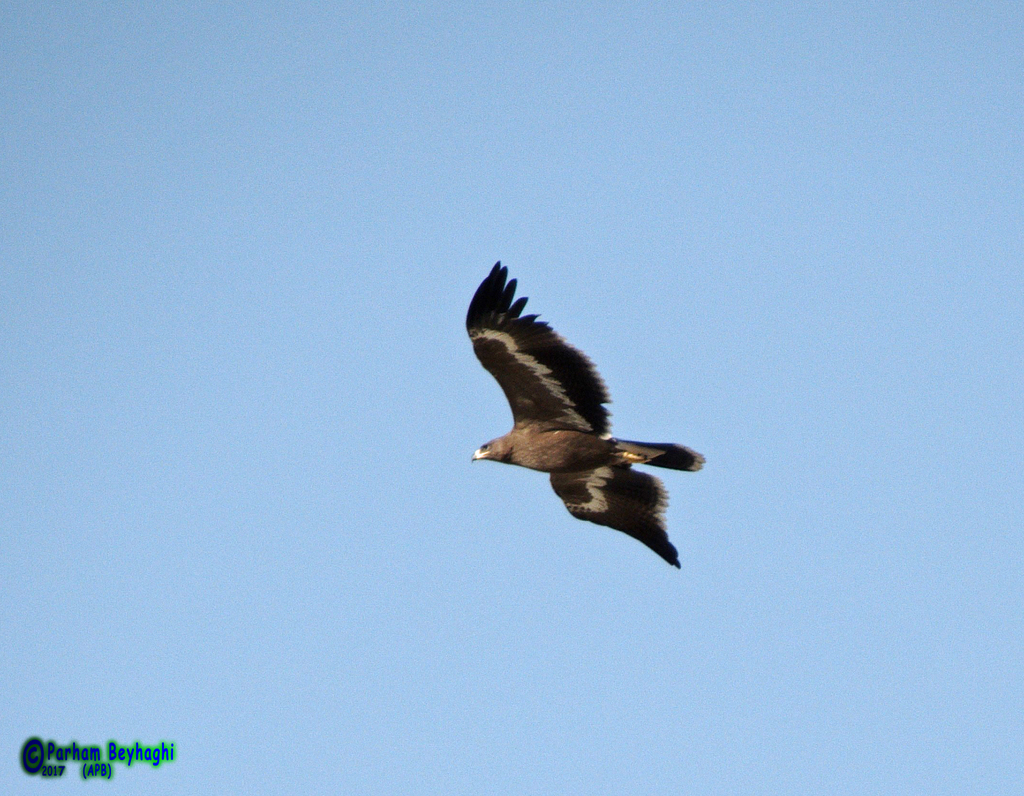
The steppe eagle (Aquila nipalensis) is a large bird of prey.
- Kingdom
- Animalia
- Phylum
- Chordata
- Class
- Aves
- Order
- Accipitriformes
- Family
- Accipitridae
- Genus
- Aquila
- Species
- Aquila nipalensis
Description
The steppe eagle (Aquila nipalensis) is a large bird of prey. Like all eagles, it belongs to the family Accipitridae. The steppe eagle's well-feathered legs illustrate it to be a member of the subfamily Aquilinae, also known as the "Booted eagles". This species was once considered to be closely related to the sedentary tawny eagle (Aquila rapax) and the two forms have previously been treated as conspecific. They were split based on pronounced differences in morphology and anatomy; two molecular studies, each based on a very small number of genes, indicate that the species are distinct but disagree over how closely related they are. The Steppe eagle is in many ways a peculiar species of eagle. It is a specialized predator of ground squirrels on the breeding ground, also taking other rather small mammals and other prey, doing so more often when ground squirrels are less consistently found. In rather treeless areas of the steppe habitats, these eagles tend to nest on a slight rise, often on or near an outcrop, but may even be found on flat, wide-open ground, in a rather flat nest. They are the only eagle to nest primarily on the ground. Usually, one to three eggs are laid and, in successful nests, one to two young eagles fledge. The steppe eagle undertakes a massive migration from essentially its entire breeding range, moving en masse past major migration flyways, especially those of the Middle East, Red Sea and the Himalayas. In winter, though less closely studied than during breeding, the steppe eagle is remarkable for its sluggish and almost passive feeding ecology, focusing on insect swarms, landfills, carrion and the semi-altricial young of assorted animals, lacking the bold and predatory demeanor of their cousin species. Although still seen by the thousands at migration sites in larger numbers than other migrating eagles of these areas, the steppe eagle's entire population has declined precipitously. The threats to this species consist of increasing steppe fires and pests around the nests (both probably increased by the warming climate) which can cause a large volume of nest failures. Rivaling these factors, declines are being exacerbated by disturbance and persecution by humans, as well as trampling of nests by livestock. Free-flying steppe eagles are also being killed in alarmingly large numbers, especially in the stronghold nation for breeding of Kazakhstan, by electrocutions on dangerous electricial wires and pylons. Due to these and other reasons, the decline of the species is thought to be considerably more than 50%. Therefore, the species is considered to be endangered by the IUCN. The steppe eagle appears on the flag of Kazakhstan and is the national bird of both Kazakhstan and Egypt.
Gallery
Ajouter des photos
Partagez vos photos de cette espèce (jusqu'à 20 à la fois) : elles sont vérifiées automatiquement, puis publiées.
Répartition
Occurrences observées (données GBIF). Les zones hors aire d'origine peuvent indiquer une présence introduite ou invasive.
Sources et crédits
Informations provenant de plusieurs sources vérifiées. Dernière mise à jour : .
Crédits photos (8)
- Photo : Parham Beyhaghi (@parham_beyhaghi) · CC BY-NC 4.0 · via iNaturalist
- Photo : Serge (@rersikom) · CC BY-NC 4.0 · via iNaturalist
- Photo : Parham Beyhaghi (@parham_beyhaghi) · CC BY-NC 4.0 · via iNaturalist
- Photo : D I G I C H 𓅰 (@digichh) · CC BY-NC 4.0 · via iNaturalist
- Photo : Лариса Некрасова (@larisa_nekrasova) · CC BY-NC 4.0 · via iNaturalist
- Photo : Jonathan Hakim (@jonhakim) · CC BY-NC 4.0 · via iNaturalist
- Photo : Ramnarayan K (@ram_k) · CC BY 4.0 · via iNaturalist
- Photo : @ashimmr · CC BY-NC 4.0 · via iNaturalist
Mentions de licence
Texte disponible sous licence CC BY-SA 4.0. Il adapte notamment Wikipedia (CC BY-SA) : Steppe eagle (Wikipédia, auteurs dans l’historique de l’article).
- Taxonomie : GBIF Backbone Taxonomy (CC BY 4.0)
- Carte : occurrences GBIF, fond © contributeurs OpenStreetMap (ODbL)
Détail : Sources et licences.
Discussion (0)
Aucun message pour l’instant. Lancez la discussion sur cette fiche (sources, précisions, débats éditoriaux).
Connectez-vous pour participer à la discussion.