
Bigfin reef squid
Sepioteuthis lessoniana
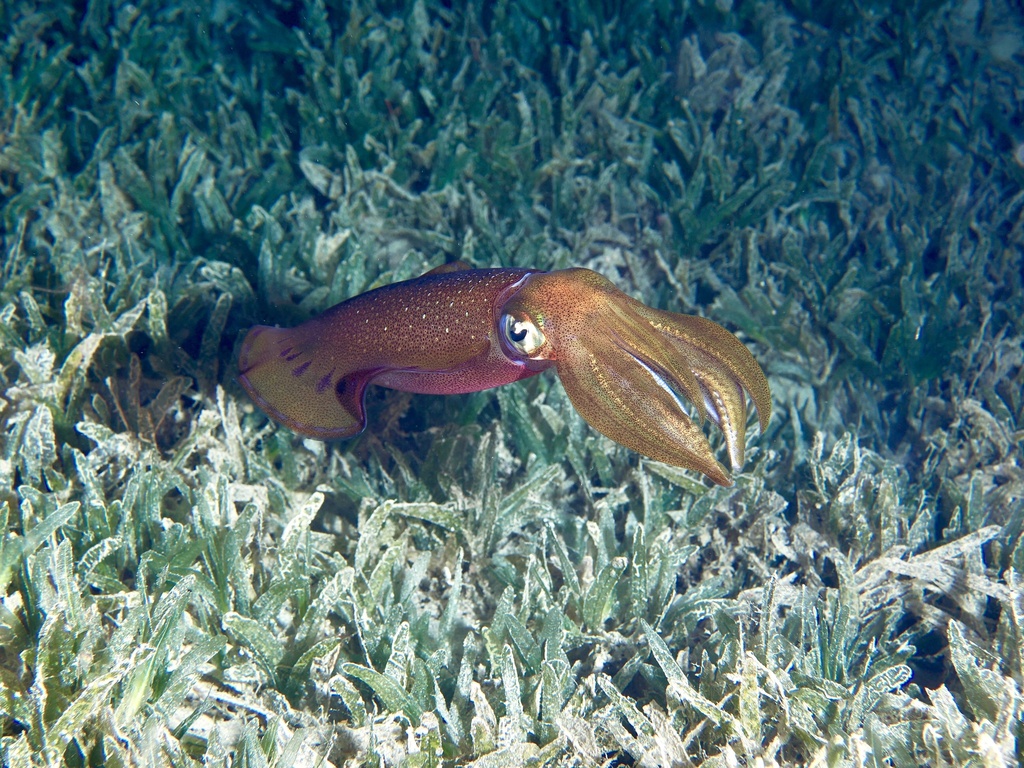
Sepioteuthis lessoniana, commonly known as the bigfin reef squid, tiger squid, glitter squid, oval squid, or northern calamari, is a species complex in the loliginid squid family.
- Kingdom
- Animalia
- Phylum
- Mollusca
- Class
- Cephalopoda
- Order
- Myopsida
- Family
- Loliginidae
- Genus
- Sepioteuthis
- Species
- Sepioteuthis lessoniana
Description
Sepioteuthis lessoniana, commonly known as the bigfin reef squid, tiger squid, glitter squid, oval squid, or northern calamari, is a species complex in the loliginid squid family. It is one of the three currently recognized species belonging to the genus Sepioteuthis. Studies in 1993, however, have indicated that bigfin reef squids may comprise several cryptic species, that are very similar and closely related. Bigfin reef squids are characterised by a large oval fin that extends throughout the margins of its mantle, giving them a superficial similarity to cuttlefish. They are small to medium-sized squids, averaging 3.8 to 33 centimetres (1.5 to 13.0 in) in length. They exhibit elaborate mating displays and usually spawn in May, but it can vary by location. The paralarvae resemble miniature adults and are remarkable for already having the capability to change body colouration upon hatching. Bigfin reef squids have the fastest recorded growth rates of any large marine invertebrate, reaching 600 g (1.3 lb) in only four months. They are a short-lived species, with a maximum recorded lifespan of 315 days. The diet of bigfin reef squids comprises mainly crustaceans and small fish. They are found in the temperate and tropical waters of the Pacific and Indian Oceans, and have recently been introduced into the Mediterranean as a Lessepsian migrant. They are commonly found near the shoreline, near rocks, and coral reefs. They are fished extensively for human consumption in Asia. Because of their rapid growth rate, short life span, and tolerance to handling and captivity, bigfin reef squids are regarded as one of the most promising species for mariculture. They are also a valuable source of giant axons for medical research.
Gallery
Ajouter des photos
Partagez vos photos de cette espèce (jusqu'à 20 à la fois) : elles sont vérifiées automatiquement, puis publiées.
Répartition
Occurrences observées (données GBIF). Les zones hors aire d'origine peuvent indiquer une présence introduite ou invasive.
Sources et crédits
Informations provenant de plusieurs sources vérifiées. Dernière mise à jour : .
Crédits photos (7)
- Photo : Ilan Ben Tov (@ilan65612) · CC BY-NC 4.0 · via iNaturalist
- Photo : Albert Kang (@albertkang) · CC BY-NC 4.0 · via iNaturalist
- Photo : 呂一起(Lyu yi-chi) (@pchi45) · CC BY 4.0 · via iNaturalist
- Photo : Sara Thiebaud (@thiebaud) · CC BY-NC 4.0 · via iNaturalist
- Photo : Frank Krasovec (@wetlens) · CC BY-NC 4.0 · via iNaturalist
- Photo : Andy (@poseidon_photography) · CC BY-NC 4.0 · via iNaturalist
- Photo : Adelma Hills (@insequentways) · CC BY-NC 4.0 · via iNaturalist
Mentions de licence
Texte disponible sous licence CC BY-SA 4.0. Il adapte notamment Wikipedia (CC BY-SA) : Bigfin reef squid (Wikipédia, auteurs dans l’historique de l’article).
- Taxonomie : GBIF Backbone Taxonomy (CC BY 4.0)
- Carte : occurrences GBIF, fond © contributeurs OpenStreetMap (ODbL)
- Statut de conservation : Liste rouge de l'UICN, via Wikidata (CC0)
Détail : Sources et licences.
Discussion (0)
Aucun message pour l’instant. Lancez la discussion sur cette fiche (sources, précisions, débats éditoriaux).
Connectez-vous pour participer à la discussion.