
White Warty-back Pearly Mussel
Plethobasus cicatricosus
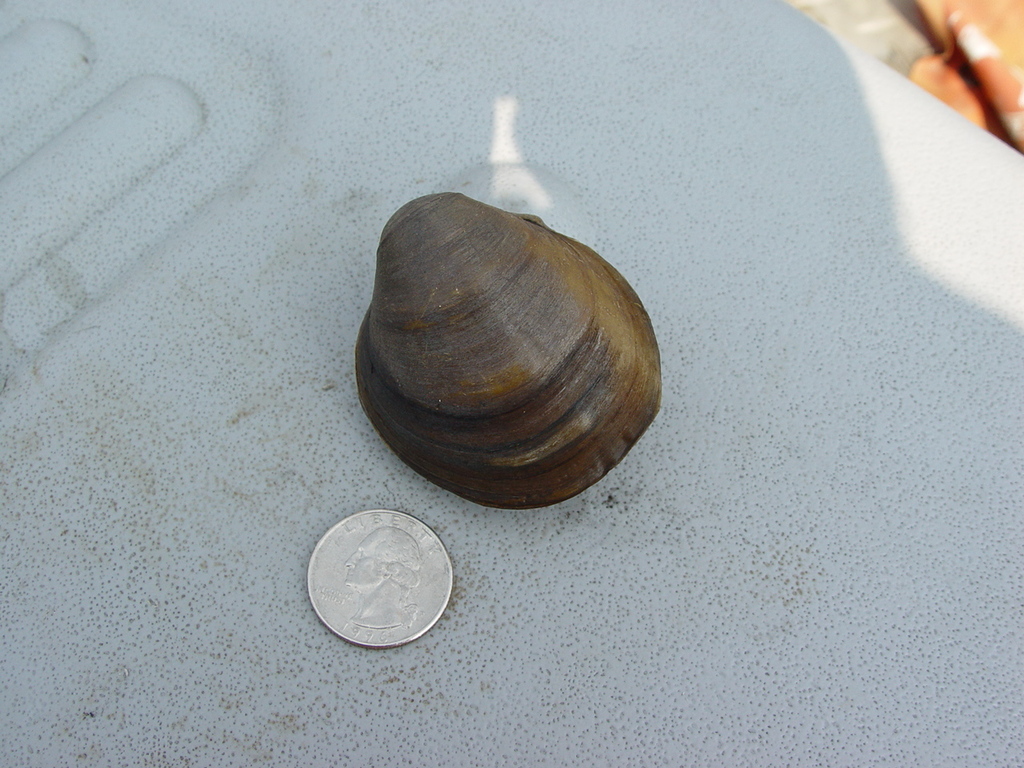
Plethobasus cicatricosus, the white warty-back pearly mussel or white wartyback, is a species of freshwater mussel in the family Unionidae, the river mussels.
- Kingdom
- Animalia
- Phylum
- Mollusca
- Class
- Bivalvia
- Order
- Unionida
- Family
- Unionidae
- Genus
- Plethobasus
- Species
- Plethobasus cicatricosus
Description
Plethobasus cicatricosus, the white warty-back pearly mussel or white wartyback, is a species of freshwater mussel in the family Unionidae, the river mussels. Once widely distributed in the Ohio, Cumberland, and Tennessee River systems in the United States, its range has declined dramatically to the point of near-extinction. It is a federally listed endangered species of the United States. This mussel is yellow-green or yellow-brown in color. The nacre is white and partly iridescent. There is a row of tubercles on one edge of the shell. The white wartyback lived in the main arteries of big rivers. It was distributed through Alabama, Illinois, Indiana, Kentucky, Ohio, Tennessee, and West Virginia. It has now been extirpated from all of these states except for Tennessee and Alabama, where it possibly remains in the main flow of the Tennessee River. However, no live individuals have been documented since 1997. If a viable population is discovered, plans exist for the white wartyback to be reintroduced to the French Broad River and the Holston River in Tennessee. There are currently no live individuals that exist in laboratories or propagation facilities.
Gallery
Ajouter des photos
Partagez vos photos de cette espèce (jusqu'à 20 à la fois) : elles sont vérifiées automatiquement, puis publiées.
Répartition
Occurrences observées (données GBIF). Les zones hors aire d'origine peuvent indiquer une présence introduite ou invasive.
Sources et crédits
Informations provenant de plusieurs sources vérifiées. Dernière mise à jour : .
Crédits photos (2)
- Photo : Jeff Garner (@jeffgarner) · CC BY-NC 4.0 · via iNaturalist
- Photo : Jeff Garner (@jeffgarner) · CC BY-NC 4.0 · via iNaturalist
Mentions de licence
Texte disponible sous licence CC BY-SA 4.0. Il adapte notamment Wikipedia (CC BY-SA) : Plethobasus cicatricosus (Wikipédia, auteurs dans l’historique de l’article).
- Taxonomie : GBIF Backbone Taxonomy (CC BY 4.0)
- Carte : occurrences GBIF, fond © contributeurs OpenStreetMap (ODbL)
- Statut de conservation : Liste rouge de l'UICN, via Wikidata (CC0)
Détail : Sources et licences.
Discussion (0)
Aucun message pour l’instant. Lancez la discussion sur cette fiche (sources, précisions, débats éditoriaux).
Connectez-vous pour participer à la discussion.