
Physella acuta
Physella acuta
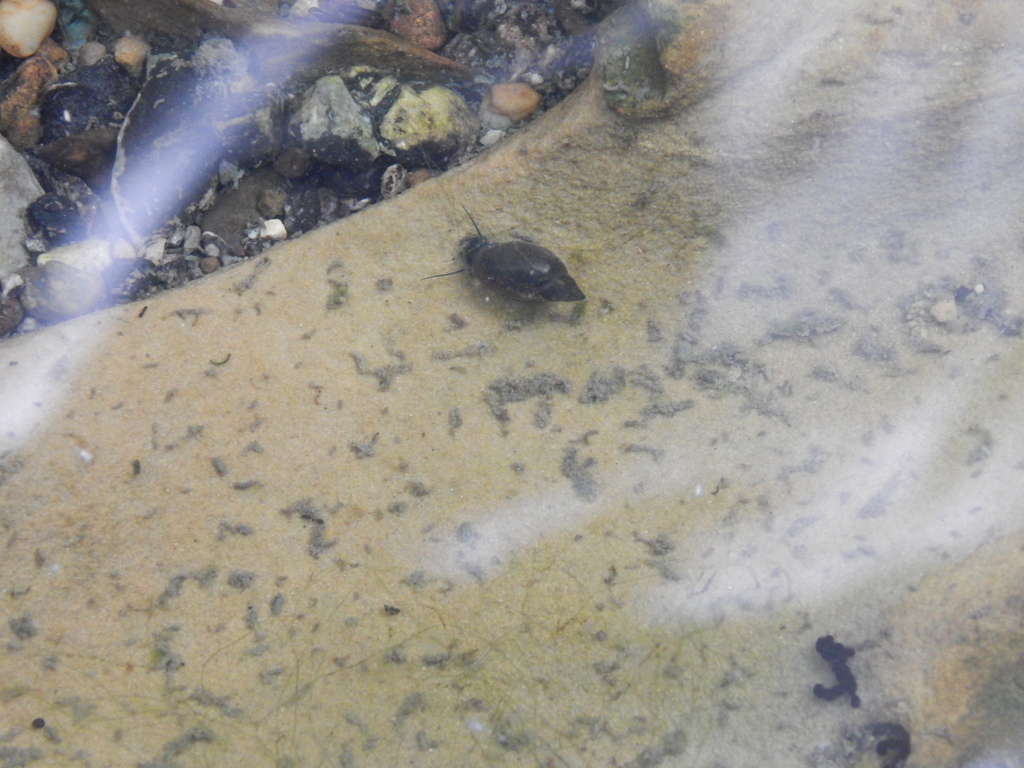
Physella acuta, also known as the European physa, tadpole snail, sewage snail, bladder snail, or acute bladder snail, is a species of small, air-breathing freshwater snail of the family Physidae.
- Kingdom
- Animalia
- Phylum
- Mollusca
- Class
- Gastropoda
- Family
- Physidae
- Genus
- Physella
- Species
- Physella acuta
Description
Physella acuta, also known as the European physa, tadpole snail, sewage snail, bladder snail, or acute bladder snail, is a species of small, air-breathing freshwater snail of the family Physidae. It originates from North America and was first described in 1805 by Jacques Philippe Raymond Draparnaud based on a specimen found in France. Like other physids, P. acuta presents a sinistral (left-coiling) shell as well as a unique set of muscles called the physid musculature that allows it to rapidly twist the shell as a defence mechanism. P. acuta is invasive on all continents except Antarctica and is considered by Dillon and colleagues (2002) as "the world's most cosmopolitan freshwater gastropod". Its first introduction outside North America likely occurred through the 18th-century cotton trade to Europe, while later spread mainly happened through the aquarium trade. The species can occupy diverse freshwater habitats and tolerates polluted as well as oxygen-poor environments. It can reproduce with other individuals and also self-fertilise. Due to its high reproductive rate and tolerance to habitat degradation, it frequently outcompetes native snail species. Prevalence of parasitic infections within invasive P. acuta populations is often low, but a 2024 study detected the human parasite Echinostoma (which causes a disease known as echinostomiasis upon infecting the gastrointestinal tract) in an individual from Rio de Janeiro, Brazil. In aquariums, P. acuta is usually introduced through ornamental plants and can become a "nuisance snail" due to its rapid reproduction. However, a controlled population in an aquarium can help clean up organic leftovers and control algal growth.
Gallery
Ajouter des photos
Partagez vos photos de cette espèce (jusqu'à 20 à la fois) : elles sont vérifiées automatiquement, puis publiées.
Répartition
Occurrences observées (données GBIF). Les zones hors aire d'origine peuvent indiquer une présence introduite ou invasive.
Sources et crédits
Informations provenant de plusieurs sources vérifiées. Dernière mise à jour : .
Crédits photos (6)
- Photo : Zachary Chapman (@galactic_bug_man) · CC BY-NC 4.0 · via iNaturalist
- Photo : Christian Carlos (@christiancarloslanda) · CC BY-NC 4.0 · via iNaturalist
- Photo : Benjamin Wright (@benjansss) · CC BY-NC 4.0 · via iNaturalist
- Photo : Antoine Thivolle (@antoine2684) · CC BY 4.0 · via iNaturalist
- Photo : Jan Ebr & Ivana Ebrová (@opisska) · CC BY 4.0 · via iNaturalist
- Photo : Sue Jaggar (@suejaggar) · CC BY-NC 4.0 · via iNaturalist
Mentions de licence
Texte disponible sous licence CC BY-SA 4.0. Il adapte notamment Wikipedia (CC BY-SA) : Physella acuta (Wikipédia, auteurs dans l’historique de l’article).
- Taxonomie : GBIF Backbone Taxonomy (CC BY 4.0)
- Carte : occurrences GBIF, fond © contributeurs OpenStreetMap (ODbL)
- Statut de conservation : Liste rouge de l'UICN, via Wikidata (CC0)
Détail : Sources et licences.
Discussion (0)
Aucun message pour l’instant. Lancez la discussion sur cette fiche (sources, précisions, débats éditoriaux).
Connectez-vous pour participer à la discussion.