
Octopus maya
Octopus maya
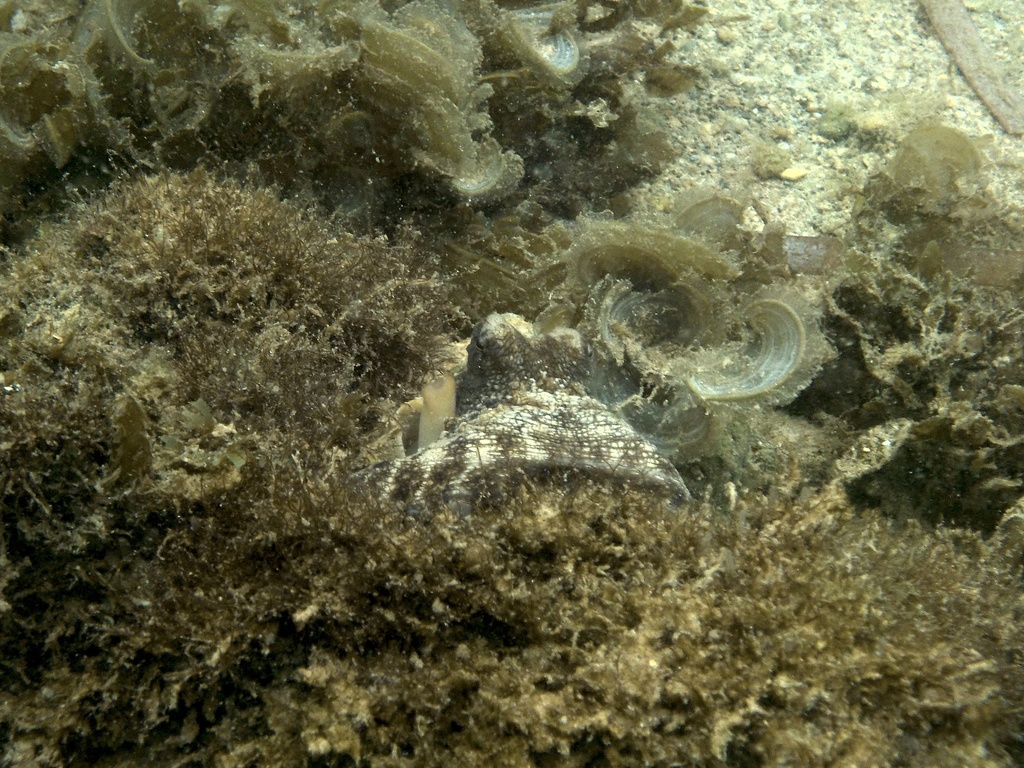
Octopus maya, known colloquially as the Mexican four-eyed octopus and the Mayan octopus is a shallow water octopus that can be found in the tropical Western Atlantic Ocean.
- Kingdom
- Animalia
- Phylum
- Mollusca
- Class
- Cephalopoda
- Order
- Octopoda
- Family
- Octopodidae
- Genus
- Octopus
- Species
- Octopus maya
Description
Octopus maya, known colloquially as the Mexican four-eyed octopus and the Mayan octopus is a shallow water octopus that can be found in the tropical Western Atlantic Ocean. It is common to sea grass prairies and coral formations. The species was initially discovered in an octopus fishery in Campeche Mexico, where its close external resemblance to Octopus vulgaris led to its mistaken grouping with the other species. O. maya makes up 80% of octopus catch in the Yucatán Peninsula, while O. vulgaris makes up the remaining 20%. Octopus maya can be identified by its large, double-ringed ocellus (a false eye spot) and large egg size (averaging 17 mm or 0.67 in). The mantle is muscular, large, and oval in shape. There is some variation in the definite shape of the posterior end of the mantle, but all are fairly narrow and meet the head at a characteristically narrow neck. Females grow to be larger than males, weighing in at 1,024 g (36 oz) with mantles measuring 124 millimetres (4.9 in). Males grow to be about 484 g (17.1 oz) with mantles 91 g (3.2 oz) long. They are usually dark brown in color but may turn red when agitated. They are also able to mimic the color of the sand on the seafloor. The ocellus is a dark red brown and found directly beneath the eye between the second and third arm. It has been found in depths between 3 and 25 m (10 and 82 ft) along the continental shelf of the Yucatán Peninsula.
Gallery
Ajouter des photos
Partagez vos photos de cette espèce (jusqu'à 20 à la fois) : elles sont vérifiées automatiquement, puis publiées.
Répartition
Occurrences observées (données GBIF). Les zones hors aire d'origine peuvent indiquer une présence introduite ou invasive.
Sources et crédits
Informations provenant de plusieurs sources vérifiées. Dernière mise à jour : .
Crédits photos (6)
- Photo : Alejandro Salazar (@alejandros) · CC BY-NC 4.0 · via iNaturalist
- Photo : Rafael de la Parra (@rafael4grampus) · CC BY-NC 4.0 · via iNaturalist
- Photo : Joel Rodríguez Duarte (@joelasus) · CC BY-NC 4.0 · via iNaturalist
- Photo : Juan Cruzado Cortés (@juancruzado) · CC BY 4.0 · via iNaturalist
- Photo : Andrew McKinlay (@apmckinlay) · CC BY 4.0 · via iNaturalist
- Photo : Gabriel Sanchez (@gabomagsan) · CC BY-NC 4.0 · via iNaturalist
Mentions de licence
Texte disponible sous licence CC BY-SA 4.0. Il adapte notamment Wikipedia (CC BY-SA) : Octopus maya (Wikipédia, auteurs dans l’historique de l’article).
- Taxonomie : GBIF Backbone Taxonomy (CC BY 4.0)
- Carte : occurrences GBIF, fond © contributeurs OpenStreetMap (ODbL)
- Statut de conservation : Liste rouge de l'UICN, via Wikidata (CC0)
Détail : Sources et licences.
Discussion (0)
Aucun message pour l’instant. Lancez la discussion sur cette fiche (sources, précisions, débats éditoriaux).
Connectez-vous pour participer à la discussion.