
Idiosepius thailandicus
Idiosepius thailandicus
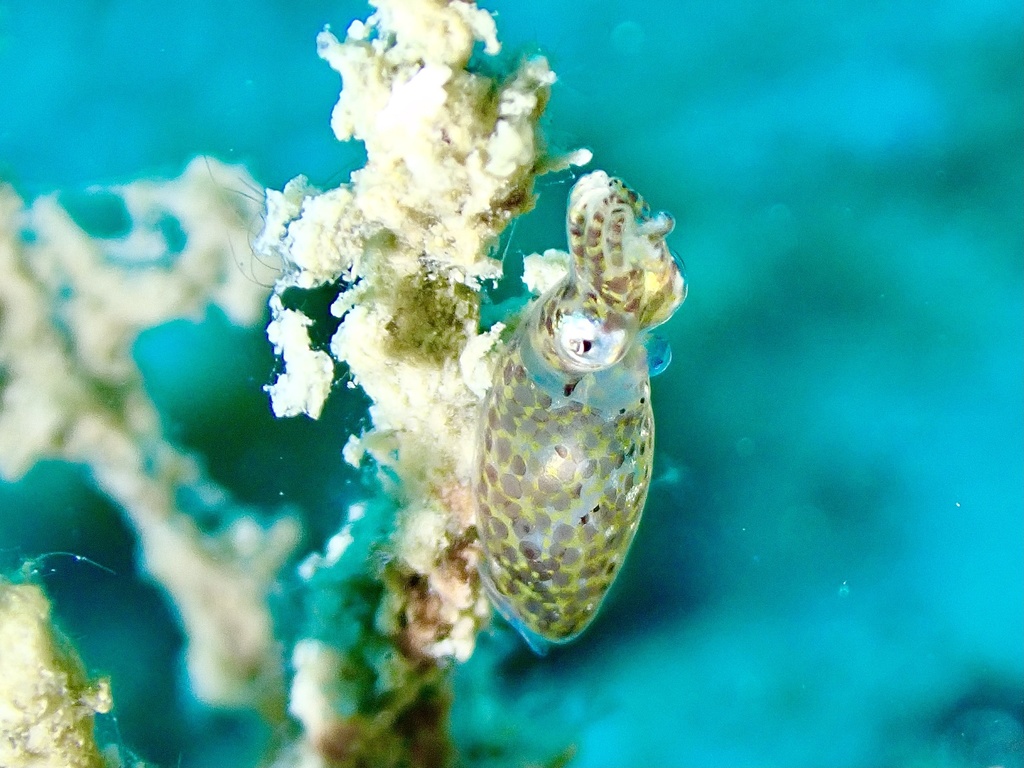
Idiosepius thailandicus, also known as the thai pygmy squid, is a species of bobtail squid native to the Indo-Pacific waters off Thailand.
- Kingdom
- Animalia
- Phylum
- Mollusca
- Class
- Cephalopoda
- Order
- Idiosepida
- Family
- Idiosepiidae
- Genus
- Idiosepius
- Species
- Idiosepius thailandicus
Description
Idiosepius thailandicus, also known as the thai pygmy squid, is a species of bobtail squid native to the Indo-Pacific waters off Thailand. The extent of this species' distribution is still to be determined and records of Idiosepius dwarf squid away from Thailand, south to Indonesia and north to Japan, may be attributable to this species. Females grow to 10 mm in mantle length (ML), while males are not known to exceed 7 mm ML. The type specimen was collected in the Gulf of Thailand and is deposited at the Marine Fisheries Division in Bangkok. In the Gulf of Thailand off eastern Thailand Idiosepius thailandicus was recorded among seaweed in the littoral zone in Rayong Province and in a mangrove habitats in Chanthaburi Province. In mangrove habitats the squid adhered their eggs to the roots of the mangrove. In the Andaman Sea, this species occurred in subtidal seagrass beds near the mouth of estuaries lined with mangroves and on sand bars which were interspersed with rocks. In these habitats the eggs were attached to the underside of blades of seagrasses. These squids and their relatives have a glue gland on their dorsal body surface that they use to adhere to submerged vegetation and other objects. Their life cycle is thought to include a juvenile pelagic stage. Idiosepius thailandicus is classified as Data Deficient by the IUCN as its exact distribution is unknown and no assessments have been made of its population size or population trends. The seagrass beds which form an important part of this species habitat are under threat and if, as may be the case, this species extends north to Japan then the seagrass beds there have been severely negatively impacted by human activities.
Ajouter des photos
Partagez vos photos de cette espèce (jusqu'à 20 à la fois) : elles sont vérifiées automatiquement, puis publiées.
Répartition
Occurrences observées (données GBIF). Les zones hors aire d'origine peuvent indiquer une présence introduite ou invasive.
Sources et crédits
Informations provenant de plusieurs sources vérifiées. Dernière mise à jour : .
Crédits photos (1)
- Photo : @meijiwanders · CC BY-NC 4.0 · via iNaturalist
Mentions de licence
Texte disponible sous licence CC BY-SA 4.0. Il adapte notamment Wikipedia (CC BY-SA) : Idiosepius thailandicus (Wikipédia, auteurs dans l’historique de l’article).
- Taxonomie : GBIF Backbone Taxonomy (CC BY 4.0)
- Carte : occurrences GBIF, fond © contributeurs OpenStreetMap (ODbL)
- Statut de conservation : Liste rouge de l'UICN, via Wikidata (CC0)
Détail : Sources et licences.
Discussion (0)
Aucun message pour l’instant. Lancez la discussion sur cette fiche (sources, précisions, débats éditoriaux).
Connectez-vous pour participer à la discussion.