
Blue-lined octopus
Hapalochlaena fasciata
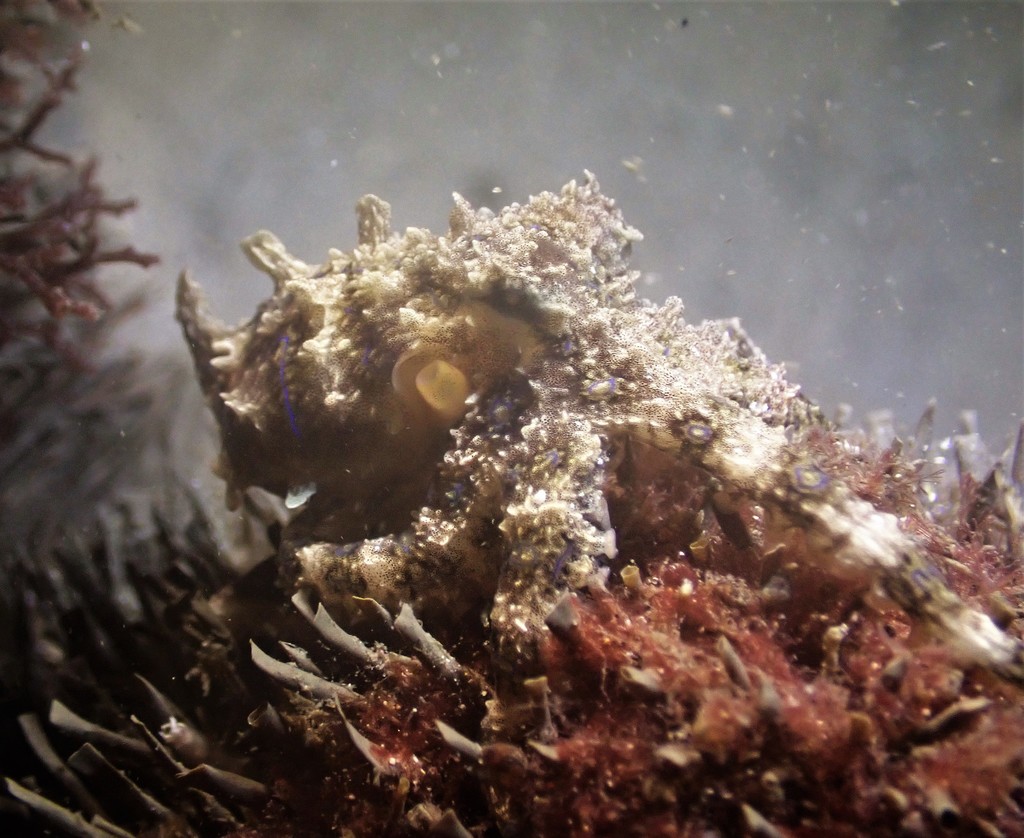
The blue-lined octopus (Hapalochlaena fasciata) is one of four species of extremely venomous blue-ringed octopuses.
- Kingdom
- Animalia
- Phylum
- Mollusca
- Class
- Cephalopoda
- Order
- Octopoda
- Family
- Octopodidae
- Genus
- Hapalochlaena
- Species
- Hapalochlaena fasciata
Description
The blue-lined octopus (Hapalochlaena fasciata) is one of four species of extremely venomous blue-ringed octopuses. It can be found in Pacific Ocean waters that stretch from Australia to Japan. It is most commonly found around intertidal rocky shores and coastal waters to a depth of 15 metres (49 ft) between southern Queensland and southern New South Wales. It is relatively small, with a mantle up to 45 millimetres (1.8 in) in length. In its relaxed state, it is a mottled yellow-brown with dark blue or black streaks covering the whole body apart from the underside of its arms, but its vibrant blue markings appear as a warning to predators when it feels threatened. Along with its other closely related species, the blue-lined octopus is regarded as one of the most dangerous animals in the sea, and its venom can be fatal to humans. This benthic octopus is one of four members of the genus Hapalochlaena, with the other species being the greater blue-ringed octopus (Hapalochlaena lunulata), southern blue-ringed octopus (Hapalochlaena maculosa), and the blue-ringed octopus (Hapalochlaena nierstraszi). The blue-lined octopus is the only species of the four to display lined iridescent blue marking, as opposed to circular iridescent blue marking that the three other species tend to exhibit.
Gallery
Ajouter des photos
Partagez vos photos de cette espèce (jusqu'à 20 à la fois) : elles sont vérifiées automatiquement, puis publiées.
Répartition
Occurrences observées (données GBIF). Les zones hors aire d'origine peuvent indiquer une présence introduite ou invasive.
Sources et crédits
Informations provenant de plusieurs sources vérifiées. Dernière mise à jour : .
Crédits photos (7)
- Photo : Peter (@fiftygrit) · CC BY-NC 4.0 · via iNaturalist
- Photo : Kelly-Anne Masterman (@drkellyannemasterman) · CC BY-NC 4.0 · via iNaturalist
- Photo : Harry Rosenthal (@harryrosenthal) · CC BY-NC 4.0 · via iNaturalist
- Photo : Rebecca Lloyd (@bexlloyd) · CC BY-NC 4.0 · via iNaturalist
- Photo : Kerryn Wood (@kerrynwood) · CC BY-NC 4.0 · via iNaturalist
- Photo : @ihunter · CC BY-NC 4.0 · via iNaturalist
- Photo : @wste2655 · CC BY-NC 4.0 · via iNaturalist
Mentions de licence
Texte disponible sous licence CC BY-SA 4.0. Il adapte notamment Wikipedia (CC BY-SA) : Blue-lined octopus (Wikipédia, auteurs dans l’historique de l’article).
- Taxonomie : GBIF Backbone Taxonomy (CC BY 4.0)
- Carte : occurrences GBIF, fond © contributeurs OpenStreetMap (ODbL)
- Statut de conservation : Liste rouge de l'UICN, via Wikidata (CC0)
Détail : Sources et licences.
Discussion (0)
Aucun message pour l’instant. Lancez la discussion sur cette fiche (sources, précisions, débats éditoriaux).
Connectez-vous pour participer à la discussion.