
Euprymna scolopes
Euprymna scolopes
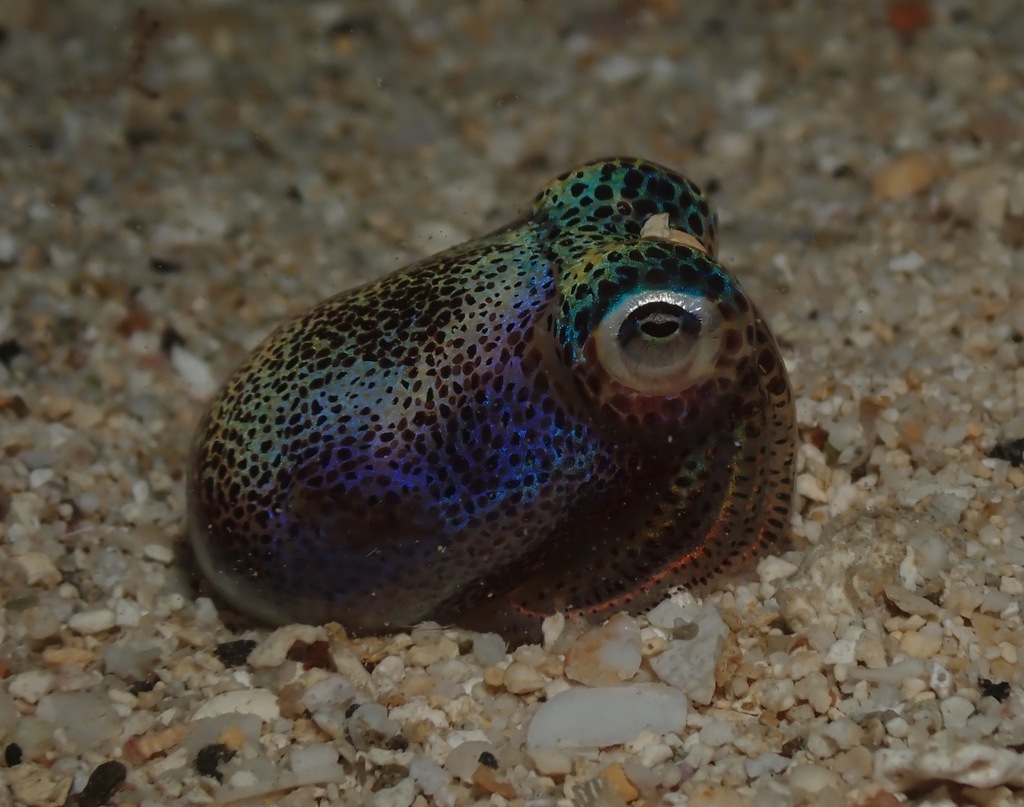
Euprymna scolopes, also known as the Hawaiian bobtail squid, is a species of bobtail squid in the family Sepiolidae native to the central Pacific Ocean, where it occurs in shallow coastal waters off the Hawaiian Islands and Midway Island.
- Kingdom
- Animalia
- Phylum
- Mollusca
- Class
- Cephalopoda
- Order
- Sepiida
- Family
- Sepiolidae
- Genus
- Euprymna
- Species
- Euprymna scolopes
Description
Euprymna scolopes, also known as the Hawaiian bobtail squid, is a species of bobtail squid in the family Sepiolidae native to the central Pacific Ocean, where it occurs in shallow coastal waters off the Hawaiian Islands and Midway Island. The type specimen was collected off the Hawaiian Islands and is located at the National Museum of Natural History in Washington, D.C. Euprymna scolopes grows to 30 mm (1.2 in) in mantle length. Hatchlings weigh 0.005 g (0.00018 oz) and mature in 80 days. Adults weigh up to 2.67 g (0.094 oz). In the wild, E. scolopes feeds on species of shrimp, including Halocaridina rubra, Palaemon debilis, and Palaemon pacificus. In the laboratory, E. scolopes has been reared on a varied diet of animals, including mysids (Anisomysis sp.), brine shrimp (Artemia salina), mosquitofish (Gambusia affinis), prawns (Leander debilis), and octopuses (Octopus cyanea). The Hawaiian monk seal (Monachus schauinslandi) preys on E. scolopes in northwestern Hawaiian waters. On June 3, 2021, SpaceX CRS-22 launched E. scolopes, along with tardigrades, to the International Space Station. The squid were launched as hatchlings and will be studied to see if they can incorporate their symbiotic bacteria Vibrio fischeri into their light organ while in space.
Gallery
Ajouter des photos
Partagez vos photos de cette espèce (jusqu'à 20 à la fois) : elles sont vérifiées automatiquement, puis publiées.
Répartition
Occurrences observées (données GBIF). Les zones hors aire d'origine peuvent indiquer une présence introduite ou invasive.
Sources et crédits
Informations provenant de plusieurs sources vérifiées. Dernière mise à jour : .
Crédits photos (6)
- Photo : Sara Thiebaud (@thiebaud) · CC BY-NC 4.0 · via iNaturalist
- Photo : Anik Grearson (@agrearson) · CC BY-NC 4.0 · via iNaturalist
- Photo : Olie Turner III (@olieturner3) · CC BY-NC 4.0 · via iNaturalist
- Photo : @jlewis0056 · CC BY-NC 4.0 · via iNaturalist
- Photo : @colinmorita · CC BY-NC 4.0 · via iNaturalist
- Photo : Olie Turner III (@olieturner3) · CC BY-NC 4.0 · via iNaturalist
Mentions de licence
Texte disponible sous licence CC BY-SA 4.0. Il adapte notamment Wikipedia (CC BY-SA) : Euprymna scolopes (Wikipédia, auteurs dans l’historique de l’article).
- Taxonomie : GBIF Backbone Taxonomy (CC BY 4.0)
- Carte : occurrences GBIF, fond © contributeurs OpenStreetMap (ODbL)
- Statut de conservation : Liste rouge de l'UICN, via Wikidata (CC0)
Détail : Sources et licences.
Discussion (0)
Aucun message pour l’instant. Lancez la discussion sur cette fiche (sources, précisions, débats éditoriaux).
Connectez-vous pour participer à la discussion.