
Giant Pacific Octopus
Enteroctopus dofleini
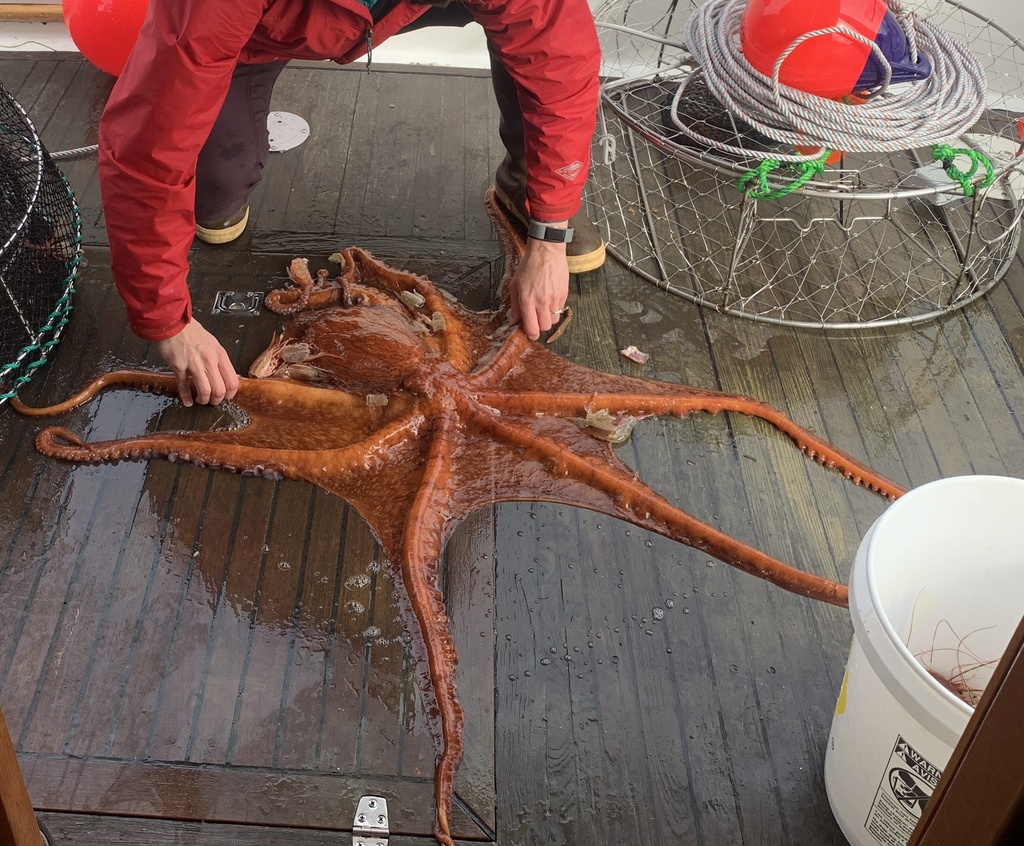
The giant Pacific octopus (Enteroctopus dofleini), also known as the North Pacific giant octopus, is a large marine cephalopod belonging to the genus Enteroctopus and Enteroctopodidae family.
- Kingdom
- Animalia
- Phylum
- Mollusca
- Class
- Cephalopoda
- Order
- Octopoda
- Family
- Enteroctopodidae
- Genus
- Enteroctopus
- Species
- Enteroctopus dofleini
Description
The giant Pacific octopus (Enteroctopus dofleini), also known as the North Pacific giant octopus, is a large marine cephalopod belonging to the genus Enteroctopus and Enteroctopodidae family. Its spatial distribution encompasses much of the coastal North Pacific, from the Mexican state of Baja California, north along the United States' West Coast (California, Oregon, Washington and Alaska, including the Aleutian Islands), and British Columbia, Canada; across the northern Pacific to the Russian Far East (Kamchatka, Sea of Okhotsk), south to the East China Sea, the Yellow Sea, the Sea of Japan, Japan's Pacific east coast, and around the Korean Peninsula. It can be found from the intertidal zone down to 2,000 m (6,600 ft), and is best-adapted to colder, oxygen- and nutrient-rich waters. It is the largest octopus species on earth and can often be found in aquariums and research facilities in addition to the ocean. E. dofleini play an important role in maintaining the health and biodiversity of deep sea ecosystems, cognitive research, and the fishing industry.
Gallery
Ajouter des photos
Partagez vos photos de cette espèce (jusqu'à 20 à la fois) : elles sont vérifiées automatiquement, puis publiées.
Répartition
Occurrences observées (données GBIF). Les zones hors aire d'origine peuvent indiquer une présence introduite ou invasive.
Sources et crédits
Informations provenant de plusieurs sources vérifiées. Dernière mise à jour : .
Crédits photos (4)
- Photo : Madison Reynolds (@madhipp) · CC BY-NC 4.0 · via iNaturalist
- Photo : Clay Steell (@claysteell) · CC BY-NC 4.0 · via iNaturalist
- Photo : @mbranfireun · CC BY-NC 4.0 · via iNaturalist
- Photo : @ilovenudis · CC BY-NC 4.0 · via iNaturalist
Mentions de licence
Texte disponible sous licence CC BY-SA 4.0. Il adapte notamment Wikipedia (CC BY-SA) : Giant Pacific octopus (Wikipédia, auteurs dans l’historique de l’article).
- Taxonomie : GBIF Backbone Taxonomy (CC BY 4.0)
- Carte : occurrences GBIF, fond © contributeurs OpenStreetMap (ODbL)
- Statut de conservation : Liste rouge de l'UICN, via Wikidata (CC0)
Détail : Sources et licences.
Discussion (0)
Aucun message pour l’instant. Lancez la discussion sur cette fiche (sources, précisions, débats éditoriaux).
Connectez-vous pour participer à la discussion.