
Black-and-white Ruffed Lemur
Varecia variegata
The black-and-white ruffed lemur (Varecia variegata) is an endangered species of ruffed lemur, one of two which are endemic to the island of Madagascar.
- Kingdom
- Animalia
- Phylum
- Chordata
- Class
- Mammalia
- Order
- Primates
- Family
- Lemuridae
- Genus
- Varecia
- Species
- Varecia variegata
Description
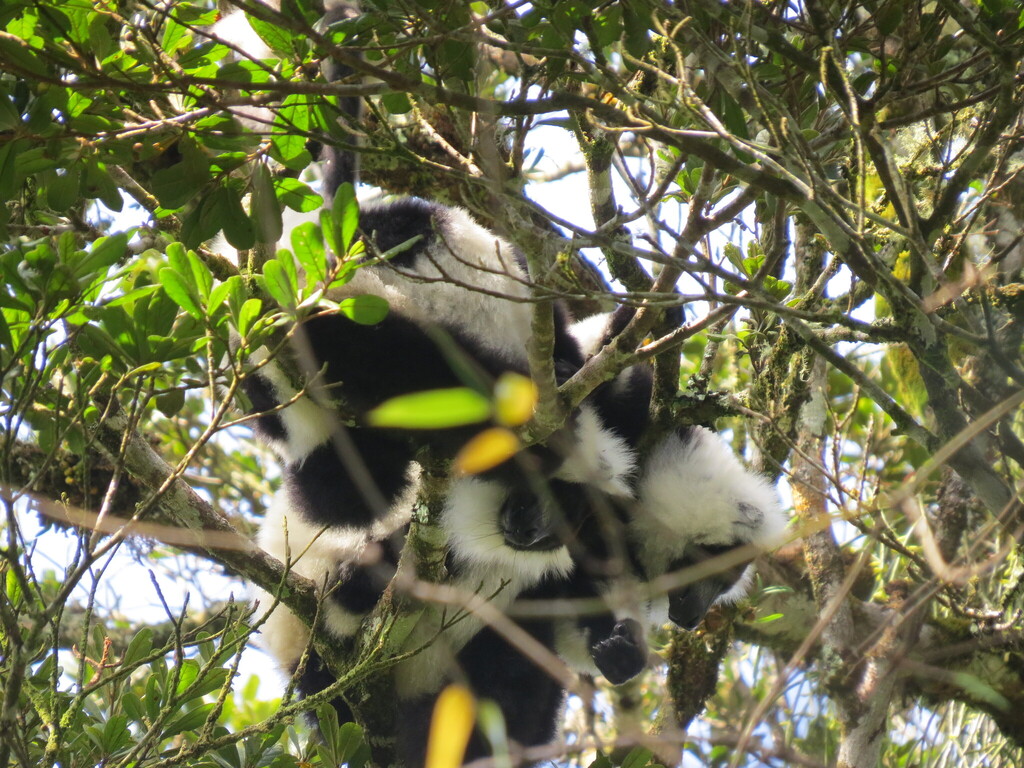
The black-and-white ruffed lemur (Varecia variegata) is an endangered species of ruffed lemur, one of two which are endemic to the island of Madagascar. Despite having a larger range than the red ruffed lemur, it has a much smaller population that is spread out, living in lower population densities and reproductively isolated. It also has less coverage and protection in large national parks than the red ruffed lemur. Three subspecies of black-and-white ruffed lemur have been recognized since the red ruffed lemur was elevated to species status in 2001. Together with the red ruffed lemur, they are the largest extant members of the family Lemuridae, ranging in length from 100 to 120 cm (39 to 47 in) and weighing between 3.1 and 4.1 kg (6.8 and 9.0 lb). They are arboreal, spending most of their time in the high canopy of the seasonal rainforests on the eastern side of the island. They are also diurnal, active exclusively in daylight hours. Quadrupedal locomotion is preferred in the trees and on the ground, and suspensory behavior is seen during feeding. As the most frugivorous of lemurs, the diet consists mainly of fruit, although nectar and flowers are also favored, followed by leaves and some seeds. The black-and-white ruffed lemur has a complex social structure and is known for its loud, raucous calls. It is unusual in that it exhibits several reproductive traits typically found in small, nocturnal lemurs, such as a short gestation period, large litters and rapid maturation. In captivity, they can live up to 36 years.
Gallery
Ajouter des photos
Partagez vos photos de cette espèce (jusqu'à 20 à la fois) : elles sont vérifiées automatiquement, puis publiées.
Répartition
Occurrences observées (données GBIF). Les zones hors aire d'origine peuvent indiquer une présence introduite ou invasive.
Sources et crédits
Informations provenant de plusieurs sources vérifiées. Dernière mise à jour : .
Crédits photos (8)
- Photo : Mick (@rmmellor) · CC BY-NC 4.0 · via iNaturalist
- Photo : @ursussierramus · CC BY-NC 4.0 · via iNaturalist
- Photo : Jurga Motiejūnaitė (@jurga_li) · CC BY-NC 4.0 · via iNaturalist
- Photo : @gbrunvoll · CC BY-NC 4.0 · via iNaturalist
- Photo : Larry H Moore (@morehus) · CC BY-NC 4.0 · via iNaturalist
- Photo : @n_armstrong · CC0 (domaine public) · via iNaturalist
- Photo : @jhp68 · CC BY-NC 4.0 · via iNaturalist
- Photo : Nicolaas Myburgh (@nicolaasmyburgh) · CC BY-NC 4.0 · via iNaturalist
Mentions de licence
Texte disponible sous licence CC BY-SA 4.0. Il adapte notamment Varecia variegata, Wikipedia (CC BY-SA) : Black-and-white ruffed lemur (Wikipédia, auteurs dans l’historique de l’article).
- Taxonomie : GBIF Backbone Taxonomy (CC BY 4.0)
- Carte : occurrences GBIF, fond © contributeurs OpenStreetMap (ODbL)
- Statut de conservation : Liste rouge de l'UICN, via Wikidata (CC0)
Détail : Sources et licences.
Discussion (0)
Aucun message pour l’instant. Lancez la discussion sur cette fiche (sources, précisions, débats éditoriaux).
Connectez-vous pour participer à la discussion.