
Common brushtail possum
Trichosurus vulpecula
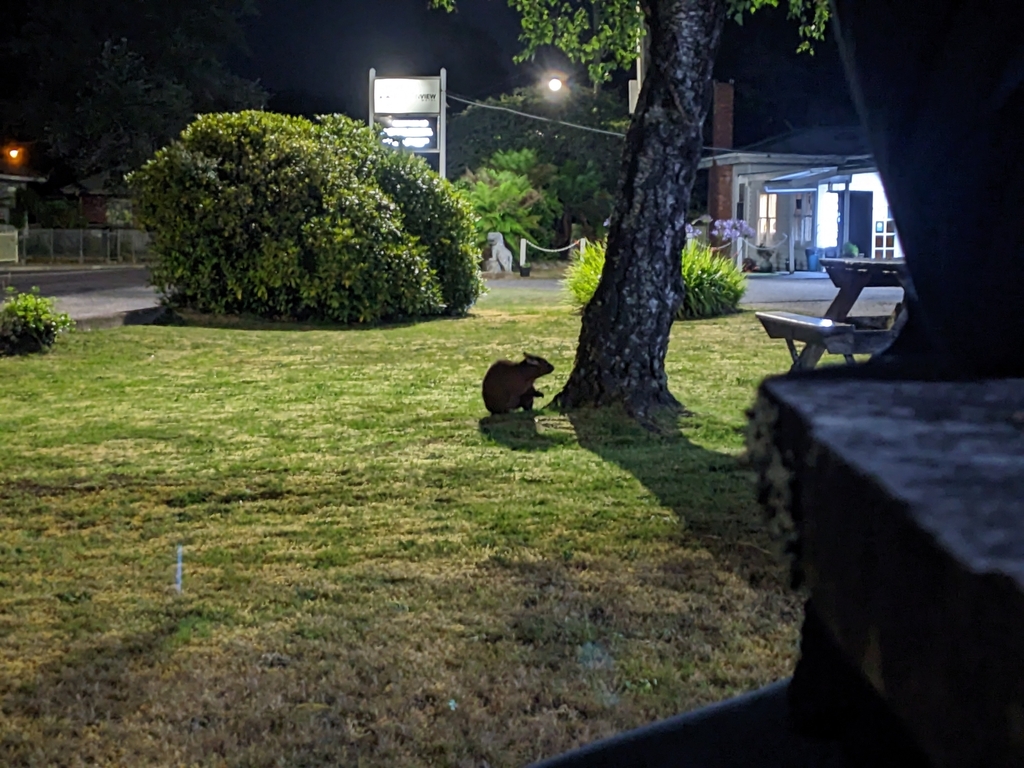
The common brushtail possum (Trichosurus vulpecula, from the Greek for "furry tailed" and the Latin for "little fox", previously in the genus Phalangista) is a nocturnal, semiarboreal marsupial of the family Phalangeridae, native to…
- Kingdom
- Animalia
- Phylum
- Chordata
- Class
- Mammalia
- Order
- Diprotodontia
- Family
- Phalangeridae
- Genus
- Trichosurus
- Species
- Trichosurus vulpecula
Description
The common brushtail possum (Trichosurus vulpecula, from the Greek for "furry tailed" and the Latin for "little fox", previously in the genus Phalangista) is a nocturnal, semiarboreal marsupial of the family Phalangeridae, native to Australia and invasive in New Zealand, and the second-largest of the Australasian possums. Like most possums, the common brushtail possum is nocturnal. It is mainly a folivore, but has been known to eat small mammals such as rats. In most Australian habitats, eucalyptus leaves are a significant part of the diet, but rarely the sole item eaten. Its tail is prehensile and naked on its lower underside. The four colour variations are silver-grey, brown, black, and gold. It is the Australian marsupial most often seen by city dwellers, as it is one of few that thrive in cities and a wide range of natural and human-modified environments. Around human habitations, common brushtails are inventive and determined foragers with a liking for fruit trees, vegetable gardens, and kitchen raids. Its once vast distribution has been greatly affected by drought, epizootic disease and intrusion of invasive mammals into its habitat. The common brushtail possum was introduced to New Zealand in the 1850s to establish a fur industry, but in the mild subtropical climate of New Zealand, and with few to no natural predators, it thrived to the extent that it became a major agricultural and conservation pest.
Gallery
Ajouter des photos
Partagez vos photos de cette espèce (jusqu'à 20 à la fois) : elles sont vérifiées automatiquement, puis publiées.
Répartition
Occurrences observées (données GBIF). Les zones hors aire d'origine peuvent indiquer une présence introduite ou invasive.
Sources et crédits
Informations provenant de plusieurs sources vérifiées. Dernière mise à jour : .
Crédits photos (7)
- Photo : Antonio (@antoniobaron) · CC BY-NC 4.0 · via iNaturalist
- Photo : Spookpadda (@spookpadda) · CC BY-NC 4.0 · via iNaturalist
- Photo : Martin Predavec (@mulgara) · CC0 (domaine public) · via iNaturalist
- Photo : Pat Neve (@patneve) · CC BY-NC 4.0 · via iNaturalist
- Photo : @sf_ · CC BY-NC 4.0 · via iNaturalist
- Photo : Joshua S. Martin (@bioshots_jm) · CC0 (domaine public) · via iNaturalist
- Photo : Caro Telfer (@carotelfer) · CC BY-NC 4.0 · via iNaturalist
Mentions de licence
Texte disponible sous licence CC BY-SA 4.0. Il adapte notamment Trichosurus vulpecula, Wikipedia (CC BY-SA) : Common brushtail possum (Wikipédia, auteurs dans l’historique de l’article).
- Taxonomie : GBIF Backbone Taxonomy (CC BY 4.0)
- Carte : occurrences GBIF, fond © contributeurs OpenStreetMap (ODbL)
- Statut de conservation : Liste rouge de l'UICN, via Wikidata (CC0)
Détail : Sources et licences.
Discussion (0)
Aucun message pour l’instant. Lancez la discussion sur cette fiche (sources, précisions, débats éditoriaux).
Connectez-vous pour participer à la discussion.