
Mountain nyala
Tragelaphus buxtoni
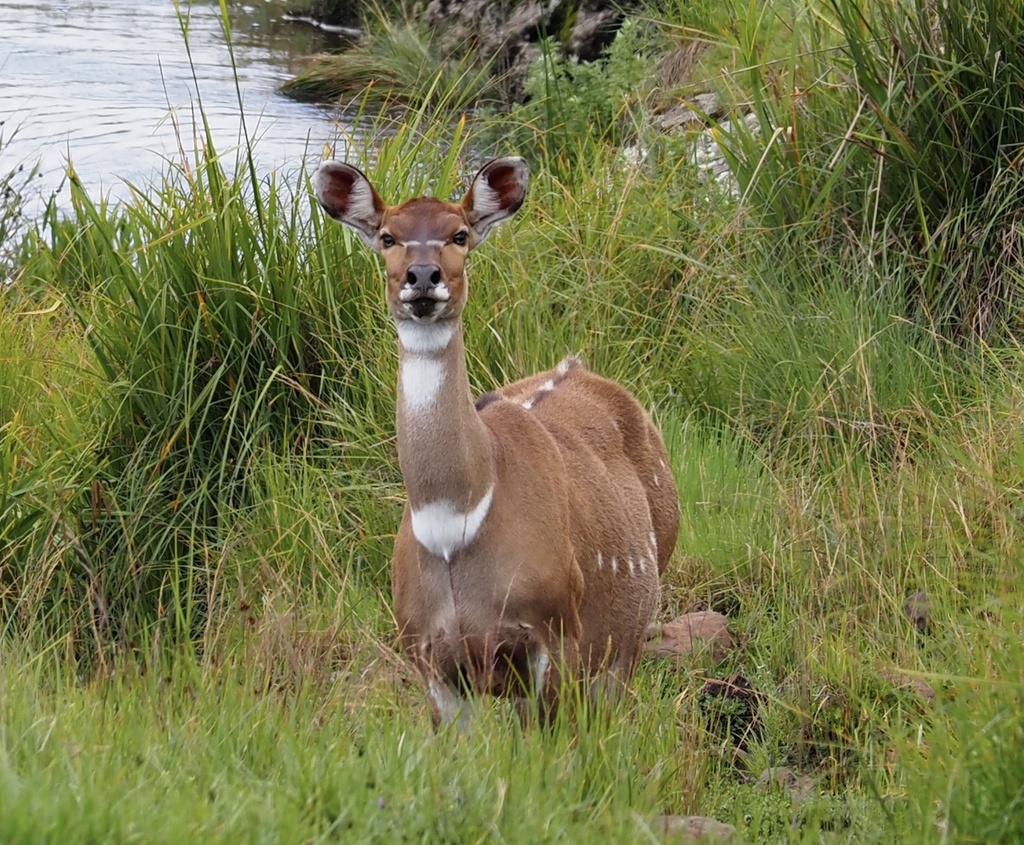
The mountain nyala (Amharic: የደጋ አጋዘን) (Tragelaphus buxtoni) or balbok, is a large antelope found in high altitude woodlands in a small part of central Ethiopia.
- Kingdom
- Animalia
- Phylum
- Chordata
- Class
- Mammalia
- Order
- Artiodactyla
- Family
- Bovidae
- Genus
- Tragelaphus
- Species
- Tragelaphus buxtoni
Description
The mountain nyala (Amharic: የደጋ አጋዘን) (Tragelaphus buxtoni) or balbok, is a large antelope found in high altitude woodlands in a small part of central Ethiopia. It is a monotypic species (without any identified subspecies) first described by English naturalist Richard Lydekker in 1910. The males are typically 120–135 cm (47–53 in) tall while females stand 90–100 cm (35–39 in) at the shoulder. Males weigh 180–300 kg (400–660 lb) and females weigh 150–200 kg (330–440 lb). The coat is grey to brown, marked with two to five poorly defined white strips extending from the back to the underside, and a row of six to ten white spots. White markings are present on the face, throat and legs as well. Males have a short dark erect crest, about 10 cm (3.9 in) high, running along the middle of the back. Only males possess horns. The mountain nyala are shy and elusive towards human beings. Four to five individuals may congregate for short intervals of time to form small herds. Males are not territorial. Primarily a browser, the mountain nyala may switch to grazing occasionally. Females start mating at two years of age, and males too become sexually mature by that time. Gestation lasts for eight to nine months, after which a single calf is born. The lifespan of a mountain nyala is around 15 to 20 years. The typical habitat for the mountain nyala is composed of montane woodlands at an altitude of 3,000–3,400 m (9,800–11,200 ft). Human settlement and large livestock population have forced the animal to occupy heath forests at an altitude of above 3,400 m (11,200 ft). Mountain nyala are endemic to the Ethiopian Highlands east of the Rift Valley, between 6°N and 10°N. Up to half of the total population of the mountain nyala occurs in the 200 km2 (77 sq mi) area of Gaysay, in the northern part of the Bale Mountains National Park. The mountain nyala has been classified under the Endangered category of the International Union for Conservation of Nature and Natural Resources (IUCN). Their influence on Ethiopian culture is notable, with the mountain nyala being featured on the obverse of Ethiopian ten cents coins.
Gallery
Ajouter des photos
Partagez vos photos de cette espèce (jusqu'à 20 à la fois) : elles sont vérifiées automatiquement, puis publiées.
Répartition
Occurrences observées (données GBIF). Les zones hors aire d'origine peuvent indiquer une présence introduite ou invasive.
Sources et crédits
Informations provenant de plusieurs sources vérifiées. Dernière mise à jour : .
Crédits photos (8)
- Photo : Michael Bierbaumer (@michael_bierbaumer) · CC BY-NC 4.0 · via iNaturalist
- Photo : @piu-piu · CC BY-NC 4.0 · via iNaturalist
- Photo : Rafael Medina (@rmedina) · CC BY 4.0 · via iNaturalist
- Photo : @vlad123 · CC BY-NC 4.0 · via iNaturalist
- Photo : Berit Gehrke (@beritgehrke) · CC BY-NC 4.0 · via iNaturalist
- Photo : @bretthartl · CC BY-NC 4.0 · via iNaturalist
- Photo : @marcdurano · CC BY-NC 4.0 · via iNaturalist
- Photo : Ned Brinkley (@nedbrinkley) · CC BY-NC 4.0 · via iNaturalist
Mentions de licence
Texte disponible sous licence CC BY-SA 4.0. Il adapte notamment Tragelaphus buxtoni, Wikipedia (CC BY-SA) : Mountain nyala (Wikipédia, auteurs dans l’historique de l’article).
- Taxonomie : GBIF Backbone Taxonomy (CC BY 4.0)
- Carte : occurrences GBIF, fond © contributeurs OpenStreetMap (ODbL)
Détail : Sources et licences.
Discussion (0)
Aucun message pour l’instant. Lancez la discussion sur cette fiche (sources, précisions, débats éditoriaux).
Connectez-vous pour participer à la discussion.