
Tiger
Panthera tigris
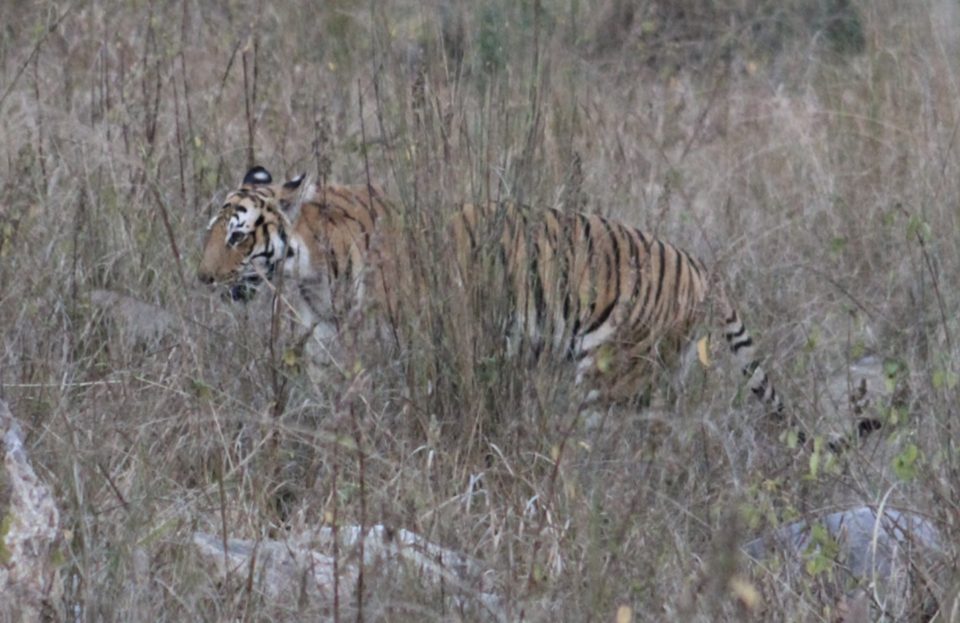
The tiger (Panthera tigris) is a large cat and a member of the genus Panthera native to Asia.
- Kingdom
- Animalia
- Phylum
- Chordata
- Class
- Mammalia
- Order
- Carnivora
- Family
- Felidae
- Genus
- Panthera
- Species
- Panthera tigris
Description
The tiger (Panthera tigris) is a large cat and a member of the genus Panthera native to Asia. It has a powerful, muscular body with a large head and paws, a long tail and orange fur that fades to white in parts, with black, mostly vertical stripes. It is traditionally classified into nine subspecies, though some recognise only two subspecies, the mainland Asian tiger and the Sunda Islands tiger. Throughout its range, it inhabits mainly forests, from coniferous and temperate broadleaf and mixed forests in the Russian Far East and Northeast China to tropical and subtropical moist broadleaf forests on the Indian subcontinent and Southeast Asia. The tiger is an apex predator and preys mainly on hooved mammals, which it takes by ambush. It lives a mostly solitary life and occupies home ranges, defending these from individuals of the same sex. The range of a male tiger overlaps with that of multiple females with whom he mates. Females give birth to usually two or three cubs that stay with their mother for about two years. When becoming independent, they leave their mother's home range and establish their own. Since the early 20th century, tiger populations have lost at least 93% of their historic range and are locally extinct in West and Central Asia, in large areas of China and on the islands of Java and Bali. Today, the tiger's range is severely fragmented. It is listed as Endangered on the IUCN Red List of Threatened Species, as its range is thought to have declined by 53% to 68% since the late 1990s. Major threats to tigers are habitat destruction and fragmentation due to deforestation, poaching for fur and the illegal trade of body parts for medicinal purposes. Tigers are also victims of human–wildlife conflict as they attack and prey on livestock in areas where natural prey is scarce. The tiger is legally protected in all range countries. National conservation measures consist of action plans, anti-poaching patrols and schemes for monitoring tiger populations. In several range countries, wildlife corridors have been established and tiger reintroduction is planned. The tiger is among the most popular of the world's charismatic megafauna. It has been kept in captivity since ancient times and has been trained to perform in circuses and other entertainment shows. The tiger featured prominently in the ancient mythology and folklore of cultures throughout its historic range and has continued to appear in culture worldwide.
Gallery
Ajouter des photos
Partagez vos photos de cette espèce (jusqu'à 20 à la fois) : elles sont vérifiées automatiquement, puis publiées.
Répartition
Occurrences observées (données GBIF). Les zones hors aire d'origine peuvent indiquer une présence introduite ou invasive.
Sources et crédits
Informations provenant de plusieurs sources vérifiées. Dernière mise à jour : .
Crédits photos (7)
- Photo : Akul Kumar · CC BY-SA 3.0
- Photo : Nikhil-SREJ · CC BY-SA 4.0
- Photo : @mirmurmel · CC BY-NC 4.0 · via iNaturalist
- Photo : Becky Brenner (@jbecky) · CC BY-NC 4.0 · via iNaturalist
- Photo : @benjamynweil · CC BY-NC 4.0 · via iNaturalist
- Photo : @annahd · CC BY-NC 4.0 · via iNaturalist
- Photo : Suman Poudel (@sumanpoudel) · CC BY-NC 4.0 · via iNaturalist
Mentions de licence
Texte disponible sous licence CC BY-SA 4.0. Il adapte notamment Wikipedia (CC BY-SA) : Tiger (Wikipédia, auteurs dans l’historique de l’article).
- Taxonomie : GBIF Backbone Taxonomy (CC BY 4.0)
- Carte : occurrences GBIF, fond © contributeurs OpenStreetMap (ODbL)
Détail : Sources et licences.
Discussion (0)
Aucun message pour l’instant. Lancez la discussion sur cette fiche (sources, précisions, débats éditoriaux).
Connectez-vous pour participer à la discussion.