
Palawan stink badger
Mydaus marchei
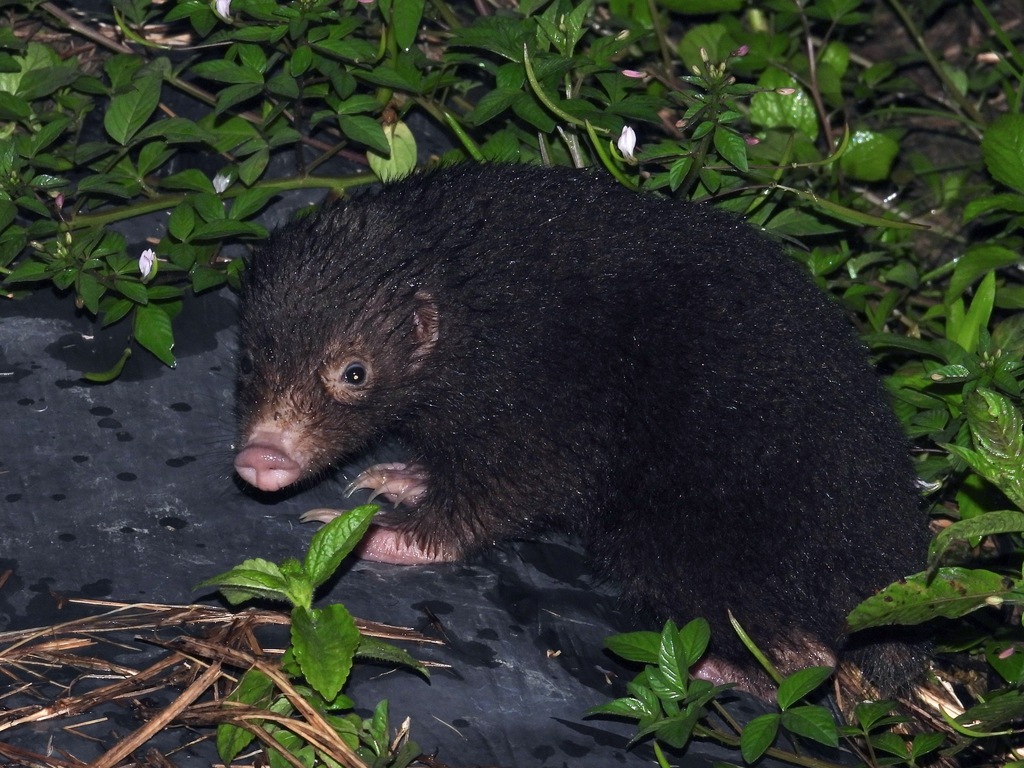
The Palawan stink badger (Mydaus marchei), pantot or tuldo in the Batak language, is a carnivoran of the western Philippines named for its resemblance to badgers, its powerful smell, and the largest island to which it is native, Palawan.
- Kingdom
- Animalia
- Phylum
- Chordata
- Class
- Mammalia
- Order
- Carnivora
- Family
- Mephitidae
- Genus
- Mydaus
- Species
- Mydaus marchei
Description
The Palawan stink badger (Mydaus marchei), pantot or tuldo in the Batak language, is a carnivoran of the western Philippines named for its resemblance to badgers, its powerful smell, and the largest island to which it is native, Palawan. Like all stink badgers, the Palawan stink badger was once thought to share a more recent common ancestor with badgers than with skunks. Recent genetic evidence, however, has led to their re-classification as one of the Mephitidae, the skunk family of mammals. It is the size of a large skunk or small badger, and uses its badger-like body to dig by night for invertebrates in open areas near patches of brush. While it lacks the whitish dorsal patches typical of its closest relatives, predators and hunters generally avoid the powerful noxious chemicals it can spray from the specialized anal glands characteristic of mephitids.
Gallery
Ajouter des photos
Partagez vos photos de cette espèce (jusqu'à 20 à la fois) : elles sont vérifiées automatiquement, puis publiées.
Répartition
Occurrences observées (données GBIF). Les zones hors aire d'origine peuvent indiquer une présence introduite ou invasive.
Sources et crédits
Informations provenant de plusieurs sources vérifiées. Dernière mise à jour : .
Crédits photos (6)
- Photo : Albert Kang (@albertkang) · CC BY-NC 4.0 · via iNaturalist
- Photo : Herwig Leinsinger (@kuya_herwig) · CC BY-NC 4.0 · via iNaturalist
- Photo : @hartwig_dellmour · CC BY-NC 4.0 · via iNaturalist
- Photo : @guydutson · CC BY-NC 4.0 · via iNaturalist
- Photo : @alexericsonlee · CC BY-NC 4.0 · via iNaturalist
- Photo : Herwig Leinsinger (@kuya_herwig) · CC BY-NC 4.0 · via iNaturalist
Mentions de licence
Texte disponible sous licence CC BY-SA 4.0. Il adapte notamment Télagon de Palawan, Wikipedia (CC BY-SA) : Palawan stink badger (Wikipédia, auteurs dans l’historique de l’article).
- Taxonomie : GBIF Backbone Taxonomy (CC BY 4.0)
- Carte : occurrences GBIF, fond © contributeurs OpenStreetMap (ODbL)
- Statut de conservation : Liste rouge de l'UICN, via Wikidata (CC0)
Détail : Sources et licences.
Discussion (0)
Aucun message pour l’instant. Lancez la discussion sur cette fiche (sources, précisions, débats éditoriaux).
Connectez-vous pour participer à la discussion.