
South American Tapir
Tapirus terrestris
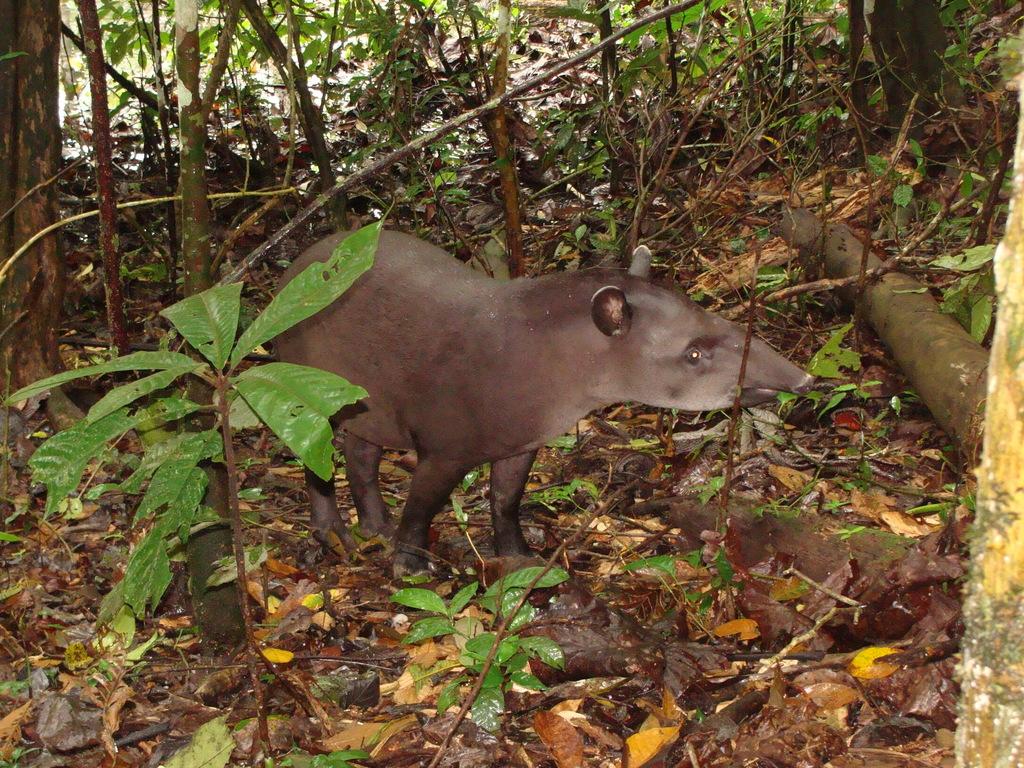
The South American tapir (Tapirus terrestris), also commonly called the Brazilian tapir (from the Tupi tapi'ira), the Amazonian tapir, the maned tapir, the lowland tapir, anta (Brazilian Portuguese), and sachavaca (literally "bushcow",…
- Kingdom
- Animalia
- Phylum
- Chordata
- Class
- Mammalia
- Order
- Perissodactyla
- Family
- Tapiridae
- Genus
- Tapirus
- Species
- Tapirus terrestris
Description
The South American tapir (Tapirus terrestris), also commonly called the Brazilian tapir (from the Tupi tapi'ira), the Amazonian tapir, the maned tapir, the lowland tapir, anta (Brazilian Portuguese), and sachavaca (literally "bushcow", in mixed Quechua and Spanish), is one of the four recognized species in the tapir family (of the order Perissodactyla, with the mountain tapir, the Malayan tapir, and the Baird's tapir). It is the largest surviving native terrestrial mammal in the Amazon. Most classifications also include Tapirus kabomani (also known as the dwarf black tapir or the kabomani tapir) as also belonging to the species Tapirus terrestris (Brazilian tapir), despite its questionable existence and the overall lack of information on its habits and distribution. The specific epithet derives from arabo kabomani, the word for tapir in the local Paumarí language. The formal description of this tapir did not suggest a common name for the species. The Karitiana people call it the little black tapir. It is, purportedly, the smallest tapir species, even smaller than the mountain tapir (T. pinchaque), which had been considered the smallest. T. kabomani is allegedly also found in the Amazon rainforest, where it appears to be sympatric with the well-known South American tapir (T. terrestris). When it was described in December of 2013, T. kabomani was the first odd-toed ungulate discovered in over 100 years. However, T. kabomani has not been officially recognized by the Tapir Specialist Group as a distinct species; recent genetic evidence further suggests it is likely a subspecies of T. terrestris. In 2024, the International Commission on Zoological Nomenclature (ICZN) has officially ruled that the binomen Tapirus pygmaeus has priority over Tapirus kabomani given that they are synonyms after a 2014 petition.
Gallery
Ajouter des photos
Partagez vos photos de cette espèce (jusqu'à 20 à la fois) : elles sont vérifiées automatiquement, puis publiées.
Répartition
Occurrences observées (données GBIF). Les zones hors aire d'origine peuvent indiquer une présence introduite ou invasive.
Sources et crédits
Informations provenant de plusieurs sources vérifiées. Dernière mise à jour : .
Crédits photos (5)
- Photo : Holger Beck (@holgerbeck) · CC BY-NC 4.0 · via iNaturalist
- Photo : @pbulman · CC BY-NC 4.0 · via iNaturalist
- Photo : KENNEDY BORGES (@kennedy-borges-road) · CC BY-NC 4.0 · via iNaturalist
- Photo : David Bree (@dbree) · CC BY-NC 4.0 · via iNaturalist
- Photo : Leonel Roget (@carancho) · CC BY 4.0 · via iNaturalist
Mentions de licence
Texte disponible sous licence CC BY-SA 4.0. Il adapte notamment Wikipedia (CC BY-SA) : South American tapir (Wikipédia, auteurs dans l’historique de l’article).
- Taxonomie : GBIF Backbone Taxonomy (CC BY 4.0)
- Carte : occurrences GBIF, fond © contributeurs OpenStreetMap (ODbL)
- Statut de conservation : Liste rouge de l'UICN, via Wikidata (CC0)
Détail : Sources et licences.
Discussion (0)
Aucun message pour l’instant. Lancez la discussion sur cette fiche (sources, précisions, débats éditoriaux).
Connectez-vous pour participer à la discussion.