
Swamp Rabbit
Sylvilagus aquaticus
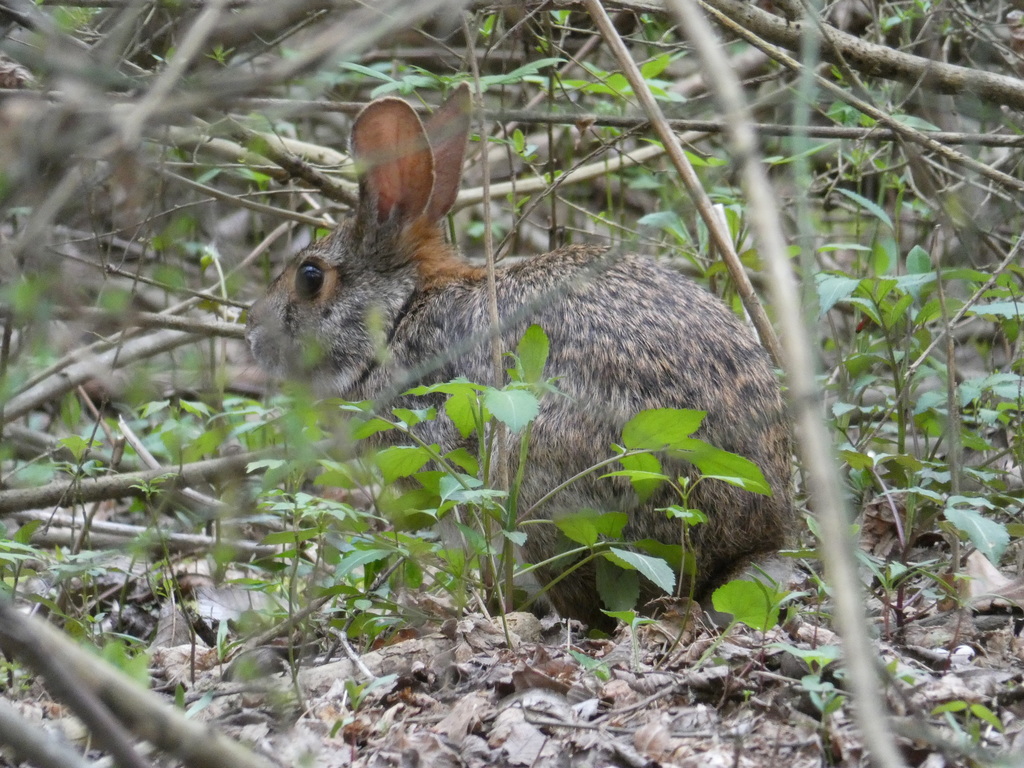
The swamp rabbit (Sylvilagus aquaticus), also known as the cane cutter, swamper, or cane jake, is a species of cottontail rabbit found in the swamps and wetlands of the southern United States.
- Kingdom
- Animalia
- Phylum
- Chordata
- Class
- Mammalia
- Order
- Lagomorpha
- Family
- Leporidae
- Genus
- Sylvilagus
- Species
- Sylvilagus aquaticus
Description
The swamp rabbit (Sylvilagus aquaticus), also known as the cane cutter, swamper, or cane jake, is a species of cottontail rabbit found in the swamps and wetlands of the southern United States. It is herbivorous, territorial, and nocturnal. The largest of the cottontail rabbits, it is similar in appearance to the eastern cottontail, but has distinctly smaller ears and orange-colored hind legs. Swamp rabbits are closely related to the marsh rabbit. The two species likely separated during the Pleistocene epoch. The swamp rabbit is most abundant in Alabama, Mississippi, and Louisiana, and also inhabits South Carolina, Arkansas, Tennessee, Texas, Oklahoma, Missouri, Kentucky, Illinois, Indiana, Georgia. Its habitat is largely dominated by regions near lowland water. Unlike other cottontail rabbits, the swamp rabbit is territorial and maintains a social order between higher- and lower-ranking males and females via displays of dominance, vocalizations, and occasional fighting. This rabbit is unique in that it ventures into water on its own, unlike other Texas rabbits, and is rarely spotted during the day due to its secretive nature. When threatened, it will take to water and swim. Swamp rabbits in a given population usually breed around the same time, giving birth to young that are born blind, immobile, and completely dependent for the first few days. Their nests-called forms-are lined with fur and grass. Each litter produces one to six young. The breeding season varies across the species' range: In Texas, the breeding season lasts all year, but elsewhere occurs between February and August. Predators, parasites, and human interaction pose threats to the swamp rabbit. Dogs, American alligators, and feral pigs prey upon the swamp rabbit, and it is a potential host to several parasites such as roundworms, flukes, and the rabbit tick. The swamp rabbit is also affected by tularemia, an infectious disease. It is hunted for its meat and fur, and faces habitat loss due to expansion of agricultural developments that both remove usable habitat and cause frequent flooding. The International Union for Conservation of Nature lists it as a least-concern species, but in some states it is protected as a vulnerable or special concern species.
Gallery
Ajouter des photos
Partagez vos photos de cette espèce (jusqu'à 20 à la fois) : elles sont vérifiées automatiquement, puis publiées.
Répartition
Occurrences observées (données GBIF). Les zones hors aire d'origine peuvent indiquer une présence introduite ou invasive.
Sources et crédits
Informations provenant de plusieurs sources vérifiées. Dernière mise à jour : .
Crédits photos (8)
- Photo : @jefferykarafa · CC BY-NC 4.0 · via iNaturalist
- Photo : Claire O'Neill (@akilee) · CC BY-NC 4.0 · via iNaturalist
- Photo : @swilk-2 · CC BY-NC 4.0 · via iNaturalist
- Photo : Janet Wright (@janetwright) · CC BY-NC 4.0 · via iNaturalist
- Photo : Isaac Eastland (@isaaceastland) · CC BY-NC 4.0 · via iNaturalist
- Photo : @duncanbishop24 · CC BY-NC 4.0 · via iNaturalist
- Photo : @ctrtl57 · CC BY-NC 4.0 · via iNaturalist
- Photo : Erik Atwell (@erikatwell) · CC BY-NC 4.0 · via iNaturalist
Mentions de licence
Texte disponible sous licence CC BY-SA 4.0. Il adapte notamment Sylvilagus aquaticus, Wikipedia (CC BY-SA) : Swamp rabbit (Wikipédia, auteurs dans l’historique de l’article).
- Taxonomie : GBIF Backbone Taxonomy (CC BY 4.0)
- Carte : occurrences GBIF, fond © contributeurs OpenStreetMap (ODbL)
- Statut de conservation : Liste rouge de l'UICN, via Wikidata (CC0)
Détail : Sources et licences.
Discussion (0)
Aucun message pour l’instant. Lancez la discussion sur cette fiche (sources, précisions, débats éditoriaux).
Connectez-vous pour participer à la discussion.