
Stripe-faced Dunnart
Sminthopsis macroura
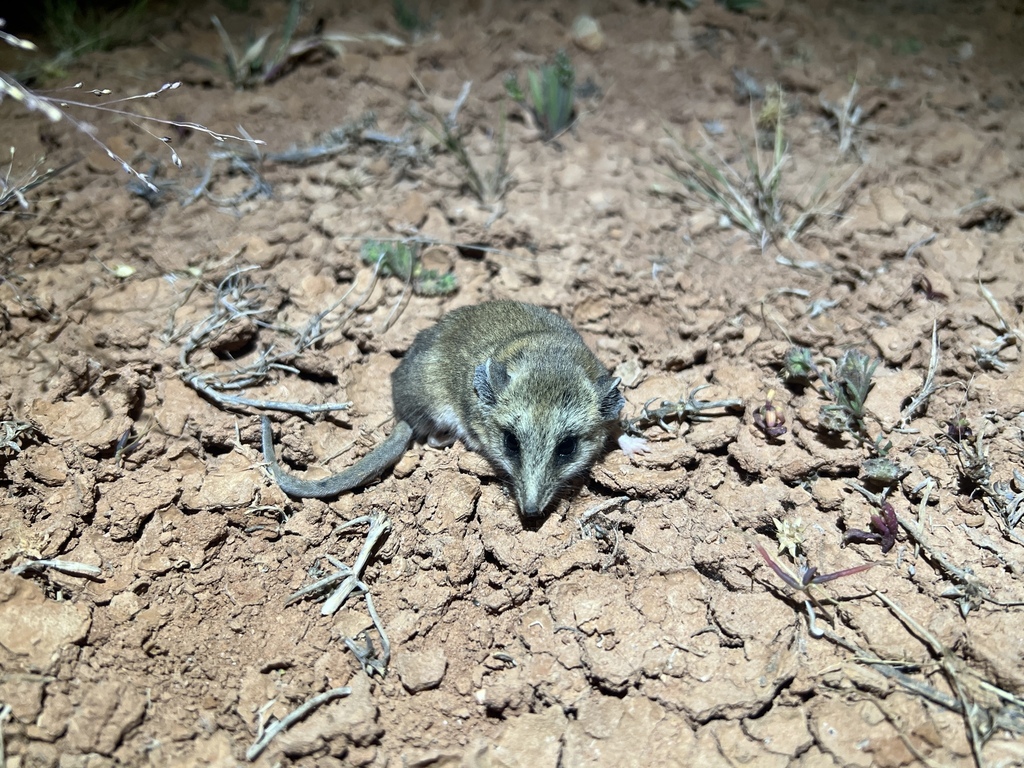
The striped-faced dunnart (Sminthopsis macroura) is a small, Australian, nocturnal, "marsupial mouse," part of the family Dasyuridae.
- Kingdom
- Animalia
- Phylum
- Chordata
- Class
- Mammalia
- Order
- Dasyuromorphia
- Family
- Dasyuridae
- Genus
- Sminthopsis
- Species
- Sminthopsis macroura
Description
The striped-faced dunnart (Sminthopsis macroura) is a small, Australian, nocturnal, "marsupial mouse," part of the family Dasyuridae. The species' distribution occurs throughout much of inland central and northern Australia, occupying a range of arid and semi-arid habitats. While the species has a broad distribution range, it has been declining across much of Australia, including the western region of New South Wales (NSW). This is due to several threatening processes, primarily habitat degradation. This has led to the NSW Office of Environment and Heritage listing the species as 'vulnerable'. The species is not listed on the Environment Protection and Biodiversity Conservation Act 1999 (EPBC Act). The International Union for Conservation of Nature (IUCN) Red List of Threatened Species list the species as of 'least concern'. Recent genetic studies have discovered that this dunnart species is in fact three distinct species that over several million years diverged from each other. However, because they are difficult to distinguish, they tend to be treated as a single species. The three subspecies are as follows: Sminthopsis macroura macroura in central, eastern, and western Australia S.m. stalkeri in central northern Australia S.m. froggatti in the Kimberley region
Gallery
Ajouter des photos
Partagez vos photos de cette espèce (jusqu'à 20 à la fois) : elles sont vérifiées automatiquement, puis publiées.
Répartition
Occurrences observées (données GBIF). Les zones hors aire d'origine peuvent indiquer une présence introduite ou invasive.
Sources et crédits
Informations provenant de plusieurs sources vérifiées. Dernière mise à jour : .
Crédits photos (8)
- Photo : @jbilby · CC BY-NC 4.0 · via iNaturalist
- Photo : @kenty_8881 · CC BY-NC 4.0 · via iNaturalist
- Photo : Pete Woodall (@nyoni-pete) · CC BY-NC 4.0 · via iNaturalist
- Photo : Daniel Terrington (@daniel_terrington) · CC BY-NC 4.0 · via iNaturalist
- Photo : @floralou · CC BY-NC 4.0 · via iNaturalist
- Photo : Nathan Ruser (@nrg800) · CC BY 4.0 · via iNaturalist
- Photo : Julian Teh (@julianteh) · CC BY-NC 4.0 · via iNaturalist
- Photo : @rufusgrandis · CC BY-NC 4.0 · via iNaturalist
Mentions de licence
Texte disponible sous licence CC BY-SA 4.0. Il adapte notamment Sminthopsis macroura, Wikipedia (CC BY-SA) : Stripe-faced dunnart (Wikipédia, auteurs dans l’historique de l’article).
- Taxonomie : GBIF Backbone Taxonomy (CC BY 4.0)
- Carte : occurrences GBIF, fond © contributeurs OpenStreetMap (ODbL)
- Statut de conservation : Liste rouge de l'UICN, via Wikidata (CC0)
Détail : Sources et licences.
Discussion (0)
Aucun message pour l’instant. Lancez la discussion sur cette fiche (sources, précisions, débats éditoriaux).
Connectez-vous pour participer à la discussion.