
Black-handed spider monkey
Ateles geoffroyi
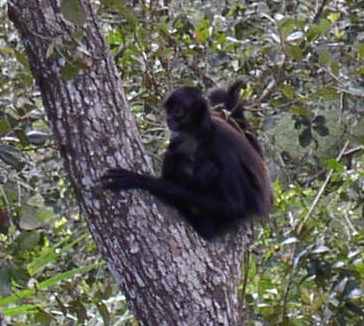
Geoffroy's spider monkey (Ateles geoffroyi), also known as the black-handed spider monkey or the Central American spider monkey, is a species of spider monkey, a type of New World monkey, from Central America, parts of Mexico and…
- Kingdom
- Animalia
- Phylum
- Chordata
- Class
- Mammalia
- Order
- Primates
- Family
- Atelidae
- Genus
- Ateles
- Species
- Ateles geoffroyi
Description
Geoffroy's spider monkey (Ateles geoffroyi), also known as the black-handed spider monkey or the Central American spider monkey, is a species of spider monkey, a type of New World monkey, from Central America, parts of Mexico and possibly a small portion of Colombia. There are at least five subspecies. Some primatologists classify the black-headed spider monkey (A. fusciceps), found in Panama, Colombia, and Ecuador as the same species as Geoffroy's spider monkey. It is one of the largest New World monkeys, often weighing as much as 9 kg (20 lb). Its arms are significantly longer than its legs, and its prehensile tail can support the entire weight of the monkey and is used as an extra limb. Its hands have only a vestigial thumb, but long, strong, hook-like fingers. These adaptations allow the monkey to move by swinging by its arms beneath the tree branches. Geoffroy's spider monkey lives in fission–fusion societies that contain between 20 and 42 members. Its diet consists primarily of ripe fruit and it requires large tracts of forest to survive. As a result of habitat loss, hunting and capture for the pet trade, it is considered to be endangered by the IUCN.
Gallery
Ajouter des photos
Partagez vos photos de cette espèce (jusqu'à 20 à la fois) : elles sont vérifiées automatiquement, puis publiées.
Répartition
Occurrences observées (données GBIF). Les zones hors aire d'origine peuvent indiquer une présence introduite ou invasive.
Sources et crédits
Informations provenant de plusieurs sources vérifiées. Dernière mise à jour : .
Crédits photos (10)
- Photo : --Sapphic · CC BY-SA 3.0
- Photo : Sapphic at English Wikipedia · CC BY-SA 3.0 · via Wikimedia Commons
- Photo : Tim Ross · Domaine public
- Photo : Joxerra aihartza · CC BY-SA 3.0
- Photo : Roger Le Guen · CC BY-SA 2.0
- Photo : @isabell_10 · CC BY-NC 4.0 · via iNaturalist
- Photo : Daniel Martínez Galíndez (@dani_mg) · CC BY-NC 4.0 · via iNaturalist
- Photo : @leuli · CC BY-NC 4.0 · via iNaturalist
- Photo : @jpmy13 · CC BY-NC 4.0 · via iNaturalist
- Photo : Michele Reniche (@michele38) · CC BY-NC 4.0 · via iNaturalist
Mentions de licence
Texte disponible sous licence CC BY-SA 4.0. Il adapte notamment Singe-araignée de Geoffroy, Wikipedia (CC BY-SA) : Geoffroy's spider monkey (Wikipédia, auteurs dans l’historique de l’article).
- Taxonomie : GBIF Backbone Taxonomy (CC BY 4.0)
- Carte : occurrences GBIF, fond © contributeurs OpenStreetMap (ODbL)
Détail : Sources et licences.
Discussion (0)
Aucun message pour l’instant. Lancez la discussion sur cette fiche (sources, précisions, débats éditoriaux).
Connectez-vous pour participer à la discussion.