
Pig-tailed langur
Simias concolor
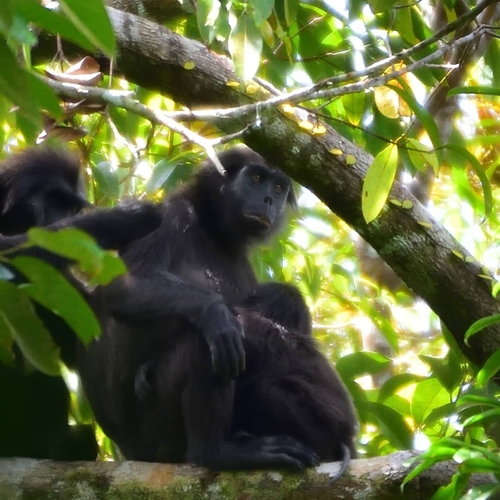
The pig-tailed langur (Simias concolor), monotypic in genus Simias, is a large Old World monkey, endemic to several small islands off the coast of Sumatra in Indonesia.
- Kingdom
- Animalia
- Phylum
- Chordata
- Class
- Mammalia
- Order
- Primates
- Family
- Cercopithecidae
- Genus
- Simias
- Species
- Simias concolor
Description
The pig-tailed langur (Simias concolor), monotypic in genus Simias, is a large Old World monkey, endemic to several small islands off the coast of Sumatra in Indonesia. Its face is black, its fur is black-brown and it has a relatively short tail. It is a diurnal species, feeding in the rainforest canopy on leaves, and to a lesser extent, fruit and berries. Little is known of its natural history, but it is heavily hunted, its populations have been declining rapidly and the International Union for Conservation of Nature has assessed its conservation status as being "critically endangered". It has been included on a list of the World's 25 Most Endangered Primates. As an arboreal primate the pig-tailed langur spends most of its time in the canopy devoting the majority of its activity budget towards resting and feeding. The structure of groups is single-male, multi-female. Group sizes range from around 3 to 9 individuals depending on locations and hunting pressures. There are two subspecies of this primate, Simias concolor concolor which lives in the southern Mentawai islands, and Simias concolor siberu which lives exclusively in the northern island of Siberut. Sexual dimorphism and sexual swelling is exhibited by this species. Population estimates from the 1980s compared to data from the 2000s show a decrease in population size. The northern island of Siberut shows a greater abundance of this species in comparison to the southern Mentawai islands. This can largely be attributed to the difference in conservation efforts as much of northern Siberut has been declared a national park whereas the southern islands have historically been devastated by commercial logging. This species is subject to hunting by local inhabitants. The reduction in forest cover has allowed for greater levels of human activity and settlement which facilitates hunting, especially in the southern islands where most areas are unprotected.
Gallery
Ajouter des photos
Partagez vos photos de cette espèce (jusqu'à 20 à la fois) : elles sont vérifiées automatiquement, puis publiées.
Répartition
Occurrences observées (données GBIF). Les zones hors aire d'origine peuvent indiquer une présence introduite ou invasive.
Sources et crédits
Informations provenant de plusieurs sources vérifiées. Dernière mise à jour : .
Crédits photos (3)
- Photo : (c) mark_spence, some rights reserved (CC BY-NC), uploaded by mark_spence · CC BY-NC 4.0 · via iNaturalist
- Photo : Monkey93 (@monkey93) · CC BY-NC 4.0 · via iNaturalist
- Photo : James Eaton (@james_birdtourasia) · CC0 (domaine public) · via iNaturalist
Mentions de licence
Texte disponible sous licence CC BY-SA 4.0. Il adapte notamment Simias concolor, Wikipedia (CC BY-SA) : Pig-tailed langur (Wikipédia, auteurs dans l’historique de l’article).
- Taxonomie : GBIF Backbone Taxonomy (CC BY 4.0)
- Carte : occurrences GBIF, fond © contributeurs OpenStreetMap (ODbL)
- Statut de conservation : Liste rouge de l'UICN, via Wikidata (CC0)
Détail : Sources et licences.
Discussion (0)
Aucun message pour l’instant. Lancez la discussion sur cette fiche (sources, précisions, débats éditoriaux).
Connectez-vous pour participer à la discussion.