
Serval
Leptailurus serval
The serval (Leptailurus serval) is a wild small cat native to Africa.
- Kingdom
- Animalia
- Phylum
- Chordata
- Class
- Mammalia
- Order
- Carnivora
- Family
- Felidae
- Genus
- Leptailurus
- Species
- Leptailurus serval
Description
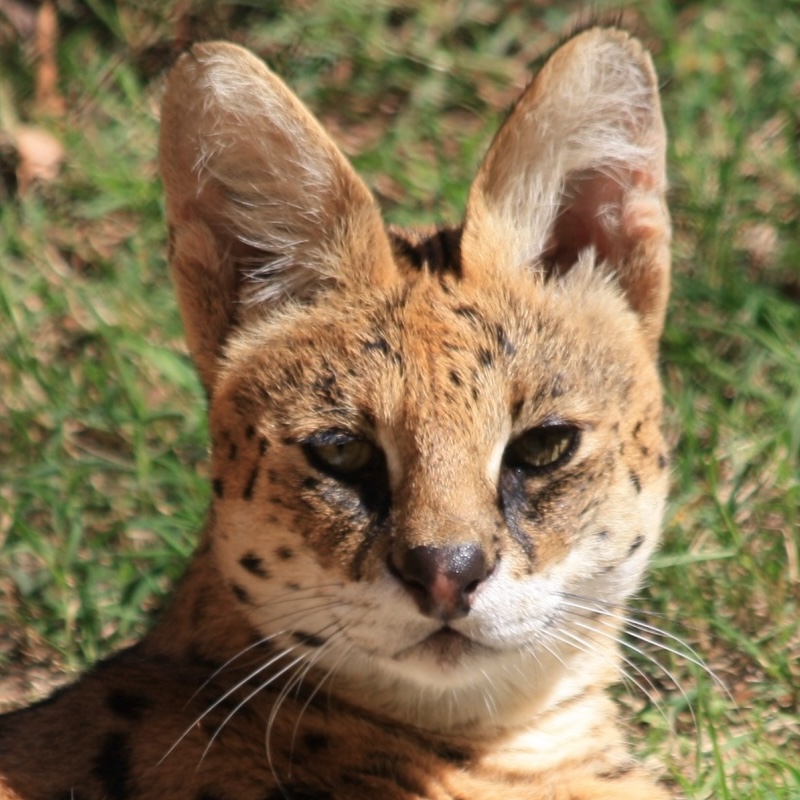
The serval (Leptailurus serval) is a wild small cat native to Africa. It is widespread in sub-Saharan countries, where it inhabits grasslands, wetlands, moorlands and bamboo thickets. Across its range, it occurs in protected areas, and hunting it is either prohibited or regulated in range countries. It is the sole member of the genus Leptailurus. Three subspecies are recognised. The serval is a slender, medium-sized cat that stands 54–62 cm (21–24 in) tall at the shoulder and has a weight range of approximately 9–18 kg (20–40 lb). It is characterised by a small head, large ears, a golden-yellow to buff coat spotted and striped with black, and a short, black-tipped tail. The serval has the longest legs of any cat relative to its body size. The serval is a solitary carnivore and active both by day and at night. It preys on rodents, particularly vlei rats, small birds, frogs, insects, and reptiles, using its hearing to locate prey. It leaps over 2 m (6 ft 7 in) above the ground to land on the prey on its forefeet, and kills it with a bite to the neck or the head. Both sexes establish highly overlapping home ranges of 10 to 32 km2 (3.9 to 12.4 sq mi), and mark them with feces and saliva. Mating takes place at different times of the year in different parts of their range, but typically once or twice a year in an area. After a gestational period of two to three months, a litter of one to four kittens is born. They are weaned at the age of one month and begin hunting on their own at six months of age. They leave their mother at the age of around 12 months.
Gallery
Ajouter des photos
Partagez vos photos de cette espèce (jusqu'à 20 à la fois) : elles sont vérifiées automatiquement, puis publiées.
Répartition
Occurrences observées (données GBIF). Les zones hors aire d'origine peuvent indiquer une présence introduite ou invasive.
Sources et crédits
Informations provenant de plusieurs sources vérifiées. Dernière mise à jour : .
Crédits photos (6)
- Photo : Sheila Brown · CC0 (domaine public)
- Photo : @bauer_lion · CC BY-NC 4.0 · via iNaturalist
- Photo : Mathias D'haen (@mathiasdhaen) · CC BY-NC 4.0 · via iNaturalist
- Photo : @joysglobal · CC BY-NC 4.0 · via iNaturalist
- Photo : @sventheentomologist · CC BY-NC 4.0 · via iNaturalist
- Photo : Alyssa Semerdjian (@asemerdj) · CC BY-NC 4.0 · via iNaturalist
Mentions de licence
Texte disponible sous licence CC BY-SA 4.0. Il adapte notamment Wikipedia (CC BY-SA) : Serval (Wikipédia, auteurs dans l’historique de l’article).
- Taxonomie : GBIF Backbone Taxonomy (CC BY 4.0)
- Carte : occurrences GBIF, fond © contributeurs OpenStreetMap (ODbL)
- Statut de conservation : Liste rouge de l'UICN, via Wikidata (CC0)
Détail : Sources et licences.
Discussion (0)
Aucun message pour l’instant. Lancez la discussion sur cette fiche (sources, précisions, débats éditoriaux).
Connectez-vous pour participer à la discussion.