
Saola
Pseudoryx nghetinhensis
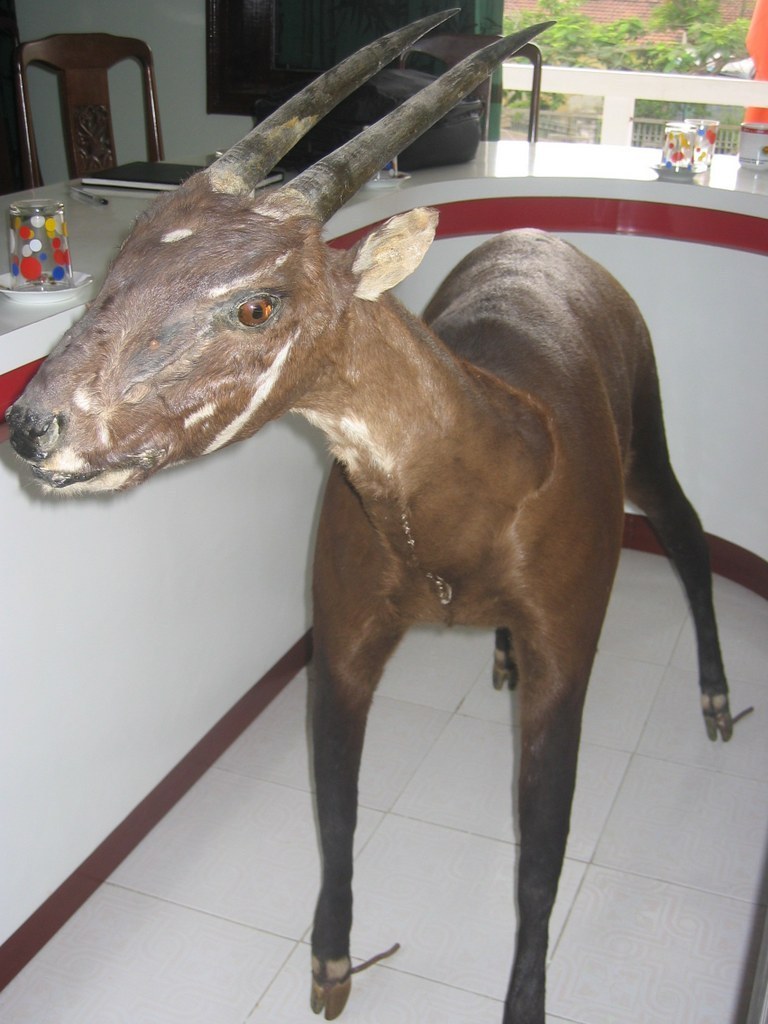
The saola (Pseudoryx nghetinhensis), also called the spindlehorn, Asian unicorn, or infrequently, Vũ Quang bovid, is a forest-dwelling bovid native to the Annamite Range in Vietnam and Laos.
- Kingdom
- Animalia
- Phylum
- Chordata
- Class
- Mammalia
- Order
- Artiodactyla
- Family
- Bovidae
- Genus
- Pseudoryx
- Species
- Pseudoryx nghetinhensis
Description
The saola (Pseudoryx nghetinhensis), also called the spindlehorn, Asian unicorn, or infrequently, Vũ Quang bovid, is a forest-dwelling bovid native to the Annamite Range in Vietnam and Laos. It was first described in 1993 following a discovery of remains in Vũ Quang National Park by a joint survey of the Vietnamese Ministry of Forestry and the World Wide Fund for Nature, Saolas have since been kept in captivity multiple times, although only for short periods as they died within a matter of weeks to months. Saola live in restricted areas of high-altitude wet evergreen forest and have probably always had a relatively low population density. The first photograph of a living saola was taken in captivity in 1993. The most recent one was taken in 2013 by a movement-triggered camera in the forest of central Vietnam, which represents the most recent record of the saola. The saola is listed as critically endangered by the IUCN, being heavily threatened by snares intended to trap other animals within their forest habitat and to a lesser extent by habitat destruction, with an estimated population of 50–300 individuals as of 2015. There is concern that the species may already be extinct, and even if individuals are still alive, extinction has been described as "inevitable" within 10 years from 2025 without intervention. The saola is the only species in the genus Pseudoryx and the earliest diverging member of the tribe Bovini, placing buffalo and cattle as its closest relatives.
Ajouter des photos
Partagez vos photos de cette espèce (jusqu'à 20 à la fois) : elles sont vérifiées automatiquement, puis publiées.
Répartition
Occurrences observées (données GBIF). Les zones hors aire d'origine peuvent indiquer une présence introduite ou invasive.
Sources et crédits
Informations provenant de plusieurs sources vérifiées. Dernière mise à jour : .
Crédits photos (1)
- Photo : James Hardcastle (@surfbirder) · CC BY 4.0 · via iNaturalist
Mentions de licence
Texte disponible sous licence CC BY-SA 4.0. Il adapte notamment Saola, Wikipedia (CC BY-SA) : Saola (Wikipédia, auteurs dans l’historique de l’article).
- Taxonomie : GBIF Backbone Taxonomy (CC BY 4.0)
- Carte : occurrences GBIF, fond © contributeurs OpenStreetMap (ODbL)
- Statut de conservation : Liste rouge de l'UICN, via Wikidata (CC0)
Détail : Sources et licences.
Discussion (0)
Aucun message pour l’instant. Lancez la discussion sur cette fiche (sources, précisions, débats éditoriaux).
Connectez-vous pour participer à la discussion.