
Central American Squirrel Monkey
Saimiri oerstedii
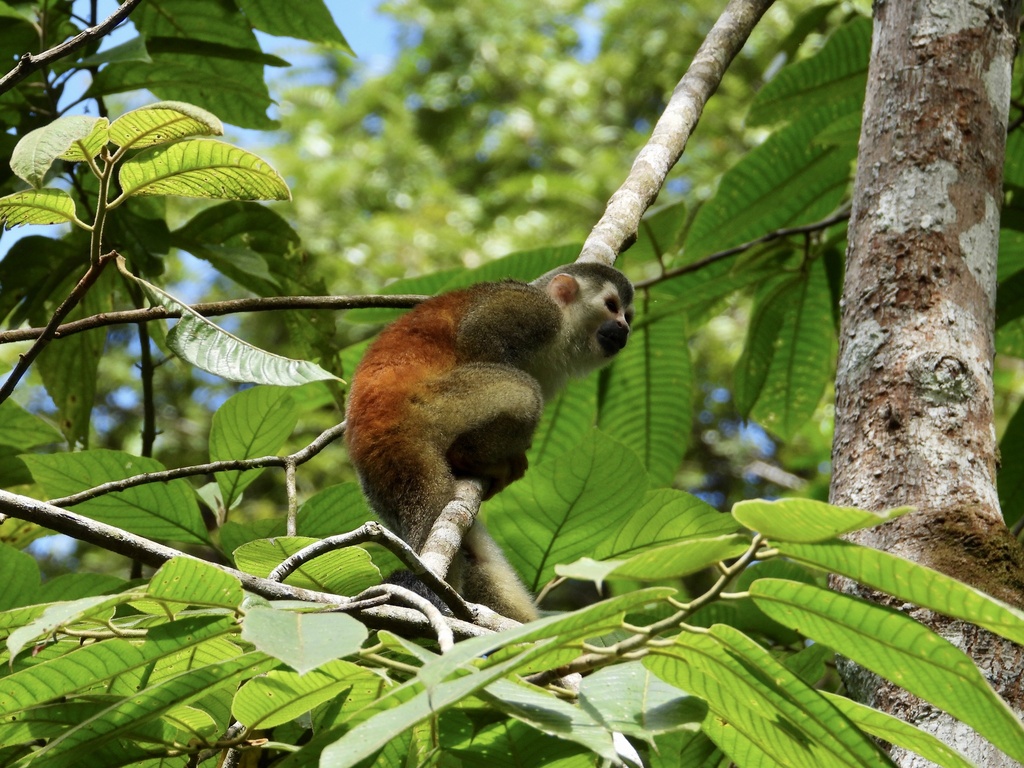
The Central American squirrel monkey (Saimiri oerstedii), also known as the red-backed squirrel monkey, is a squirrel monkey species from the Pacific coast of Costa Rica and Panama.
- Kingdom
- Animalia
- Phylum
- Chordata
- Class
- Mammalia
- Order
- Primates
- Family
- Cebidae
- Genus
- Saimiri
- Species
- Saimiri oerstedii
Description
The Central American squirrel monkey (Saimiri oerstedii), also known as the red-backed squirrel monkey, is a squirrel monkey species from the Pacific coast of Costa Rica and Panama. It is restricted to the northwestern tip of Panama near the border with Costa Rica, and the central and southern Pacific coast of Costa Rica, primarily in Manuel Antonio and Corcovado National Parks. It is a small monkey with an orange back and a distinctive white and black facial mask. It has an omnivorous diet, eating fruits, other plant materials, invertebrates and some small vertebrates. In turn, it has a number of predators, including raptors, cats and snakes. It lives in large groups that typically contain between 20 and 75 monkeys. It has one of the most egalitarian social structures of all monkeys. Females do not form dominance hierarchies, and males do so only at breeding season. Females become sexually mature at 2+1⁄2 years, and males at 4 to 5 years. Sexually mature females leave the natal group, but males can remain with their natal group their entire life. The Central American squirrel monkey can live for more than 15 years. The Central American squirrel monkey population declined precipitously after the 1970s. This decline is believed to be caused by deforestation, hunting, and capture to be kept as pets. Efforts are underway to preserve the species.
Gallery
Ajouter des photos
Partagez vos photos de cette espèce (jusqu'à 20 à la fois) : elles sont vérifiées automatiquement, puis publiées.
Répartition
Occurrences observées (données GBIF). Les zones hors aire d'origine peuvent indiquer une présence introduite ou invasive.
Sources et crédits
Informations provenant de plusieurs sources vérifiées. Dernière mise à jour : .
Crédits photos (8)
- Photo : Joel Chamberlain (@naturenerd_joel) · CC BY-NC 4.0 · via iNaturalist
- Photo : Ricardo Rodero Henández (@ricardo-anapri) · CC BY-NC 4.0 · via iNaturalist
- Photo : @toucan_sam · CC BY-NC 4.0 · via iNaturalist
- Photo : Jasen Liu (@jasen_liu) · CC BY-NC 4.0 · via iNaturalist
- Photo : @lola_crassulaceae_sp · CC BY-NC 4.0 · via iNaturalist
- Photo : @floris_heemskerk · CC BY-NC 4.0 · via iNaturalist
- Photo : Alex Damiano (@adamiano531) · CC BY-NC 4.0 · via iNaturalist
- Photo : Nicolas Lagière (@surfelife) · CC BY-NC 4.0 · via iNaturalist
Mentions de licence
Texte disponible sous licence CC BY-SA 4.0. Il adapte notamment Saimiri oerstedii, Wikipedia (CC BY-SA) : Central American squirrel monkey (Wikipédia, auteurs dans l’historique de l’article).
- Taxonomie : GBIF Backbone Taxonomy (CC BY 4.0)
- Carte : occurrences GBIF, fond © contributeurs OpenStreetMap (ODbL)
Détail : Sources et licences.
Discussion (0)
Aucun message pour l’instant. Lancez la discussion sur cette fiche (sources, précisions, débats éditoriaux).
Connectez-vous pour participer à la discussion.