
Greater Sac-winged Bat
Saccopteryx bilineata
The greater sac-winged bat (Saccopteryx bilineata) is a bat of the family Emballonuridae native to Central and South America.
- Kingdom
- Animalia
- Phylum
- Chordata
- Class
- Mammalia
- Order
- Chiroptera
- Family
- Emballonuridae
- Genus
- Saccopteryx
- Species
- Saccopteryx bilineata
Description
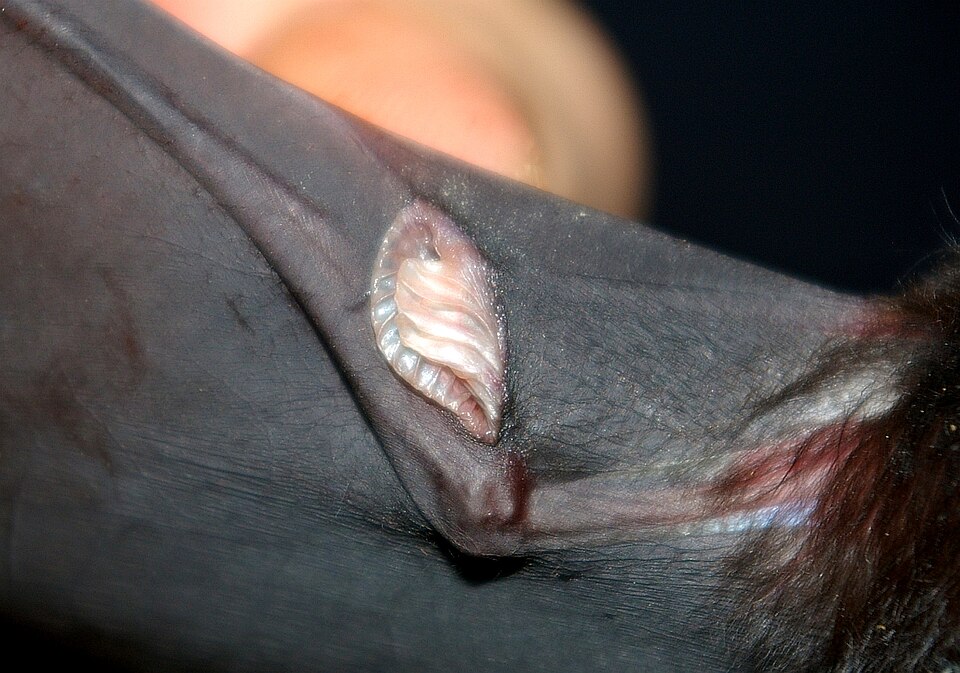
The greater sac-winged bat (Saccopteryx bilineata) is a bat of the family Emballonuridae native to Central and South America. They are common bats seen in the rainforest, as they often roost on the outside of large trees. They are insectivores and use echolocation calls through the mouth to track their prey, which includes flies, beetles, butterflies and moths. The long nose and upper lip are highly mobile and can shift upward to enlarge the mouth opening. The term "sac-winged" refers to small pouches on the wings. These sacs are used by males to attract females and to mark their harem territory. During daily grooming, males will fill these sacs with drops of urine and glandular secretions. During displays for females, the male will hover in front of the female and fan her vigorously to expose her to the scent of the mixture in the wing sacs. Males will also shake the contents of the sac towards bats outside of the male's harem territory to warn off intruders. Microbial fermentation in the sac may produce identifiable scent signals. Sac-wing pups have been recorded making various calls in a jumbled context. For example, a female pup will give the male trill of courting followed by echolocation clicks then adult territorial challenges. These mixed-up vocalizations have been equated with human infant babbling and mispronounced songs of young birds. This is the first example of mammal babbling outside of the primate order.
Gallery
Ajouter des photos
Partagez vos photos de cette espèce (jusqu'à 20 à la fois) : elles sont vérifiées automatiquement, puis publiées.
Répartition
Occurrences observées (données GBIF). Les zones hors aire d'origine peuvent indiquer une présence introduite ou invasive.
Sources et crédits
Informations provenant de plusieurs sources vérifiées. Dernière mise à jour : .
Crédits photos (8)
- Photo : Karin Schneeberger alias Felineora · CC BY-SA 3.0
- Photo : Karin Schneeberger alias Felineora · CC BY-SA 3.0
- Photo : Karin Schneeberger alias Felineora · CC BY-SA 3.0
- Photo : Luis F. Aguirre (@laguirre) · CC BY-NC 4.0 · via iNaturalist
- Photo : Yves Bas (@yvesbas) · CC BY 4.0 · via iNaturalist
- Photo : Callie (@callieoldfield) · CC BY-NC 4.0 · via iNaturalist
- Photo : @bernardocarranza · CC BY-NC 4.0 · via iNaturalist
- Photo : Jean Eichholtzer (@jean_eichholtzer) · CC BY-NC 4.0 · via iNaturalist
Mentions de licence
Texte disponible sous licence CC BY-SA 4.0. Il adapte notamment Saccopteryx bilineata, Wikipedia (CC BY-SA) : Greater sac-winged bat (Wikipédia, auteurs dans l’historique de l’article).
- Taxonomie : GBIF Backbone Taxonomy (CC BY 4.0)
- Carte : occurrences GBIF, fond © contributeurs OpenStreetMap (ODbL)
- Statut de conservation : Liste rouge de l'UICN, via Wikidata (CC0)
Détail : Sources et licences.
Discussion (0)
Aucun message pour l’instant. Lancez la discussion sur cette fiche (sources, précisions, débats éditoriaux).
Connectez-vous pour participer à la discussion.