
Egyptian fruit bat
Rousettus aegyptiacus
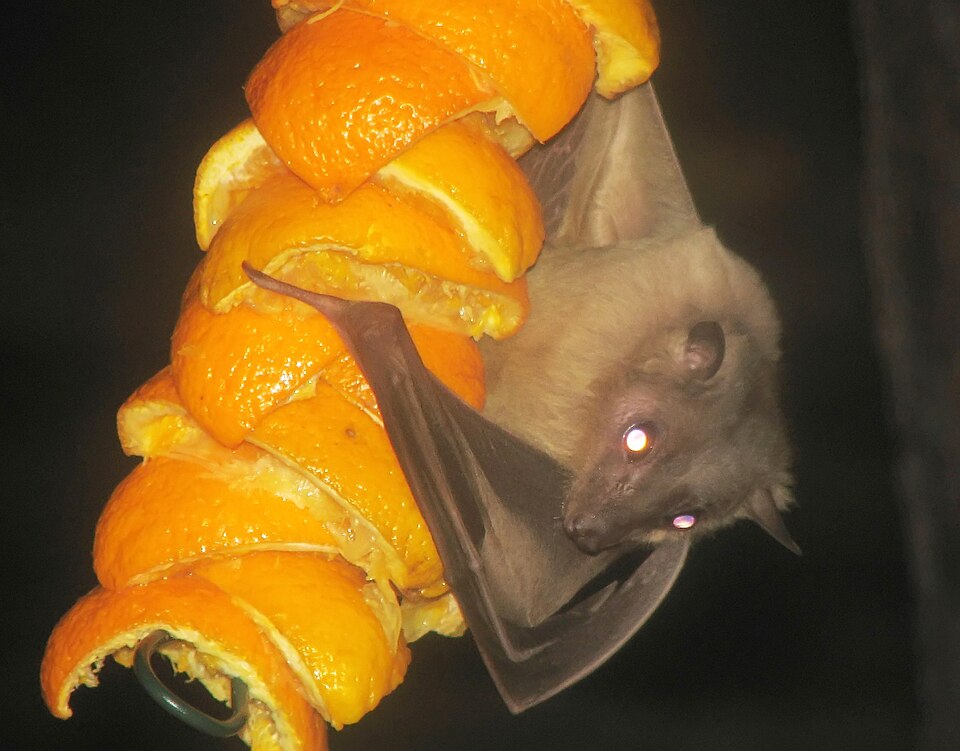
The Egyptian fruit bat or Egyptian rousette (Rousettus aegyptiacus) is a species of megabat that occurs in Africa, the Middle East, the Mediterranean and the Indian subcontinent.
- Kingdom
- Animalia
- Phylum
- Chordata
- Class
- Mammalia
- Order
- Chiroptera
- Family
- Pteropodidae
- Genus
- Rousettus
- Species
- Rousettus aegyptiacus
Description
The Egyptian fruit bat or Egyptian rousette (Rousettus aegyptiacus) is a species of megabat that occurs in Africa, the Middle East, the Mediterranean and the Indian subcontinent. It is one of three Rousettus species with an African-Malagasy range, though the only species of its genus found on continental Africa. The common ancestor of the three species colonized the region in the late Pliocene or early Pleistocene. The species is traditionally divided into six subspecies. It is considered a medium-sized megabat, with adults weighing 80–170 g (2.8–6.0 oz) and possessing wingspans of approximately 60 cm (24 in). Individuals are dark brown or grayish brown, with their undersides paler than their backs. The Egyptian fruit bat is a highly social species, usually living in colonies with thousands of other bats. It, along with other members of the genus Rousettus, are some of the only fruit bats to use echolocation, though a more primitive version than used by bats in other families. It has also developed a socially-complex vocalization system to communicate with conspecifics. The Egyptian fruit bat is a frugivore that consumes a variety of fruits depending on the season and local availability. Because of its consumption of commercially-grown fruits, the Egyptian fruit bat is considered a pest by farmers. It also acts as a pollinator and seed disperser for many species of trees and other plants.
Gallery
Ajouter des photos
Partagez vos photos de cette espèce (jusqu'à 20 à la fois) : elles sont vérifiées automatiquement, puis publiées.
Répartition
Occurrences observées (données GBIF). Les zones hors aire d'origine peuvent indiquer une présence introduite ou invasive.
Sources et crédits
Informations provenant de plusieurs sources vérifiées. Dernière mise à jour : .
Crédits photos (6)
- Photo : Arpingstone · Domaine public
- Photo : Gökhan EREN (@gkhn_rn) · CC BY-NC 4.0 · via iNaturalist
- Photo : Natalie Weber (@natalie) · CC BY-NC 4.0 · via iNaturalist
- Photo : Valentin Moser (@vmoser) · CC BY 4.0 · via iNaturalist
- Photo : Evelyne Schindler (@loumasri) · CC BY-NC 4.0 · via iNaturalist
- Photo : @rokcestnik · CC BY-NC 4.0 · via iNaturalist
Mentions de licence
Texte disponible sous licence CC BY-SA 4.0. Il adapte notamment Wikipedia (CC BY-SA) : Egyptian fruit bat (Wikipédia, auteurs dans l’historique de l’article).
- Taxonomie : GBIF Backbone Taxonomy (CC BY 4.0)
- Carte : occurrences GBIF, fond © contributeurs OpenStreetMap (ODbL)
- Statut de conservation : Liste rouge de l'UICN, via Wikidata (CC0)
Détail : Sources et licences.
Discussion (0)
Aucun message pour l’instant. Lancez la discussion sur cette fiche (sources, précisions, débats éditoriaux).
Connectez-vous pour participer à la discussion.