
Black rhinoceros
Diceros bicornis
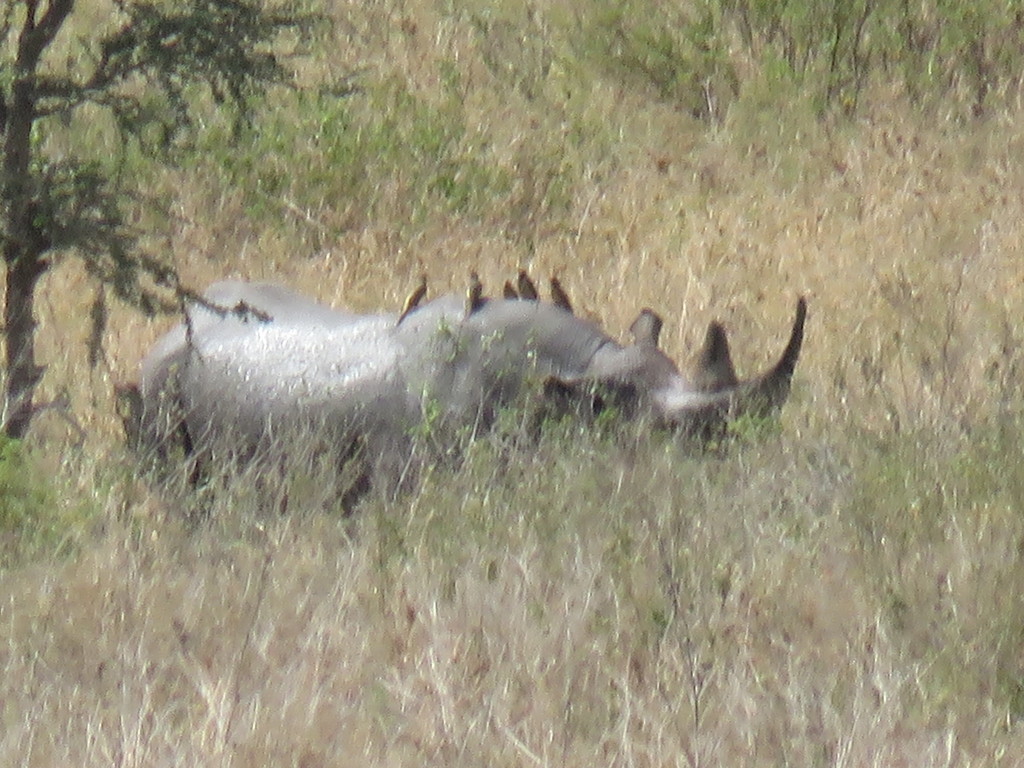
The black rhinoceros (Diceros bicornis), also called the black rhino or the hooked-lip rhinoceros, is a species of rhinoceros native to East and Southern Africa, including Angola, Botswana, Eswatini, Kenya, Lesotho, Malawi, Mozambique,…
- Kingdom
- Animalia
- Phylum
- Chordata
- Class
- Mammalia
- Order
- Perissodactyla
- Family
- Rhinocerotidae
- Genus
- Diceros
- Species
- Diceros bicornis
Description
The black rhinoceros (Diceros bicornis), also called the black rhino or the hooked-lip rhinoceros, is a species of rhinoceros native to East and Southern Africa, including Angola, Botswana, Eswatini, Kenya, Lesotho, Malawi, Mozambique, Namibia, South Africa, Tanzania, Zambia, and Zimbabwe. Although the species is referred to as black, its colours vary from brown to grey. It is the only extant species of the genus Diceros. The other rhinoceros native to Africa is the white rhinoceros (Ceratotherium simum). The word "white" in the name "white rhinoceros" is often said to be a misinterpretation of the Afrikaans word wyd (Dutch wijd) meaning wide, referring to its square upper lip, as opposed to the pointed or hooked lip of the black rhinoceros. These species are now sometimes referred to as the square-lipped (for white) or hook-lipped (for black) rhinoceros. The species overall is classified as critically endangered (even though the south-western black rhinoceros is classified as near threatened) and is threatened by multiple factors including poaching and habitat reduction. Three subspecies have been declared extinct, including the western black rhinoceros, which was declared extinct by the International Union for Conservation of Nature (IUCN) in 2011. The IUCN estimates that 3,142 mature individuals remain in the wild.
Gallery
Ajouter des photos
Partagez vos photos de cette espèce (jusqu'à 20 à la fois) : elles sont vérifiées automatiquement, puis publiées.
Répartition
Occurrences observées (données GBIF). Les zones hors aire d'origine peuvent indiquer une présence introduite ou invasive.
Sources et crédits
Informations provenant de plusieurs sources vérifiées. Dernière mise à jour : .
Crédits photos (5)
- Photo : @gazzakingo · CC BY-NC 4.0 · via iNaturalist
- Photo : Richard Johnstone (@richard_johnstone) · CC BY-NC 4.0 · via iNaturalist
- Photo : Raúl MT (@ornagrion) · CC BY-NC 4.0 · via iNaturalist
- Photo : Paul Prior (@paul_prior) · CC BY 4.0 · via iNaturalist
- Photo : Darren Obbard (@darren_j_obbard) · CC BY 4.0 · via iNaturalist
Mentions de licence
Texte disponible sous licence CC BY-SA 4.0. Il adapte notamment Wikipedia (CC BY-SA) : Black rhinoceros (Wikipédia, auteurs dans l’historique de l’article).
- Taxonomie : GBIF Backbone Taxonomy (CC BY 4.0)
- Carte : occurrences GBIF, fond © contributeurs OpenStreetMap (ODbL)
- Statut de conservation : Liste rouge de l'UICN, via Wikidata (CC0)
Détail : Sources et licences.
Discussion (0)
Aucun message pour l’instant. Lancez la discussion sur cette fiche (sources, précisions, débats éditoriaux).
Connectez-vous pour participer à la discussion.