
Golden-capped fruit bat
Acerodon jubatus
The giant golden-crowned flying fox (Acerodon jubatus), also known as the golden-capped fruit bat, is a species of megabat endemic to the Philippines.
- Kingdom
- Animalia
- Phylum
- Chordata
- Class
- Mammalia
- Order
- Chiroptera
- Family
- Pteropodidae
- Genus
- Acerodon
- Species
- Acerodon jubatus
Description
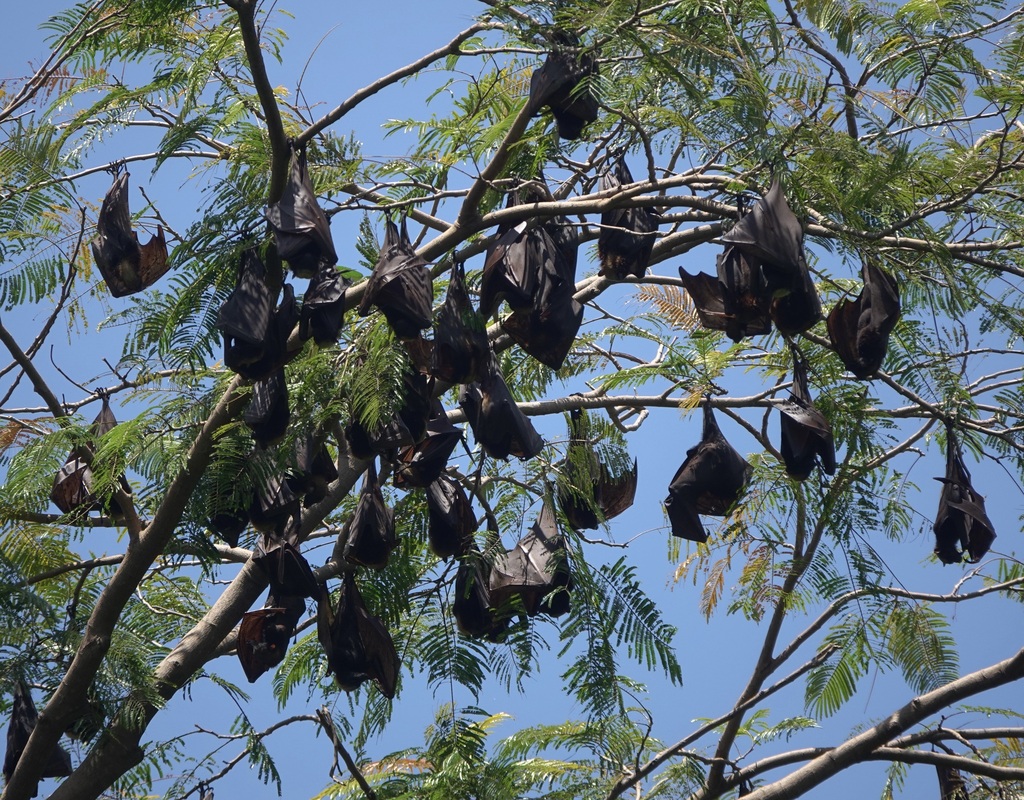
The giant golden-crowned flying fox (Acerodon jubatus), also known as the golden-capped fruit bat, is a species of megabat endemic to the Philippines. Since its description in 1831, three subspecies of the giant golden-crowned flying fox have been recognized, one of which is extinct. The extinct subspecies (A. jubatus lucifer) was formerly recognized as a full species, the Panay golden-crowned flying fox. Formerly, this species was placed in the genus Pteropus; while it is no longer within the genus, it has many physical similarities to Pteropus megabats. It is one of the largest bat species in the world, weighing up to 1.4 kg (3.1 lb)-only the Indian and great flying fox can weigh more. It has the longest documented forearm length of any bat species at 21 cm (8.3 in). It is primarily frugivorous, consuming several kinds of fig and some leaves. It forages at night and sleeps during the day in tree roosts. These roosts can consist of thousands of individuals, often including another species, the large flying fox. Not much is known about its reproduction; it gives birth annually from April through June, with females having one pup at a time. Predators of the giant golden-crowned flying fox include raptors such as eagles, the reticulated python, and humans. Owing to deforestation and poaching for bushmeat, it is an endangered species. Though national and international law makes hunting and trade of this species illegal, these regulations are inadequately enforced, meaning that the species is frequently hunted nonetheless. Even in roosts that are more stringently protected from poaching, it is still affected by human disturbance via tourists who intentionally disturb them during the day. An early description of this species may be found in William Dampier's account of his circumnavigation, A New Voyage Round the World (1697).
Gallery
Ajouter des photos
Partagez vos photos de cette espèce (jusqu'à 20 à la fois) : elles sont vérifiées automatiquement, puis publiées.
Répartition
Occurrences observées (données GBIF). Les zones hors aire d'origine peuvent indiquer une présence introduite ou invasive.
Sources et crédits
Informations provenant de plusieurs sources vérifiées. Dernière mise à jour : .
Crédits photos (8)
- Photo : @kenny_well · CC BY-NC 4.0 · via iNaturalist
- Photo : Stefanie De Win (@stefanie_de_win) · CC BY-NC 4.0 · via iNaturalist
- Photo : @blackdogto · CC BY-NC 4.0 · via iNaturalist
- Photo : Stefanie De Win (@stefanie_de_win) · CC BY-NC 4.0 · via iNaturalist
- Photo : Susan Tsang (@stsang) · CC BY-NC 4.0 · via iNaturalist
- Photo : @alcedo77 · CC BY-NC 4.0 · via iNaturalist
- Photo : @frogtime · CC BY-NC 4.0 · via iNaturalist
- Photo : @ingkong · CC BY-NC 4.0 · via iNaturalist
Mentions de licence
Texte disponible sous licence CC BY-SA 4.0. Il adapte notamment Renard volant des Philippines, Wikipedia (CC BY-SA) : Giant golden-crowned flying fox (Wikipédia, auteurs dans l’historique de l’article).
- Taxonomie : GBIF Backbone Taxonomy (CC BY 4.0)
- Carte : occurrences GBIF, fond © contributeurs OpenStreetMap (ODbL)
Détail : Sources et licences.
Discussion (0)
Aucun message pour l’instant. Lancez la discussion sur cette fiche (sources, précisions, débats éditoriaux).
Connectez-vous pour participer à la discussion.