
Bohor reedbuck
Redunca redunca
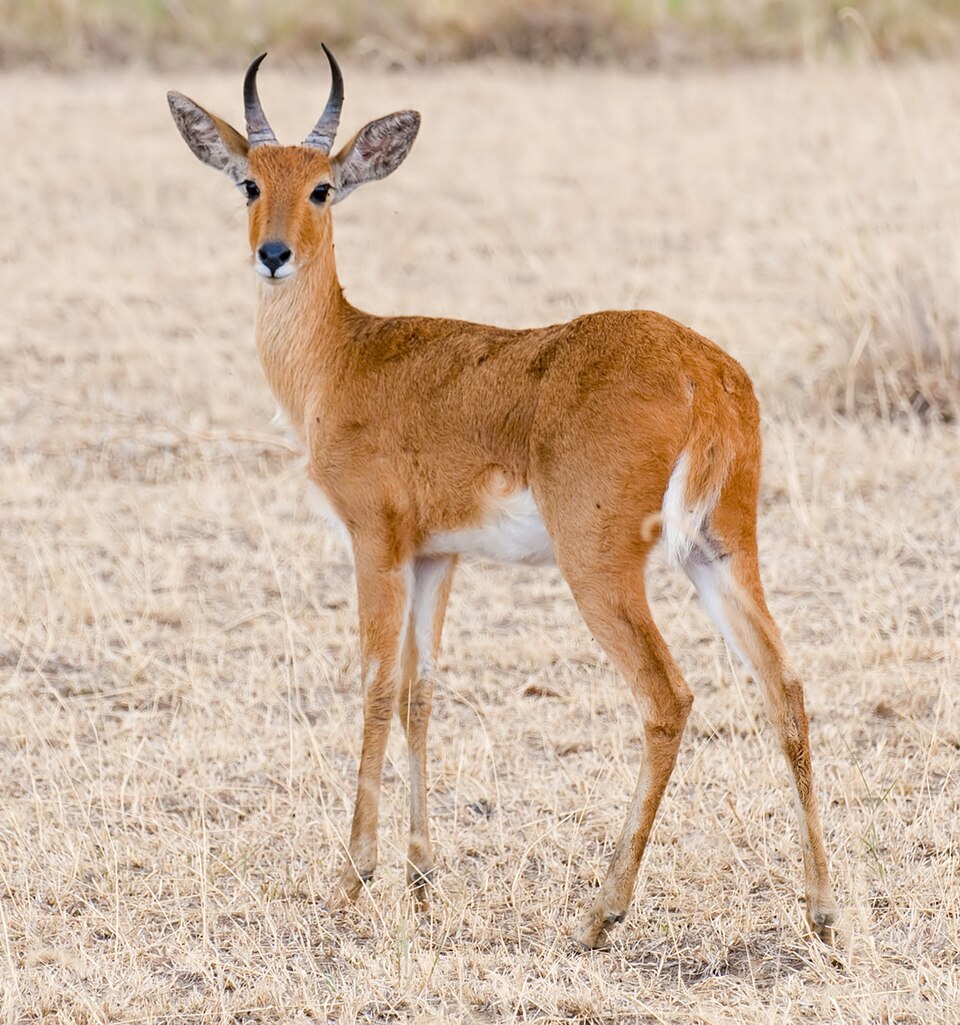
The bohor reedbuck (Redunca redunca) is an antelope native to central Africa.
- Kingdom
- Animalia
- Phylum
- Chordata
- Class
- Mammalia
- Order
- Artiodactyla
- Family
- Bovidae
- Genus
- Redunca
- Species
- Redunca redunca
Description
The bohor reedbuck (Redunca redunca) is an antelope native to central Africa. The animal is placed under the genus Redunca and in the family Bovidae. It was first described by German zoologist and botanist Peter Simon Pallas in 1767. The bohor reedbuck has five subspecies. The head-and-body length of this medium-sized antelope is typically between 100–135 cm (39–53 in). Males reach approximately 75–89 cm (30–35 in) at the shoulder, while females reach 69–76 cm (27–30 in). Males typically weigh 43–65 kg (95–143 lb) and females 35–45 kg (77–99 lb). This sturdily built antelope has a yellow to grayish brown coat. Only the males possess horns which measure about 25–35 cm (9.8–13.8 in) long. A herbivore, the bohor reedbuck prefers grasses and tender reed shoots with high protein and low fiber content. This reedbuck is dependent on water, though green pastures can fulfill its water requirement. The social structure of the bohor reedbuck is highly flexible. Large aggregations are observed during the dry season, when hundreds of bohor reedbuck assemble near a river. Males become sexually mature at the age of three to four years, while females can conceive at just one year of age, reproducing every nine to fourteen months. Though there is no fixed breeding season, mating peaks in the rainy season. The gestation period is seven and a half months long, after which a single calf is born. The calves are weaned at eight to nine months of age. The bohor reedbuck inhabits moist grasslands and swamplands as well as woodlands. The bohor reedbuck is native to Benin, Burkina Faso, Burundi, Cameroon, Central African Republic, Chad, Democratic Republic of the Congo, Ethiopia, the Gambia, Ghana, Guinea, Guinea-Bissau, Kenya, Mali, Mauritania, Niger, Nigeria, Rwanda, Senegal, Sudan, Tanzania, Togo, and Uganda. The animal is possibly extinct in Ivory Coast. Reckless hunting and loss of habitat as a result of human settlement have led to significant decline in the numbers of the bohor reedbuck, although this antelope tends to survive longer in such over-exploited areas as compared to its relatives. The total populations of the bohor reedbuck are estimated to be above 100,000. Larger populations occur in eastern and central Africa than in western Africa. The International Union for Conservation of Nature (IUCN) rates the bohor reedbuck as of least concern.
Gallery
Ajouter des photos
Partagez vos photos de cette espèce (jusqu'à 20 à la fois) : elles sont vérifiées automatiquement, puis publiées.
Répartition
Occurrences observées (données GBIF). Les zones hors aire d'origine peuvent indiquer une présence introduite ou invasive.
Sources et crédits
Informations provenant de plusieurs sources vérifiées. Dernière mise à jour : .
Crédits photos (9)
- Photo : Yathin S Krishnappa · CC BY-SA 3.0
- Photo : This image was produced by me, David Castor (user:dcastor). The pictures I submit to the Wikipedia Project are released to the public domain. This gives you the right to use them in any way you like, without any kind of notification. This said, I would still appreciate to be mentioned as the originator whenever you think it complies well with your use of the picture. A message to me about how it has been used would also be welcome. You are obviously not required to respond to these wishes of mine, just in a friendly manner encouraged to. (All my photos are placed in Category:Images by David Castor or a subcategory thereof.) · CC0 (domaine public) · via Wikimedia Commons
- Photo : This image was produced by me, David Castor (user:dcastor). The pictures I submit to the Wikipedia Project are released to the public domain. This gives you the right to use them in any way you like, without any kind of notification. This said, I would still appreciate to be mentioned as the originator whenever you think it complies well with your use of the picture. A message to me about how it has been used would also be welcome. You are obviously not required to respond to these wishes of mine, just in a friendly manner encouraged to. (All my photos are placed in Category:Images by David Castor or a subcategory thereof.) · CC0 (domaine public) · via Wikimedia Commons
- Photo : This image was produced by me, David Castor (user:dcastor). The pictures I submit to the Wikipedia Project are released to the public domain. This gives you the right to use them in any way you like, without any kind of notification. This said, I would still appreciate to be mentioned as the originator whenever you think it complies well with your use of the picture. A message to me about how it has been used would also be welcome. You are obviously not required to respond to these wishes of mine, just in a friendly manner encouraged to. (All my photos are placed in Category:Images by David Castor or a subcategory thereof.) · CC0 (domaine public) · via Wikimedia Commons
- Photo : ONG OeBenin (@oebenin) · CC BY-NC 4.0 · via iNaturalist
- Photo : RAFAEL (@rafael-ritter72) · CC BY-NC 4.0 · via iNaturalist
- Photo : ONG OeBenin (@oebenin) · CC BY-NC 4.0 · via iNaturalist
- Photo : Ben Simmons (@ben__simms) · CC BY-NC 4.0 · via iNaturalist
- Photo : Royle Safaris (@roylesafaris) · CC BY-NC 4.0 · via iNaturalist
Mentions de licence
Texte disponible sous licence CC BY-SA 4.0. Il adapte notamment Redunca redunca, Wikipedia (CC BY-SA) : Bohor reedbuck (Wikipédia, auteurs dans l’historique de l’article).
- Taxonomie : GBIF Backbone Taxonomy (CC BY 4.0)
- Carte : occurrences GBIF, fond © contributeurs OpenStreetMap (ODbL)
- Statut de conservation : Liste rouge de l'UICN, via Wikidata (CC0)
Détail : Sources et licences.
Discussion (0)
Aucun message pour l’instant. Lancez la discussion sur cette fiche (sources, précisions, débats éditoriaux).
Connectez-vous pour participer à la discussion.