
Reindeer
Rangifer tarandus
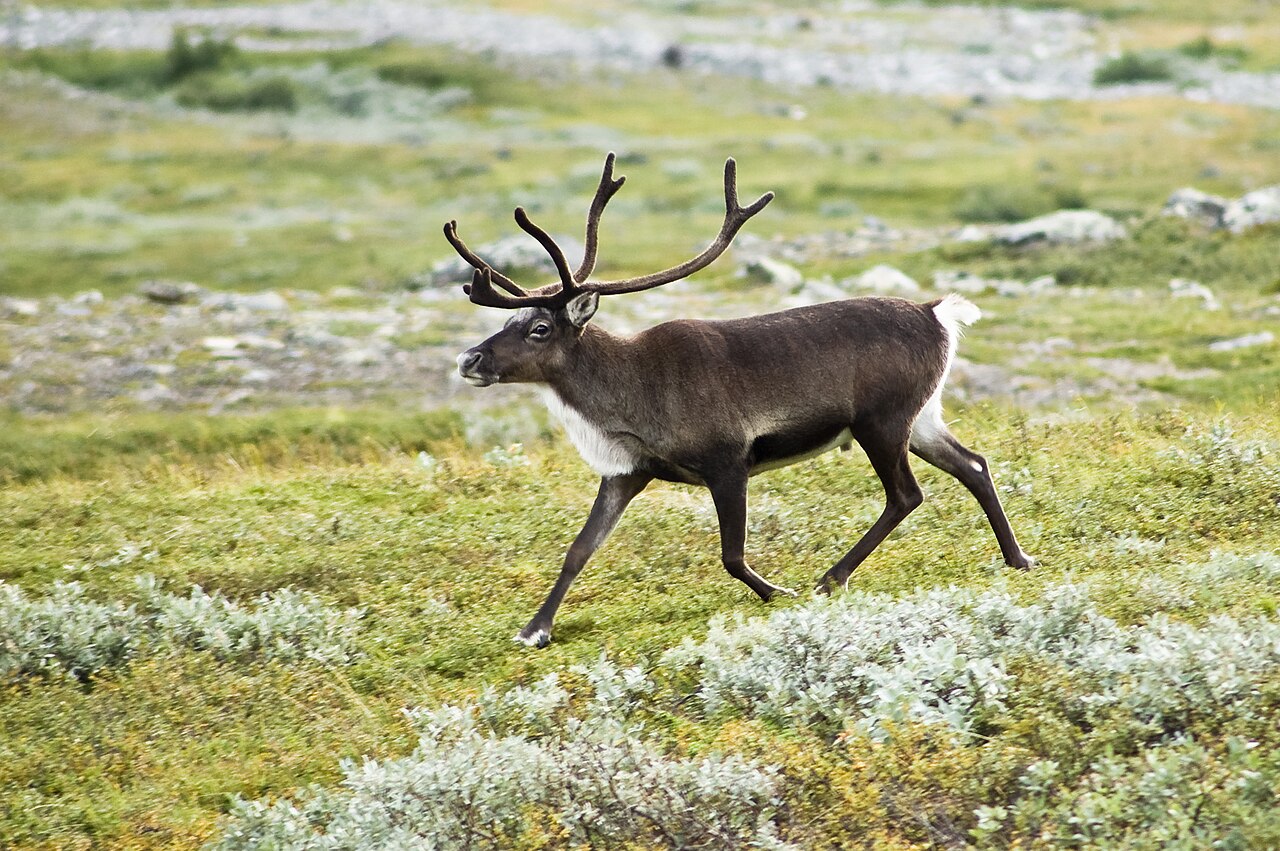
The reindeer or caribou (Rangifer tarandus) is a species of deer with circumpolar distribution, native to Arctic, subarctic, tundra, boreal, and mountainous regions of Northern Europe, Siberia, and North America.
- Kingdom
- Animalia
- Phylum
- Chordata
- Class
- Mammalia
- Order
- Artiodactyla
- Family
- Cervidae
- Genus
- Rangifer
- Species
- Rangifer tarandus
Description
The reindeer or caribou (Rangifer tarandus) is a species of deer with circumpolar distribution, native to Arctic, subarctic, tundra, boreal, and mountainous regions of Northern Europe, Siberia, and North America. It is the only representative of the genus Rangifer. More recent studies suggest the splitting of reindeer and caribou (North American terminology). "All caribou and reindeer throughout the world are considered to be the same species, but there are 7 subspecies." Reindeer occur in both migratory and sedentary populations, and their herd sizes vary greatly in different regions. The tundra subspecies are adapted for extreme cold, and some are adapted for long-distance migration. Reindeer vary greatly in size and color from the smallest, the Svalbard reindeer (R. (t.) platyrhynchus), to the largest, Osborn's caribou (R. t. osborni). Although reindeer are quite numerous, some species and subspecies are in decline and considered vulnerable. They are unique among deer (Cervidae) in that females may have antlers, although the prevalence of antlered females varies by subspecies. Reindeer are the only successfully semi-domesticated deer on a large scale in the world. Both wild and domestic reindeer have been an important source of food, clothing, and shelter for Arctic people from prehistorical times. They are still herded and hunted today. In some traditional Christmas legends, Santa Claus's reindeer pull a sleigh through the night sky to help Santa Claus deliver gifts to good children on Christmas Eve.
Gallery
Ajouter des photos
Partagez vos photos de cette espèce (jusqu'à 20 à la fois) : elles sont vérifiées automatiquement, puis publiées.
Répartition
Occurrences observées (données GBIF). Les zones hors aire d'origine peuvent indiquer une présence introduite ou invasive.
Sources et crédits
Informations provenant de plusieurs sources vérifiées. Dernière mise à jour : .
Crédits photos (7)
- Photo : Alexandre Buisse (Nattfodd) · CC BY-SA 3.0 · via Wikimedia Commons
- Photo : Alexandre Buisse (Nattfodd) · CC BY-SA 3.0 · via Wikimedia Commons
- Photo : @that_micicle · CC BY-NC 4.0 · via iNaturalist
- Photo : @jcams8 · CC BY-NC 4.0 · via iNaturalist
- Photo : Steve Andersen (@steve_andersen) · CC BY-NC 4.0 · via iNaturalist
- Photo : Stephanie Marsh (@bog_marsh) · CC BY-NC 4.0 · via iNaturalist
- Photo : Herschel Island-Qikiqtaruk (@qikiqtaruk) · CC BY-NC 4.0 · via iNaturalist
Mentions de licence
Texte disponible sous licence CC BY-SA 4.0. Il adapte notamment Wikipedia (CC BY-SA) : Reindeer (Wikipédia, auteurs dans l’historique de l’article).
- Taxonomie : GBIF Backbone Taxonomy (CC BY 4.0)
- Carte : occurrences GBIF, fond © contributeurs OpenStreetMap (ODbL)
- Statut de conservation : Liste rouge de l'UICN, via Wikidata (CC0)
Détail : Sources et licences.
Discussion (0)
Aucun message pour l’instant. Lancez la discussion sur cette fiche (sources, précisions, débats éditoriaux).
Connectez-vous pour participer à la discussion.