
Black-shanked douc
Pygathrix nigripes
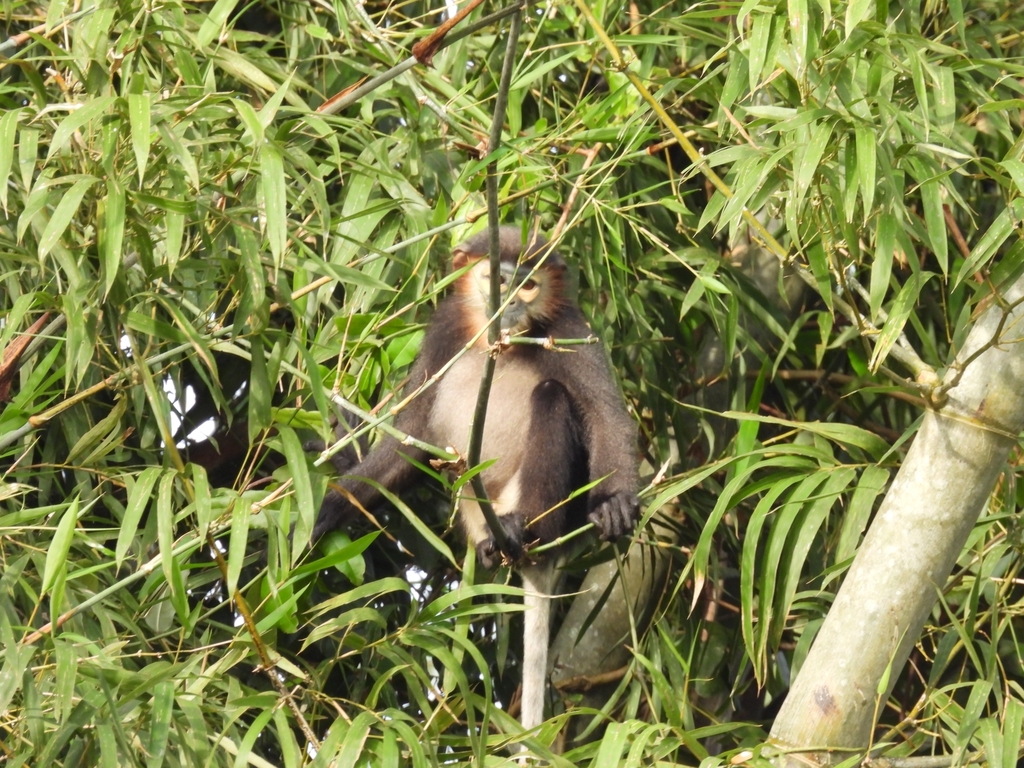
The black-shanked douc (Pygathrix nigripes) is an endangered species of douc found mostly in the forests of Eastern Cambodia, with some smaller populations in Southern Vietnam.
- Kingdom
- Animalia
- Phylum
- Chordata
- Class
- Mammalia
- Order
- Primates
- Family
- Cercopithecidae
- Genus
- Pygathrix
- Species
- Pygathrix nigripes
Description
The black-shanked douc (Pygathrix nigripes) is an endangered species of douc found mostly in the forests of Eastern Cambodia, with some smaller populations in Southern Vietnam. The region they are mostly found in is called the Annamite Range, a mountainous area that passes through Cambodia and Vietnam. Its habitat is mostly characterized by evergreen forest in the mountains, in the middle to upper canopy. They move around quadrupedally and by brachiation up in the trees. This species is unique with its coloration among the doucs as it has a bluish face with yellow rings around its eyes a blue scrotum and a pink penis. Like other doucs, this species has a tail as long as its body and head length. Black-shanked douc have been observed in groups ranging from 3 to 30 individuals, depending on their habitat. Group tend to have a fission-fusion dynamic that changes with food availability. Their diet varies from dry to wet season. Regardless of the season, their diet consists mostly of leaves, but they have also been found to consume considerable amounts of fruits and flowers during wet season. The species changed conservation status in 2015 from endangered to critically endangered in the IUCN Red List of Endangered Species. This reassessment is due to an increase of the rate of population decline. No global population estimate exists. The majority of the population can be found in Cambodia, with smaller populations in Vietnam. In fact, the Wildlife Conservation Society reports almost 25,000 individuals in Cambodia's Keo Seima Wildlife Sanctuary, a population that has remained stable over the last decade. The largest populations estimated to be in Vietnam is around 500-600 individuals. The biggest challenges that the black-shanked douc faces in terms of conservation are habitat loss and illegal poaching. Conservation efforts are being made to control illegal poaching and trade in Vietnam by putting laws against hunting and trading threatened species.
Gallery
Ajouter des photos
Partagez vos photos de cette espèce (jusqu'à 20 à la fois) : elles sont vérifiées automatiquement, puis publiées.
Répartition
Occurrences observées (données GBIF). Les zones hors aire d'origine peuvent indiquer une présence introduite ou invasive.
Sources et crédits
Informations provenant de plusieurs sources vérifiées. Dernière mise à jour : .
Crédits photos (8)
- Photo : Anna (@terrajanis) · CC BY-NC 4.0 · via iNaturalist
- Photo : @asanoth · CC BY-NC 4.0 · via iNaturalist
- Photo : @quy_hoang · CC BY-NC 4.0 · via iNaturalist
- Photo : @imgalexi · CC BY-NC 4.0 · via iNaturalist
- Photo : Grant Houston (@skintoscale) · CC BY-NC 4.0 · via iNaturalist
- Photo : Sergey Yeliseev (@sergeyyeliseev) · CC BY-NC 4.0 · via iNaturalist
- Photo : Next Continent: Wildlife, Photography and Natural History Tours (@nextcontinenttours) · CC BY-NC 4.0 · via iNaturalist
- Photo : Vsevolod Rudyi (@ruseva) · CC BY 4.0 · via iNaturalist
Mentions de licence
Texte disponible sous licence CC BY-SA 4.0. Il adapte notamment Pygathrix nigripes, Wikipedia (CC BY-SA) : Black-shanked douc (Wikipédia, auteurs dans l’historique de l’article).
- Taxonomie : GBIF Backbone Taxonomy (CC BY 4.0)
- Carte : occurrences GBIF, fond © contributeurs OpenStreetMap (ODbL)
- Statut de conservation : Liste rouge de l'UICN, via Wikidata (CC0)
Détail : Sources et licences.
Discussion (0)
Aucun message pour l’instant. Lancez la discussion sur cette fiche (sources, précisions, débats éditoriaux).
Connectez-vous pour participer à la discussion.