
Black-footed ferret
Mustela nigripes
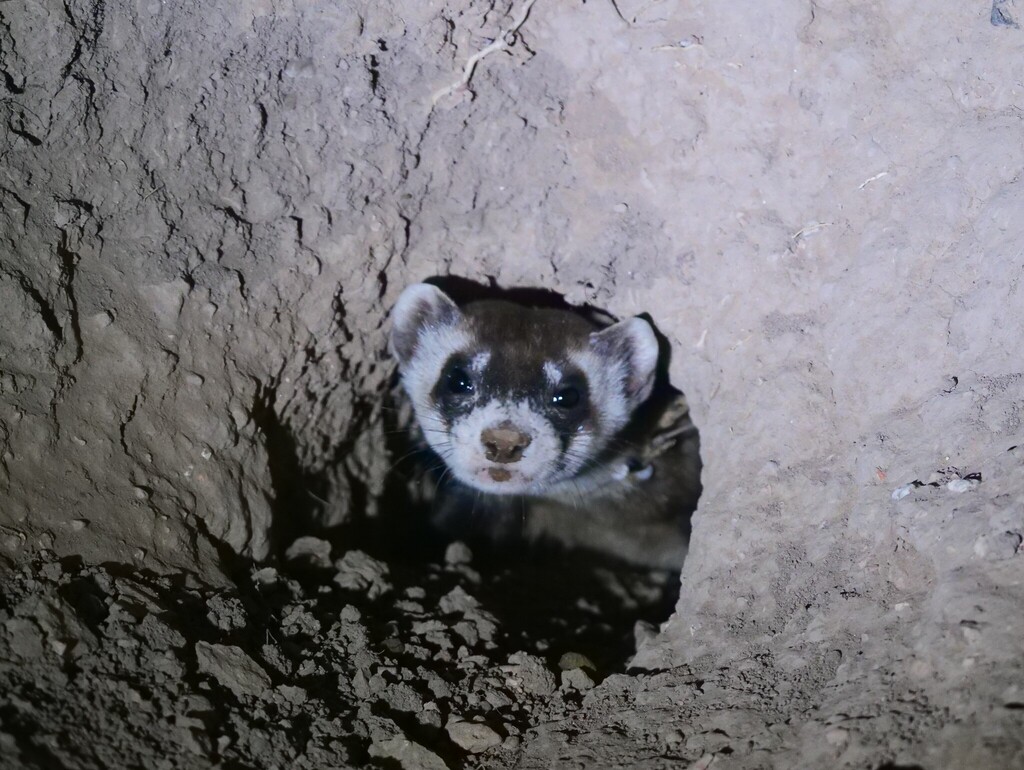
The black-footed ferret (Mustela nigripes), also known as the American polecat or prairie dog hunter, is a mustelid species native to central North America.
- Kingdom
- Animalia
- Phylum
- Chordata
- Class
- Mammalia
- Order
- Carnivora
- Family
- Mustelidae
- Genus
- Mustela
- Species
- Mustela nigripes
Description
The black-footed ferret (Mustela nigripes), also known as the American polecat or prairie dog hunter, is a mustelid species native to central North America. It is roughly the size of a mink and is similar in appearance to the European polecat and the Asian steppe polecat. It is largely nocturnal and solitary, except when breeding or raising litters. Up to 90% of its diet is composed of prairie dogs. The black-footed ferret declined throughout the 20th century, primarily as a result of decreases in prairie dog populations and sylvatic plague. It was declared extinct in 1979, but a residual wild population was discovered in 1981 in Meeteetse, Wyoming. A captive-breeding program launched by the United States Fish and Wildlife Service resulted in its reintroduction into eight western US states, Canada, and Mexico from 1991 to 2009. As of 2015, over 200 mature individuals are in the wild across 18 populations, with four self-sustaining populations in South Dakota, Arizona, and Wyoming. It was first listed as "endangered" in 1982, then as "extinct in the wild" in 1996 before being moved back up to "endangered" in the IUCN Red List in 2008. In February 2021, the first successful clone of a black-footed ferret, a female named Elizabeth Ann, was introduced to the public.
Gallery
Ajouter des photos
Partagez vos photos de cette espèce (jusqu'à 20 à la fois) : elles sont vérifiées automatiquement, puis publiées.
Répartition
Occurrences observées (données GBIF). Les zones hors aire d'origine peuvent indiquer une présence introduite ou invasive.
Sources et crédits
Informations provenant de plusieurs sources vérifiées. Dernière mise à jour : .
Crédits photos (6)
- Photo : @bretthartl · CC BY-NC 4.0 · via iNaturalist
- Photo : Barbara Muenchau (@sagewort) · CC BY-NC 4.0 · via iNaturalist
- Photo : @alschenck · CC BY-NC 4.0 · via iNaturalist
- Photo : Colorado Front Range National Wildlife Refuge Complex (@co_front_range_nwr_complex) · CC BY 4.0 · via iNaturalist
- Photo : Robert Coonrod (@robertcoonrod) · CC BY-NC 4.0 · via iNaturalist
- Photo : Jackson Nesbit (@jnesbit_wild) · CC BY-NC 4.0 · via iNaturalist
Mentions de licence
Texte disponible sous licence CC BY-SA 4.0. Il adapte notamment Putois à pieds noirs, Wikipedia (CC BY-SA) : Black-footed ferret (Wikipédia, auteurs dans l’historique de l’article).
- Taxonomie : GBIF Backbone Taxonomy (CC BY 4.0)
- Carte : occurrences GBIF, fond © contributeurs OpenStreetMap (ODbL)
Détail : Sources et licences.
Discussion (0)
Aucun message pour l’instant. Lancez la discussion sur cette fiche (sources, précisions, débats éditoriaux).
Connectez-vous pour participer à la discussion.