
Golden-crowned sifaka
Propithecus tattersalli
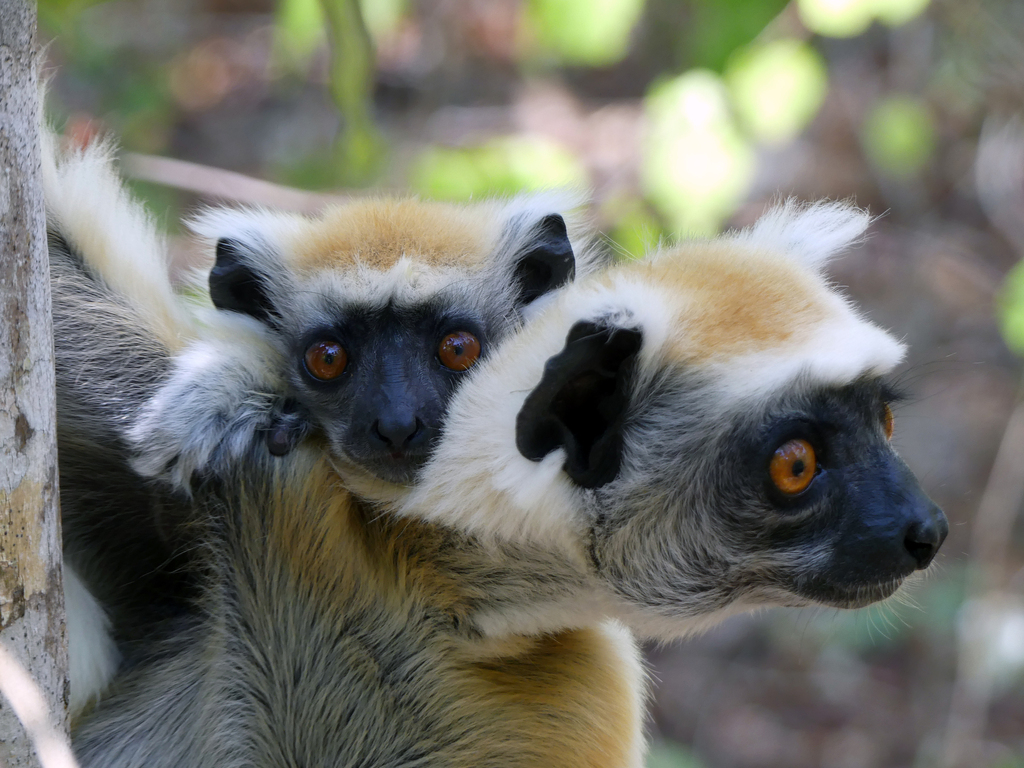
The golden-crowned sifaka or Tattersall's sifaka (Propithecus tattersalli) is a medium-sized lemur characterized by mostly white fur, prominent furry ears, and a golden-orange crown.
- Kingdom
- Animalia
- Phylum
- Chordata
- Class
- Mammalia
- Order
- Primates
- Family
- Indriidae
- Genus
- Propithecus
- Species
- Propithecus tattersalli
Description
The golden-crowned sifaka or Tattersall's sifaka (Propithecus tattersalli) is a medium-sized lemur characterized by mostly white fur, prominent furry ears, and a golden-orange crown. It is one of the smallest sifakas (genus Propithecus), weighing around 3.5 kg (7.7 lb) and measuring approximately 90 cm (35 in) from head to tail. Like all sifakas, it is a vertical clinger and leaper, and its diet includes mostly seeds and leaves. The golden-crowned sifaka is named after its discoverer, Ian Tattersall, who first spotted the species in 1974. However, it was not formally described until 1988, after a research team led by Elwyn L. Simons observed and captured some specimens for captive breeding. The golden-crowned sifaka most closely resembles the western forest sifakas of the P. verreauxi group, yet its karyotype suggests a closer relationship with the P. diadema group of eastern forest sifakas. Despite the similarities with both groups, more recent studies of its karyotype support its classification as a distinct species. Found in gallery, deciduous, and semi-evergreen forest, its restricted range includes 44 forest fragments, totaling an area of 44,125 hectares (109,040 acres; 170.37 sq mi), centered on the town of Daraina in northeast Madagascar. Its estimated population is between 4,000 and 5,000 individuals. It is primarily active during the day, although it also tends to be active at dawn and dusk during the rainy season. It sleeps in tall emergent trees and is preyed upon by the fossa. The golden-crowned sifaka lives in groups of around five to six individuals, containing a balanced number of adult males and females. Scent is used to mark territories, which are defended by growling, chasing, and ritualistic leaping displays. Reproduction is seasonal, with gestation lasting six months and lactation lasting five months. Infants are weaned during the wet season to ensure the best chances of survival. The small range and fragmented populations of this species weigh heavily on its survival. Forest fragmentation, habitat destruction, poaching, slash-and-burn agriculture, and other human factors threaten its existence. The golden-crowned sifaka is listed by the IUCN Red List as Critically Endangered. Its range was originally not covered by any national parks or protected areas in Madagascar, but a new protected area, Loky-Manambato reserve, was established in 2005 to include a 20,000 ha (49,000 acres; 77 sq mi) portion. Attempts have been made to keep the golden-crowned sifaka in captivity at the Duke Lemur Center in Durham, North Carolina. The small colony was maintained from 1988 to 2008. In Madagascar, lawlessness resulting from the 2009 political coup led to increased poaching of this species, and many were sold to local restaurants as a delicacy.
Gallery
Ajouter des photos
Partagez vos photos de cette espèce (jusqu'à 20 à la fois) : elles sont vérifiées automatiquement, puis publiées.
Répartition
Occurrences observées (données GBIF). Les zones hors aire d'origine peuvent indiquer une présence introduite ou invasive.
Sources et crédits
Informations provenant de plusieurs sources vérifiées. Dernière mise à jour : .
Crédits photos (8)
- Photo : Royle Safaris (@roylesafaris) · CC BY-NC 4.0 · via iNaturalist
- Photo : @globalherping · CC BY-NC 4.0 · via iNaturalist
- Photo : Andrianiaina Angelo (@angelomg) · CC BY-NC 4.0 · via iNaturalist
- Photo : Darrell Parsons (@dpparsons) · CC BY-NC 4.0 · via iNaturalist
- Photo : @bnchapple · CC BY-NC 4.0 · via iNaturalist
- Photo : @pfaucher · CC BY-NC 4.0 · via iNaturalist
- Photo : @sapayoa · CC BY-NC 4.0 · via iNaturalist
- Photo : @mschneider · CC BY-NC 4.0 · via iNaturalist
Mentions de licence
Texte disponible sous licence CC BY-SA 4.0. Il adapte notamment Propithecus tattersalli, Wikipedia (CC BY-SA) : Golden-crowned sifaka (Wikipédia, auteurs dans l’historique de l’article).
- Taxonomie : GBIF Backbone Taxonomy (CC BY 4.0)
- Carte : occurrences GBIF, fond © contributeurs OpenStreetMap (ODbL)
- Statut de conservation : Liste rouge de l'UICN, via Wikidata (CC0)
Détail : Sources et licences.
Discussion (0)
Aucun message pour l’instant. Lancez la discussion sur cette fiche (sources, précisions, débats éditoriaux).
Connectez-vous pour participer à la discussion.