
Long-nosed potoroo
Potorous tridactylus
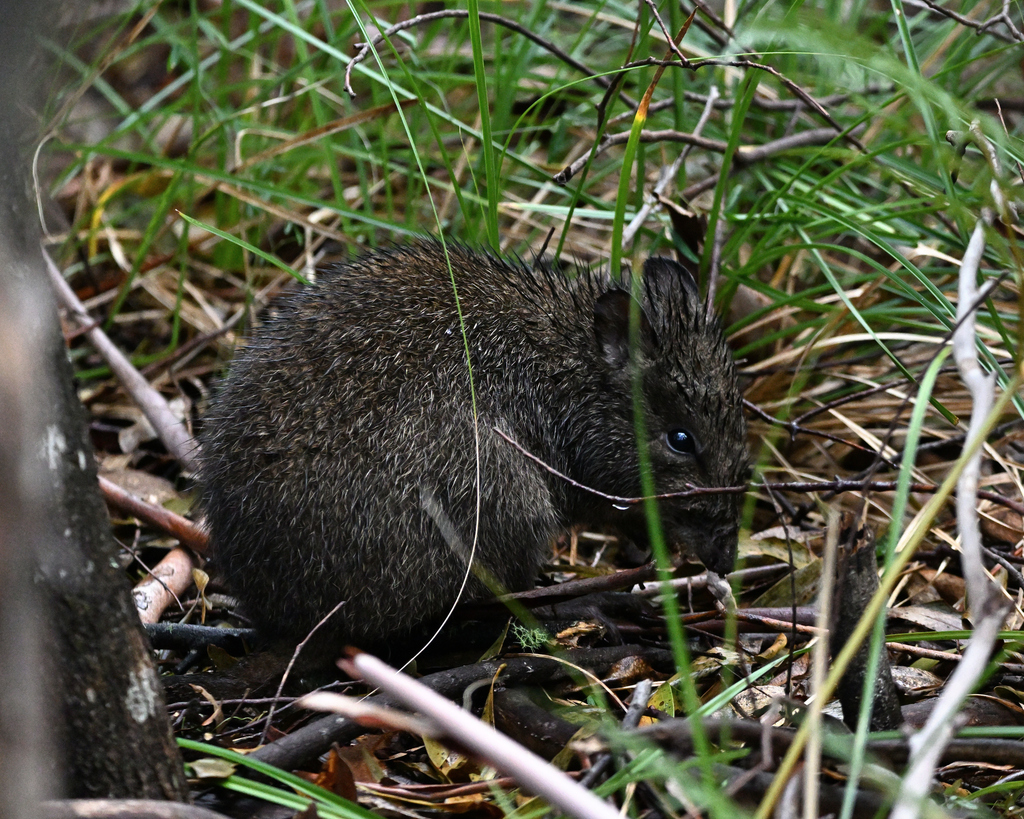
The long-nosed potoroo (Potorous tridactylus) is a small, hopping mammal native to forests and shrubland of southeastern Australia and Tasmania.
- Kingdom
- Animalia
- Phylum
- Chordata
- Class
- Mammalia
- Order
- Diprotodontia
- Family
- Potoroidae
- Genus
- Potorous
- Species
- Potorous tridactylus
Description
The long-nosed potoroo (Potorous tridactylus) is a small, hopping mammal native to forests and shrubland of southeastern Australia and Tasmania. A member of the potoroo and bettong family (Potoroidae), it lives alone and digs at night for fungi, roots, or small insects. It is also a marsupial (like kangaroos) and carries its young in a pouch. The long-nosed potoroo is threatened by habitat loss and introduced species such as cats or foxes. There are two subspecies: P. t. tridactylus on mainland Australia, and P. t. apicalis on Tasmania, with lighter fur. At first glance, the long-nosed potoroo with its pointed nose and grey-brown fur looks very much like a bandicoot : that is, until it hops away with its front feet tucked into its chest, revealing its close relationship with the kangaroo family. The long-nosed potoroo exhibits many morphological specializations such as an elongated pointed rostral region (nose), erect ears, large eyes, claws for digging, and long robust hind legs. It is only a small marsupial, with a body length between 34 and 38 cm (13–15 in), and a semi-prehensile tail length of 15 to 24 cm (5.9–9.4 in). As it is rarely seen in the wild, better indicators of its presence are the runways it makes through the undergrowth and the hollow diggings it leaves behind when feeding on underground roots and fungi.
Gallery
Ajouter des photos
Partagez vos photos de cette espèce (jusqu'à 20 à la fois) : elles sont vérifiées automatiquement, puis publiées.
Répartition
Occurrences observées (données GBIF). Les zones hors aire d'origine peuvent indiquer une présence introduite ou invasive.
Sources et crédits
Informations provenant de plusieurs sources vérifiées. Dernière mise à jour : .
Crédits photos (8)
- Photo : David Cunningham (@davidcunninghamwildlife) · CC BY-NC 4.0 · via iNaturalist
- Photo : @minnimmal · CC BY-NC 4.0 · via iNaturalist
- Photo : @littlebellanaturerefuge · CC BY-NC 4.0 · via iNaturalist
- Photo : @dazmania · CC BY-NC 4.0 · via iNaturalist
- Photo : @ka_regan · CC BY-NC 4.0 · via iNaturalist
- Photo : Quoll Society (@quollsociety) · CC BY-NC 4.0 · via iNaturalist
- Photo : Tommi Suominen (@tomsuo) · CC BY-NC 4.0 · via iNaturalist
- Photo : @deborod · CC BY-NC 4.0 · via iNaturalist
Mentions de licence
Texte disponible sous licence CC BY-SA 4.0. Il adapte notamment Potorous tridactylus, Wikipedia (CC BY-SA) : Long-nosed potoroo (Wikipédia, auteurs dans l’historique de l’article).
- Taxonomie : GBIF Backbone Taxonomy (CC BY 4.0)
- Carte : occurrences GBIF, fond © contributeurs OpenStreetMap (ODbL)
- Statut de conservation : Liste rouge de l'UICN, via Wikidata (CC0)
Détail : Sources et licences.
Discussion (0)
Aucun message pour l’instant. Lancez la discussion sur cette fiche (sources, précisions, débats éditoriaux).
Connectez-vous pour participer à la discussion.