
Bunyoro Rabbit
Poelagus marjorita
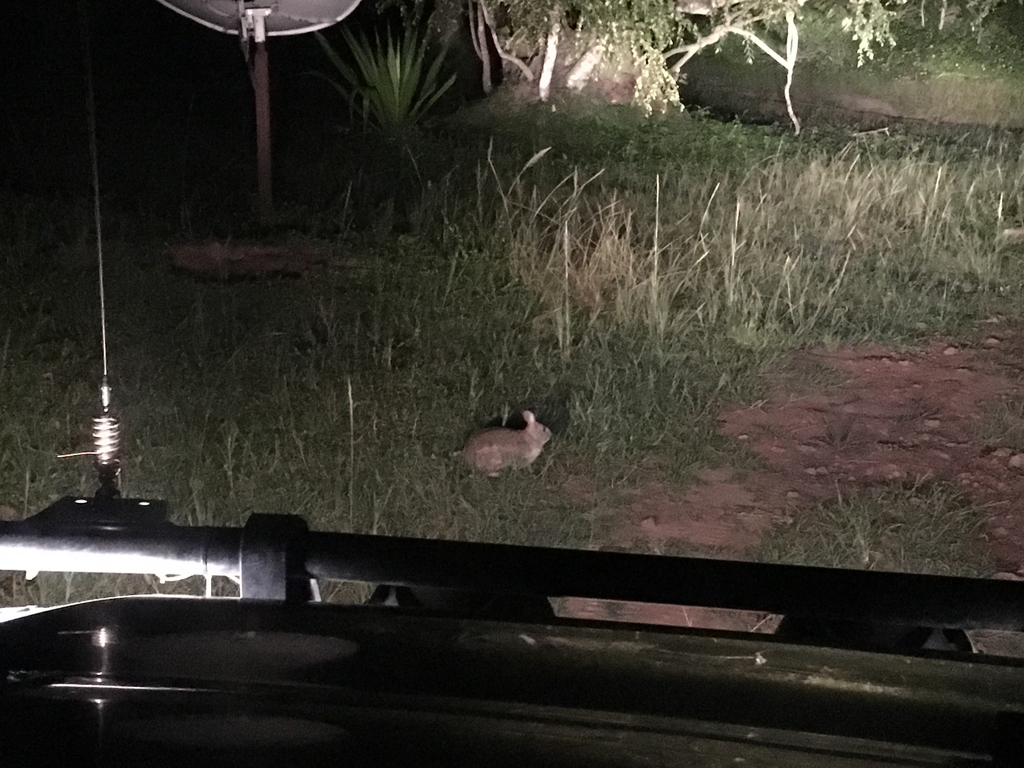
The Bunyoro rabbit or Uganda grass hare (Poelagus marjorita) is a species of mammal in the family Leporidae.
- Kingdom
- Animalia
- Phylum
- Chordata
- Class
- Mammalia
- Order
- Lagomorpha
- Family
- Leporidae
- Genus
- Poelagus
- Species
- Poelagus marjorita
Description
The Bunyoro rabbit or Uganda grass hare (Poelagus marjorita) is a species of mammal in the family Leporidae. It is the only member of the genus Poelagus. It is a medium-sized (400 to 605 millimetres (15.7 to 23.8 in) long), greyish-brown furred, nocturnal, plant-eating rabbit found in central Africa. Its typical habitat is damp savannah, often with rocky outcrops, but it also appears in forests and in rocky areas alongside rock hyraxes. First described by British mammalogist Jane St. Leger in 1929 as a member of the hares, the Bunyoro rabbit was placed within its own genus in 1932 after specimens were examined in detail with relation to other leporids. Two subspecies from what is now South Sudan were described in the following decades, but neither is recognized today. The Bunyoro rabbit's genetic relationships have been variously described; most place it as closely related to the red rock hares (Pronolagus) and the striped rabbits (Nesolagus), but at least one study describes it as a sister group of the riverine rabbit (Bunolagus). While the Bunyoro rabbit was once considered abundant, and it is classified by the International Union for Conservation of Nature (IUCN) as a least-concern species, sightings have been infrequent, and its distribution is much more limited than early estimations.
Gallery
Ajouter des photos
Partagez vos photos de cette espèce (jusqu'à 20 à la fois) : elles sont vérifiées automatiquement, puis publiées.
Répartition
Occurrences observées (données GBIF). Les zones hors aire d'origine peuvent indiquer une présence introduite ou invasive.
Sources et crédits
Informations provenant de plusieurs sources vérifiées. Dernière mise à jour : .
Crédits photos (8)
- Photo : @congonaturalist · CC BY-NC 4.0 · via iNaturalist
- Photo : Srinivasa Shenoy (@srinishenoy) · CC BY-NC 4.0 · via iNaturalist
- Photo : @thierry_aebischer_chinko · CC BY-NC 4.0 · via iNaturalist
- Photo : @marynvdlaarse · CC BY-NC 4.0 · via iNaturalist
- Photo : Mathias D'haen (@mathiasdhaen) · CC BY-NC 4.0 · via iNaturalist
- Photo : @mathieu_fr · CC BY-NC 4.0 · via iNaturalist
- Photo : Alexander Hagge (@alexanderhagge) · CC BY-NC 4.0 · via iNaturalist
- Photo : Oliver Brockmann (@maturine) · CC BY-NC 4.0 · via iNaturalist
Mentions de licence
Texte disponible sous licence CC BY-SA 4.0. Il adapte notamment Poelagus marjorita, Wikipedia (CC BY-SA) : Bunyoro rabbit (Wikipédia, auteurs dans l’historique de l’article).
- Taxonomie : GBIF Backbone Taxonomy (CC BY 4.0)
- Carte : occurrences GBIF, fond © contributeurs OpenStreetMap (ODbL)
- Statut de conservation : Liste rouge de l'UICN, via Wikidata (CC0)
Détail : Sources et licences.
Discussion (0)
Aucun message pour l’instant. Lancez la discussion sur cette fiche (sources, précisions, débats éditoriaux).
Connectez-vous pour participer à la discussion.