
White-eared titi monkey
Plecturocebus donacophilus
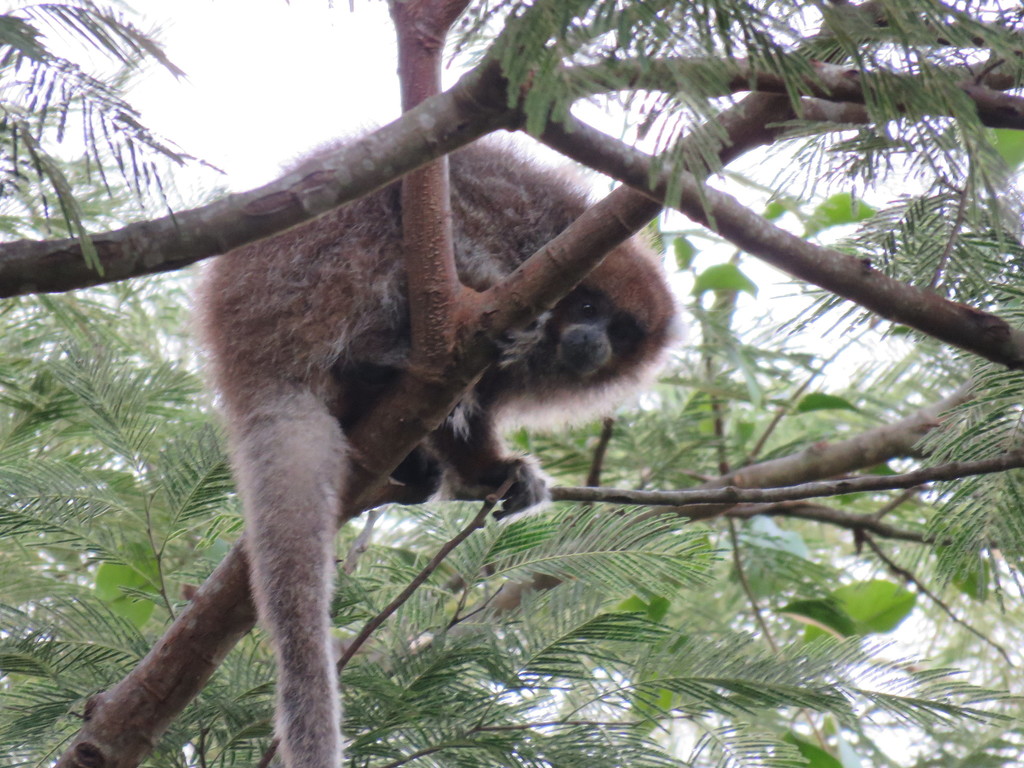
The white-eared titi monkey (Plecturocebus donacophilus) also known as the Bolivian titi or Bolivian gray titi, is a species of titi monkey, a type of New World monkey, from eastern Bolivia and an area of western Brazil.
- Kingdom
- Animalia
- Phylum
- Chordata
- Class
- Mammalia
- Order
- Primates
- Family
- Pitheciidae
- Genus
- Plecturocebus
- Species
- Plecturocebus donacophilus
Description
The white-eared titi monkey (Plecturocebus donacophilus) also known as the Bolivian titi or Bolivian gray titi, is a species of titi monkey, a type of New World monkey, from eastern Bolivia and an area of western Brazil. The species has a range that extends east from the Manique River in Beni Department, Bolivia to southern Rondônia in Brazil. The southern end of its range includes forests around the city of Santa Cruz de la Sierra. It is a medium-sized monkey with a grey back, orange underside and distinctive white ear tufts. It has an omnivorous diet, eating fruits, other plant materials and invertebrates. It is a monogamous species and lives in small groups of two to seven members consisting of the pair and their offspring. The family group has a home range of 0.5 to 14 hectares (1.2 to 34.6 acres) and the adults have a complex vocal repertoire to maintain their territory. It is also known for its characteristic twining of tails when groups are sitting together. White-eared titis can live for more than 25 years in captivity. The white-eared titi population has a declining trend. The decline is believed to be mainly caused by human-induced habitat loss and degradation. Despite this, the International Union for Conservation of Nature (IUCN) classified the species as being of least concern in 2008 as it has shown adaptability to habitat disturbance and is found over a wide range.
Gallery
Ajouter des photos
Partagez vos photos de cette espèce (jusqu'à 20 à la fois) : elles sont vérifiées automatiquement, puis publiées.
Répartition
Occurrences observées (données GBIF). Les zones hors aire d'origine peuvent indiquer une présence introduite ou invasive.
Sources et crédits
Informations provenant de plusieurs sources vérifiées. Dernière mise à jour : .
Crédits photos (8)
- Photo : Nicolas Olejnik (@nicoolejnik) · CC BY 4.0 · via iNaturalist
- Photo : @bs10aco · CC BY-NC 4.0 · via iNaturalist
- Photo : Virna Abrego (@abregovirna) · CC BY-NC 4.0 · via iNaturalist
- Photo : Josh Noseworthy (@josh_noseworthy) · CC BY 4.0 · via iNaturalist
- Photo : @guykirwan · CC BY-NC 4.0 · via iNaturalist
- Photo : Adalberto Rojas Llanos (@adalberto13633) · CC BY-NC 4.0 · via iNaturalist
- Photo : @micah_riegner · CC BY-NC 4.0 · via iNaturalist
- Photo : Barry Stewart (@moonmoths) · CC BY 4.0 · via iNaturalist
Mentions de licence
Texte disponible sous licence CC BY-SA 4.0. Il adapte notamment Plecturocebus donacophilus, Wikipedia (CC BY-SA) : White-eared titi monkey (Wikipédia, auteurs dans l’historique de l’article).
- Taxonomie : GBIF Backbone Taxonomy (CC BY 4.0)
- Carte : occurrences GBIF, fond © contributeurs OpenStreetMap (ODbL)
- Statut de conservation : Liste rouge de l'UICN, via Wikidata (CC0)
Détail : Sources et licences.
Discussion (0)
Aucun message pour l’instant. Lancez la discussion sur cette fiche (sources, précisions, débats éditoriaux).
Connectez-vous pour participer à la discussion.