
Cotton-top Tamarin
Saguinus oedipus
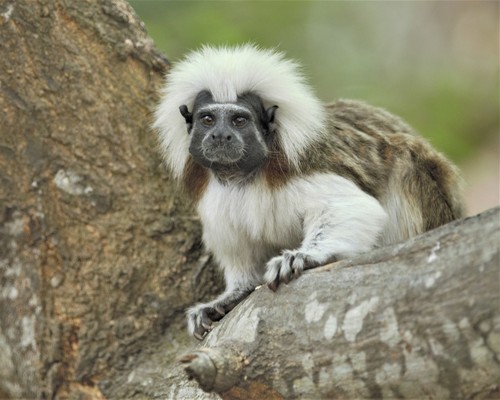
The cotton-top tamarin (Saguinus oedipus) is a small New World monkey weighing less than 0.5 kg (1.1 lb).
- Kingdom
- Animalia
- Phylum
- Chordata
- Class
- Mammalia
- Order
- Primates
- Family
- Callitrichidae
- Genus
- Saguinus
- Species
- Saguinus oedipus
Description
The cotton-top tamarin (Saguinus oedipus) is a small New World monkey weighing less than 0.5 kg (1.1 lb). One of the smallest primates, the cotton-top tamarin is easily recognized by the long, white sagittal crest extending from its forehead to its shoulders. The species is found in tropical forest edges and secondary forests in northwestern Colombia, where it is arboreal and diurnal. Its diet includes insects and plant exudates, and it is an important seed disperser in the tropical ecosystem. The cotton-top tamarin displays a wide variety of social behaviors. In particular, groups form a clear dominance hierarchy where only dominant pairs breed. The female normally gives birth to twins and uses pheromones to prevent other females in the group from breeding. These tamarins have been extensively studied for their high level of cooperative care, as well as altruistic and spiteful behaviors. Communication between cotton-top tamarins is sophisticated and shows evidence of simple grammatical structure. Up to 40,000 cotton-top tamarins are thought to have been caught and exported for use in biomedical research before 1976, when CITES gave them the highest level of protection and all international commercial trade was prohibited. Now, the species is at risk due to large-scale habitat destruction, as the lowland forest in northwestern Colombia where the cotton-top tamarin is found has been reduced to 5% of its previous area. It is currently classified as critically endangered and is one of the rarest primates in the world, with only 6,000 individuals left in the wild.
Gallery
Ajouter des photos
Partagez vos photos de cette espèce (jusqu'à 20 à la fois) : elles sont vérifiées automatiquement, puis publiées.
Répartition
Occurrences observées (données GBIF). Les zones hors aire d'origine peuvent indiquer une présence introduite ou invasive.
Sources et crédits
Informations provenant de plusieurs sources vérifiées. Dernière mise à jour : .
Crédits photos (6)
- Photo : (c) Heather Pickard, some rights reserved (CC BY-NC), uploaded by Heather Pickard · CC BY-NC 4.0 · via iNaturalist
- Photo : @mangelamaya17 · CC BY-NC 4.0 · via iNaturalist
- Photo : Royle Safaris (@roylesafaris) · CC BY-NC 4.0 · via iNaturalist
- Photo : Santi MD (@smejiadu) · CC BY-NC 4.0 · via iNaturalist
- Photo : @russnamitz · CC0 (domaine public) · via iNaturalist
- Photo : José Gabriel Julio Guzmán (@josegjulioguzman) · CC BY 4.0 · via iNaturalist
Mentions de licence
Texte disponible sous licence CC BY-SA 4.0. Il adapte notamment Pinché à crête blanche, Wikipedia (CC BY-SA) : Cotton-top tamarin (Wikipédia, auteurs dans l’historique de l’article).
- Taxonomie : GBIF Backbone Taxonomy (CC BY 4.0)
- Carte : occurrences GBIF, fond © contributeurs OpenStreetMap (ODbL)
- Statut de conservation : Liste rouge de l'UICN, via Wikidata (CC0)
Détail : Sources et licences.
Discussion (0)
Aucun message pour l’instant. Lancez la discussion sur cette fiche (sources, précisions, débats éditoriaux).
Connectez-vous pour participer à la discussion.