
Grey Seal
Halichoerus grypus
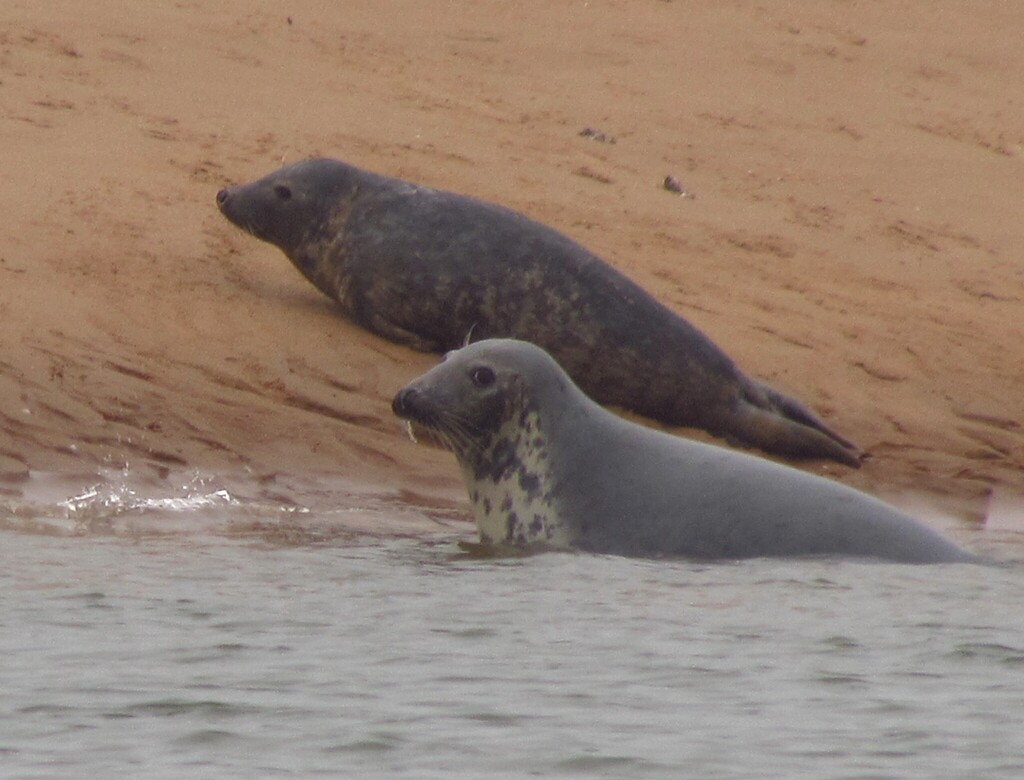
The grey seal (Halichoerus grypus), or gray seal in the United States, is a large seal of the family Phocidae, which are commonly referred to as "true seals" or "earless seals".
- Kingdom
- Animalia
- Phylum
- Chordata
- Class
- Mammalia
- Order
- Carnivora
- Family
- Phocidae
- Genus
- Halichoerus
- Species
- Halichoerus grypus
Description
The grey seal (Halichoerus grypus), or gray seal in the United States, is a large seal of the family Phocidae, which are commonly referred to as "true seals" or "earless seals". The only species classified in the genus Halichoerus, it is found on both shores of the North Atlantic Ocean. In Latin, Halichoerus grypus means "hook-nosed sea pig". It is also known as the horsehead seal, owing to its large head. The grey seal is large and heavy, with individuals from the eastern Atlantic being 1.6–2.3 m (5 ft 3 in – 7 ft 7 in) long and weighing 100–310 kg (220–680 lb), while individuals from the western Atlantic are up to 2.7 m (8 ft 10 in) long, and can reach a weight of as much as 400 kg (880 lb). It is found widely across the northern Atlantic, ranging from the US to Russia, and occasionally as far south as Portugal. It can be divided into two subspecies: the Baltic grey seal (Halichoerus grypus grypus), found in the Baltic Sea, and the Atlantic grey seal (Halichoerus grypus atlantica), found everywhere else. The largest populations are in Canada and the UK. Grey seals have a varied diet, feeding mostly on fish, and occasionally on invertebrates such as octopuses and lobsters. Their main predators are orcas, and they are also prey to sharks. The pups main predator is often eagles and gulls.
Gallery
Ajouter des photos
Partagez vos photos de cette espèce (jusqu'à 20 à la fois) : elles sont vérifiées automatiquement, puis publiées.
Répartition
Occurrences observées (données GBIF). Les zones hors aire d'origine peuvent indiquer une présence introduite ou invasive.
Sources et crédits
Informations provenant de plusieurs sources vérifiées. Dernière mise à jour : .
Crédits photos (5)
- Photo : @avaw731 · CC BY-NC 4.0 · via iNaturalist
- Photo : Kevin Lynch (@mycapecodadventurepictures) · CC BY 4.0 · via iNaturalist
- Photo : Bas van Hulst-Kuiper (@basvanhulst-kuiper) · CC BY-NC 4.0 · via iNaturalist
- Photo : Micaela Luduena (@mika03) · CC BY-NC 4.0 · via iNaturalist
- Photo : @mschneider · CC BY-NC 4.0 · via iNaturalist
Mentions de licence
Texte disponible sous licence CC BY-SA 4.0. Il adapte notamment Wikipedia (CC BY-SA) : Grey seal (Wikipédia, auteurs dans l’historique de l’article).
- Taxonomie : GBIF Backbone Taxonomy (CC BY 4.0)
- Carte : occurrences GBIF, fond © contributeurs OpenStreetMap (ODbL)
- Statut de conservation : Liste rouge de l'UICN, via Wikidata (CC0)
Détail : Sources et licences.
Discussion (0)
Aucun message pour l’instant. Lancez la discussion sur cette fiche (sources, précisions, débats éditoriaux).
Connectez-vous pour participer à la discussion.