
Southern giant slender-tailed cloud rat
Phloeomys cumingi
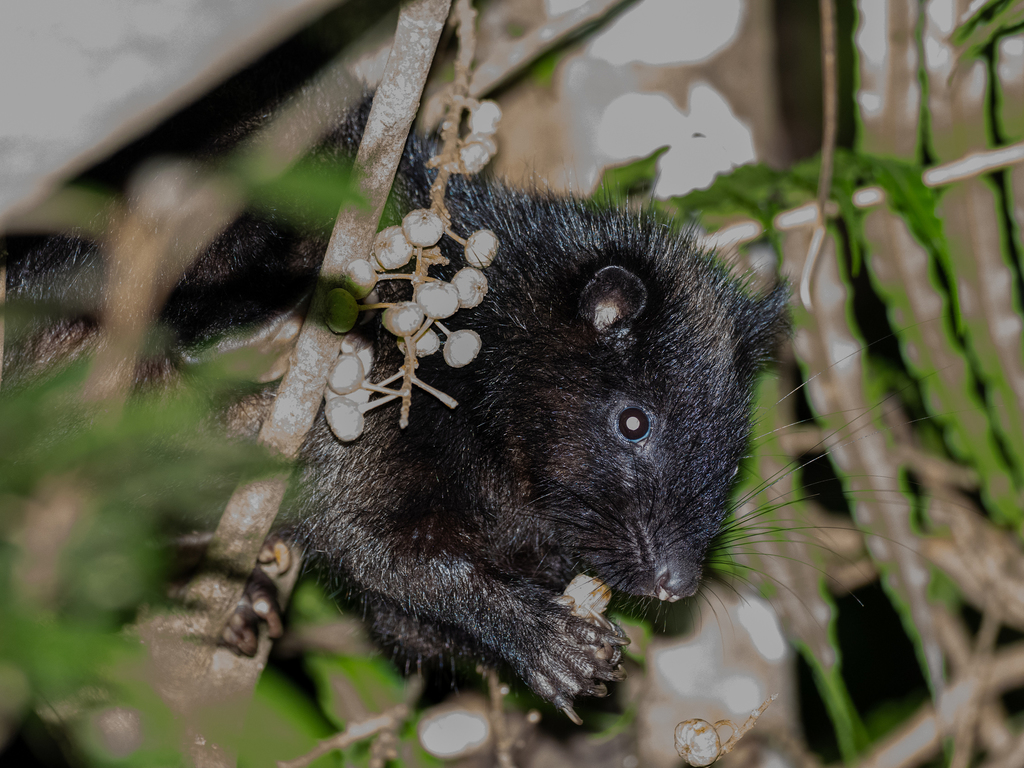
The southern giant slender-tailed cloud rat or southern Luzon giant cloud rat (Phloeomys cumingi), also known as bugkon in Filipino, is a vulnerable species of rodent in the family Muridae, found only in southern Luzon in the Philippines.
- Kingdom
- Animalia
- Phylum
- Chordata
- Class
- Mammalia
- Order
- Rodentia
- Family
- Muridae
- Genus
- Phloeomys
- Species
- Phloeomys cumingi
Description
The southern giant slender-tailed cloud rat or southern Luzon giant cloud rat (Phloeomys cumingi), also known as bugkon in Filipino, is a vulnerable species of rodent in the family Muridae, found only in southern Luzon in the Philippines. It is dark brown, occasionally with some reddish, but lacking the light-coloured sections usually seen in its close relative, the northern Luzon giant cloud rat (P. pallidus). The southern giant slender-tailed cloud rat is a large rodent that has a total length of about 67–75 cm (26–30 in) and weighs 1.45–2.1 kg (3.2–4.6 lb). Equally at home high amongst the branches of a tree as on the forest floor, the southern giant slender-tailed cloud rat is a slow-moving animal only active at night, spending the day in hollow trees or logs. It usually lives singly, or in pairs consisting of an adult male and female, or a female and her young, but larger groups have also been seen. Their diet consists primarily of tender, young leaves, but fruit is also reportedly eaten. The southern giant slender-tailed cloud rat typically gives birth to a single pup each year, with data indicating that most births take place during the late rainy season. The young are born in the hollow of a standing or fallen tree, or in a hole in the ground. The mother carries her young firmly attached to a nipple. In captivity, one cloud rat lived for over 13 years.
Gallery
Ajouter des photos
Partagez vos photos de cette espèce (jusqu'à 20 à la fois) : elles sont vérifiées automatiquement, puis publiées.
Répartition
Occurrences observées (données GBIF). Les zones hors aire d'origine peuvent indiquer une présence introduite ou invasive.
Sources et crédits
Informations provenant de plusieurs sources vérifiées. Dernière mise à jour : .
Crédits photos (6)
- Photo : Forest Botial-Jarvis (@tiluchi) · CC BY 4.0 · via iNaturalist
- Photo : @dmalerta · CC BY-NC 4.0 · via iNaturalist
- Photo : Paulo Paixão (@paulopaixao) · CC BY-NC 4.0 · via iNaturalist
- Photo : Forest Botial-Jarvis (@tiluchi) · CC BY 4.0 · via iNaturalist
- Photo : Forest Botial-Jarvis (@tiluchi) · CC BY 4.0 · via iNaturalist
- Photo : Forest Botial-Jarvis (@tiluchi) · CC BY 4.0 · via iNaturalist
Mentions de licence
Texte disponible sous licence CC BY-SA 4.0. Il adapte notamment Phloeomys cumingi, Wikipedia (CC BY-SA) : Southern giant slender-tailed cloud rat (Wikipédia, auteurs dans l’historique de l’article).
- Taxonomie : GBIF Backbone Taxonomy (CC BY 4.0)
- Carte : occurrences GBIF, fond © contributeurs OpenStreetMap (ODbL)
- Statut de conservation : Liste rouge de l'UICN, via Wikidata (CC0)
Détail : Sources et licences.
Discussion (0)
Aucun message pour l’instant. Lancez la discussion sur cette fiche (sources, précisions, débats éditoriaux).
Connectez-vous pour participer à la discussion.