
Lesser kudu
Tragelaphus imberbis
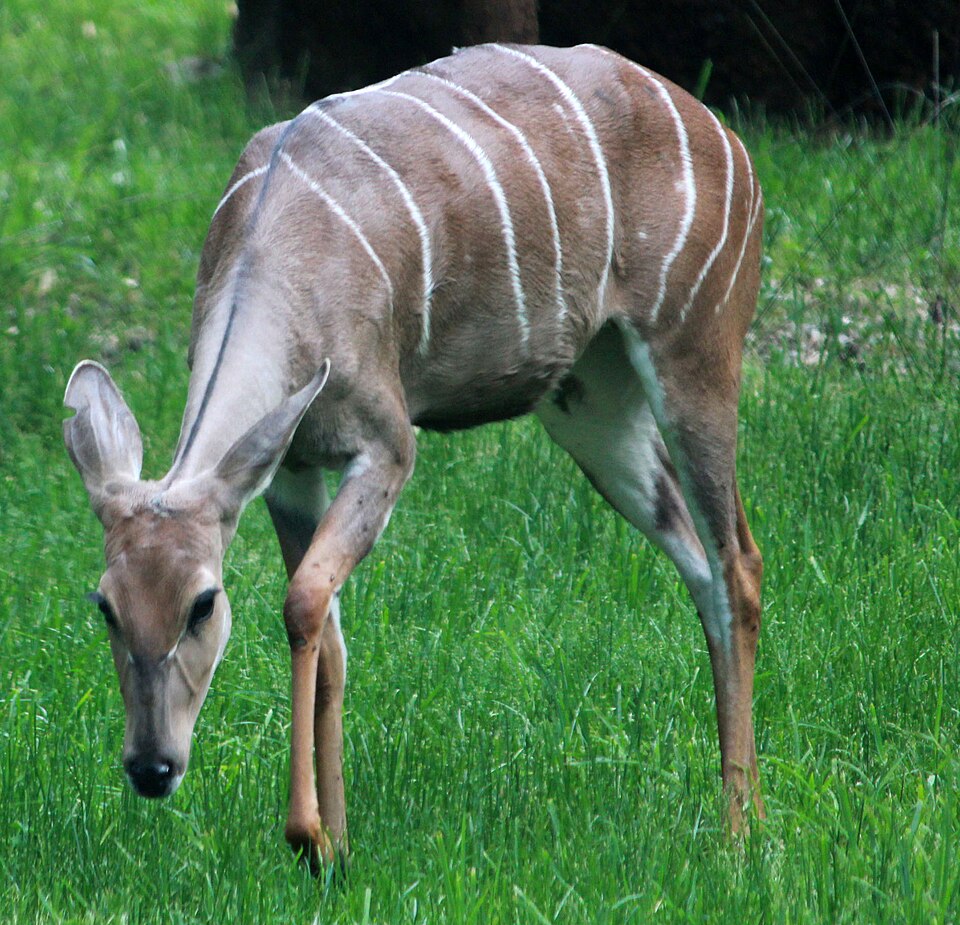
The Lesser Kudu (Tragelaphus imberbis) is a medium-sized East African antelope found in East Africa.
- Kingdom
- Animalia
- Phylum
- Chordata
- Class
- Mammalia
- Order
- Artiodactyla
- Family
- Bovidae
- Genus
- Tragelaphus
- Species
- Tragelaphus imberbis
Description
The Lesser Kudu (Tragelaphus imberbis) is a medium-sized East African antelope found in East Africa. The species is not especially closely related to the Greater Kudu, though both belong the Artiodactyl tribe Tragelaphini (family Bovidae), of striped, spiral-horned African bovids, along with the Nyala, Elands, Balbok, Bushbucks, Bongo, and Sitatunga. It was first scientifically described by English zoologist Edward Blyth (1869). The lesser kudu is a browser subsisting off of foliage from tall bushes, trees, and herbaceous perennial plants. They are not territorial, and mainly crepuscular, preferring to be active after dusk until the dawn hours, seeking shelter in dense thickets just after the sunrise. The Lesser Kudu inhabits dry bushland regions, bordering on arid grasslands, as well as scrubland and light open forest habitat. The Lesser Kudu is native to Ethiopia, Kenya, Somalia, South Sudan, Tanzania, and Uganda, but it is possibly extirpated from Djibouti. It may have been present in Saudi Arabia and Yemen as recently as 1967, though its presence in the Arabian Peninsula is still controversial. The total population of the Lesser Kudu is decreasing. Presently, the International Union for Conservation of Nature rates the Lesser Kudu as "near threatened". The handsome head of the male Lesser Kudu, with his elegant spiraled horns, is the symbol of the Saint Louis Zoo.
Gallery
Ajouter des photos
Partagez vos photos de cette espèce (jusqu'à 20 à la fois) : elles sont vérifiées automatiquement, puis publiées.
Répartition
Occurrences observées (données GBIF). Les zones hors aire d'origine peuvent indiquer une présence introduite ou invasive.
Sources et crédits
Informations provenant de plusieurs sources vérifiées. Dernière mise à jour : .
Crédits photos (6)
- Photo : Yinan Chen · Domaine public
- Photo : Hydrocycler (Elizabeth Dougherty) (@hydrocycler) · CC BY 4.0 · via iNaturalist
- Photo : Mina Zaki (@minazaki) · CC BY-NC 4.0 · via iNaturalist
- Photo : TK (@cookswelljikos) · CC BY-NC 4.0 · via iNaturalist
- Photo : @jimbowaan · CC BY-NC 4.0 · via iNaturalist
- Photo : Sidney Shema (@sidney_shema) · CC BY-NC 4.0 · via iNaturalist
Mentions de licence
Texte disponible sous licence CC BY-SA 4.0. Il adapte notamment Wikipedia (CC BY-SA) : Lesser kudu (Wikipédia, auteurs dans l’historique de l’article).
- Taxonomie : GBIF Backbone Taxonomy (CC BY 4.0)
- Carte : occurrences GBIF, fond © contributeurs OpenStreetMap (ODbL)
- Statut de conservation : Liste rouge de l'UICN, via Wikidata (CC0)
Détail : Sources et licences.
Discussion (0)
Aucun message pour l’instant. Lancez la discussion sur cette fiche (sources, précisions, débats éditoriaux).
Connectez-vous pour participer à la discussion.