
Red Giant Flying Squirrel
Petaurista petaurista
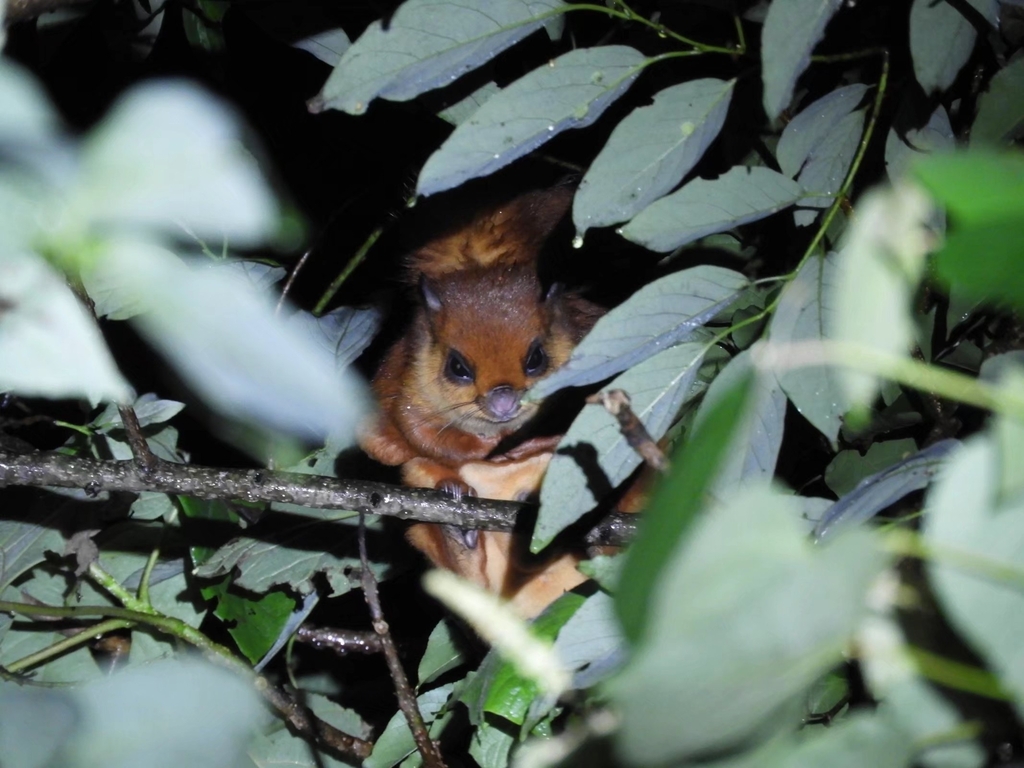
The red giant flying squirrel or common giant flying squirrel (Petaurista petaurista) is a species of rodent in the family Sciuridae (squirrels).
- Kingdom
- Animalia
- Phylum
- Chordata
- Class
- Mammalia
- Order
- Rodentia
- Family
- Sciuridae
- Genus
- Petaurista
- Species
- Petaurista petaurista
Description
The red giant flying squirrel or common giant flying squirrel (Petaurista petaurista) is a species of rodent in the family Sciuridae (squirrels). It is found in a wide variety of forest–types, plantations and more open habitats with scattered trees in Southeast Asia, ranging north to the Himalayas and southern and central China. One of the largest arboreal squirrels, all populations have at least some reddish-brown above and pale underparts, but otherwise there are significant geographic variations in the colours. The taxonomic position of those in the Sundaic region is generally agreed upon, but there is considerable uncertainty about the others, which variously have been included in this or other species, or recognized as their own species. Like other flying squirrels, the red giant flying squirrel is mostly nocturnal and able to glide (not actually fly like a bat) long distances between trees by spreading out its patagium, skin between its limbs. It is a herbivore and the female has one, infrequently two, young per litter. Although declining locally due to habitat loss and to a lesser degree hunting, it remains overall common and it is not a threatened species.
Gallery
Ajouter des photos
Partagez vos photos de cette espèce (jusqu'à 20 à la fois) : elles sont vérifiées automatiquement, puis publiées.
Répartition
Occurrences observées (données GBIF). Les zones hors aire d'origine peuvent indiquer une présence introduite ou invasive.
Sources et crédits
Informations provenant de plusieurs sources vérifiées. Dernière mise à jour : .
Crédits photos (8)
- Photo : kangkang (@xueyou) · CC BY-NC 4.0 · via iNaturalist
- Photo : @genemuller · CC BY-NC 4.0 · via iNaturalist
- Photo : John Witton (@johnwitton) · CC BY 4.0 · via iNaturalist
- Photo : Rohit Naniwadekar (@rohitnaniwadekar) · CC BY 4.0 · via iNaturalist
- Photo : Marc Thibault (@marcthibault) · CC BY-NC 4.0 · via iNaturalist
- Photo : Sourav Halder (@souravnaturalist) · CC BY-NC 4.0 · via iNaturalist
- Photo : @imdezus · CC BY-NC 4.0 · via iNaturalist
- Photo : @linnettse · CC BY-NC 4.0 · via iNaturalist
Mentions de licence
Texte disponible sous licence CC BY-SA 4.0. Il adapte notamment Petaurista petaurista, Wikipedia (CC BY-SA) : Red giant flying squirrel (Wikipédia, auteurs dans l’historique de l’article).
- Taxonomie : GBIF Backbone Taxonomy (CC BY 4.0)
- Carte : occurrences GBIF, fond © contributeurs OpenStreetMap (ODbL)
- Statut de conservation : Liste rouge de l'UICN, via Wikidata (CC0)
Détail : Sources et licences.
Discussion (0)
Aucun message pour l’instant. Lancez la discussion sur cette fiche (sources, précisions, débats éditoriaux).
Connectez-vous pour participer à la discussion.